
Shopify Print-on-Demand SEO Product Info Generator (AI Tool): Get More Traffic To Your POD Store
Overview: Learn how the Bulk POD Product Creator uses AI to generate SEO-optimized product info for Shopify print-on-demand stores, enabling you to publish hundreds of unique, keyword-rich listings that drive organic traffic and scale your business efficiently.
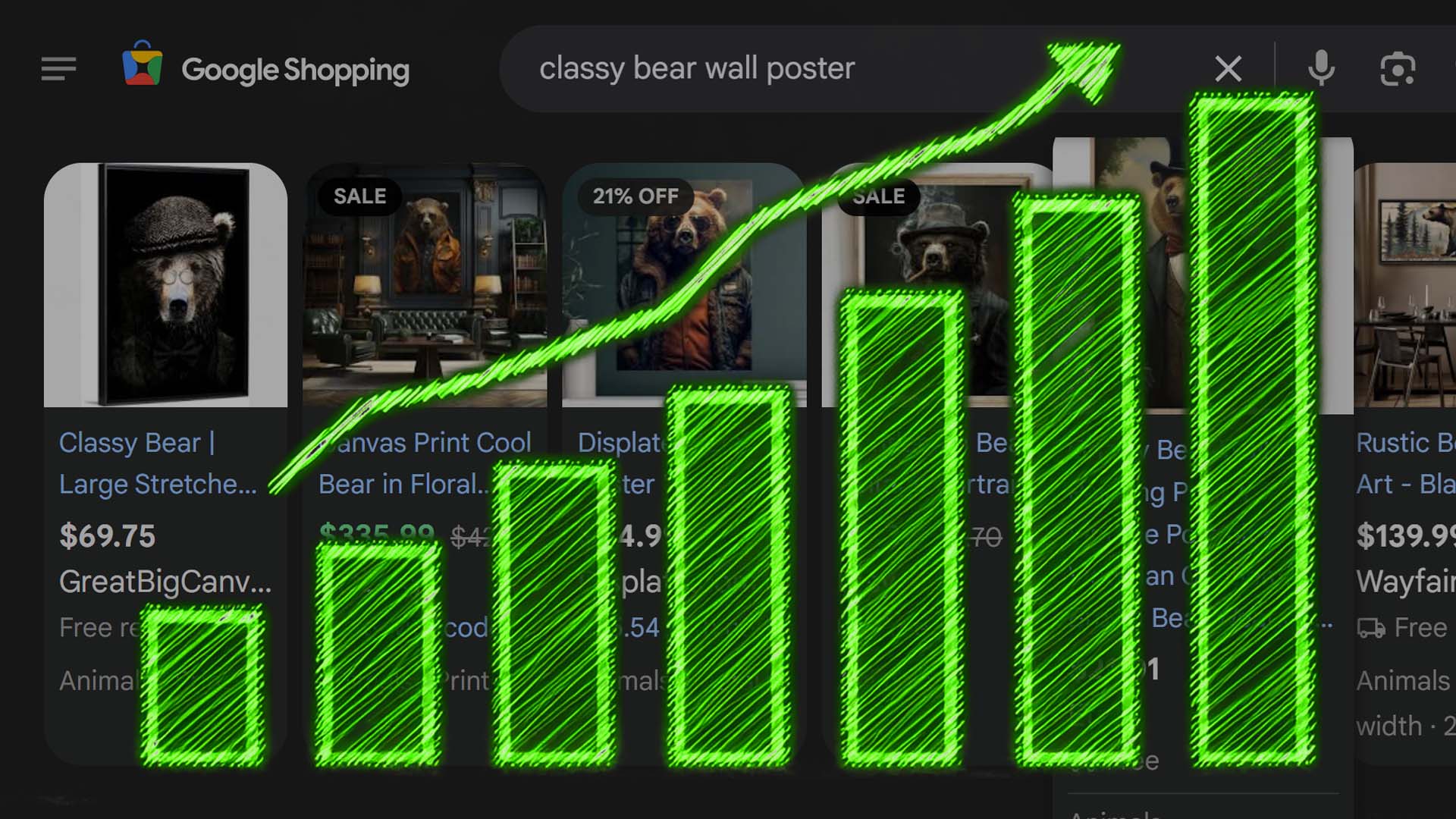
Intro — An AI-Powered SEO Product Info Generator That Drives Organic Traffic
If you want more buyers landing on your Shopify print-on-demand product pages, you need two things: volume and relevance. Volume comes from publishing many high-quality listings. Relevance comes from accurate, keyword-rich product information that matches what real shoppers type into search. The challenge is obvious: writing unique, optimized titles, descriptions, and tags for hundreds (or thousands) of products is brutally time-consuming.
Enter the Bulk POD Product Creator — a Shopify print-on-demand SEO product info generator powered by AI. It analyzes each artwork image, then writes unique, SEO-optimized titles, descriptions, and tags that precisely describe what’s in the image. Run it in bulk and you’ll produce a large number of distinct landing pages, each aligned to high-intent long-tail queries (e.g., “retro synthwave cityscape poster,” “minimalist line art floral print,” “astronaut riding motorcycle illustration”). The result is compounding organic reach: more entry points for search engines to index and more qualified traffic flowing to your store.
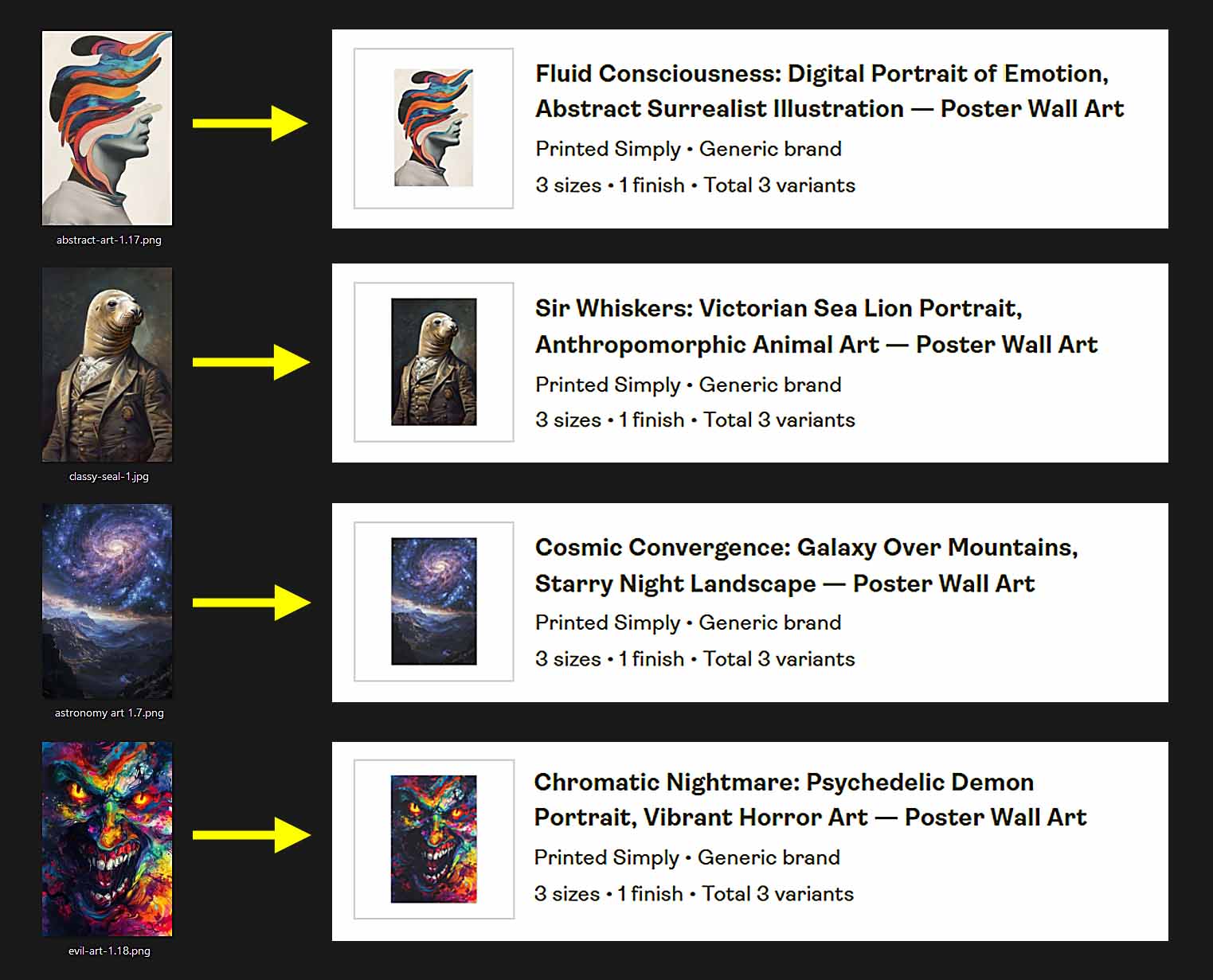
Core Benefits for POD Sellers
- Massively scaled publishing without sacrificing quality or accuracy.
- Artwork-specific SEO language that maps cleanly to long-tail searches.
- Consistent, professional listings that are ready for shoppers and search bots alike.
- Automation-first workflow so you spend time on creation and strategy, not repetitive typing.
How Exactly Does This Tool Generate SEO-Optimized POD Product Info For You?
We’ll start with the AI (how it understands images and writes), then connect it to the bulk operation runs that turn your artwork into finished products.
The AI Image Recognition: From Pixels to Precise, Searchable Language
The system uses a vision model to inspect each artwork image. It identifies:
- Subjects & scenes: e.g., astronaut, mountain sunrise, neon skyline, koi fish.
- Styles & mediums: watercolor, ink drawing, synthwave, minimalism, impressionism.
- Colors & mood: monochrome, pastel palette, high-contrast neon, serene/energetic.
- Embedded text: quotes, slogans, typography (ideal for tee or poster graphics).
From that understanding, the AI composes three SEO assets per image:
- Title: succinct, artwork-focused summary (Simple) or summary + descriptive extension (Compound).
- Description: natural, detailed paragraph(s) capturing subject, style, mood, and visual appeal.
- Tags: concise, high-relevance keywords reflecting the image’s core themes and attributes.
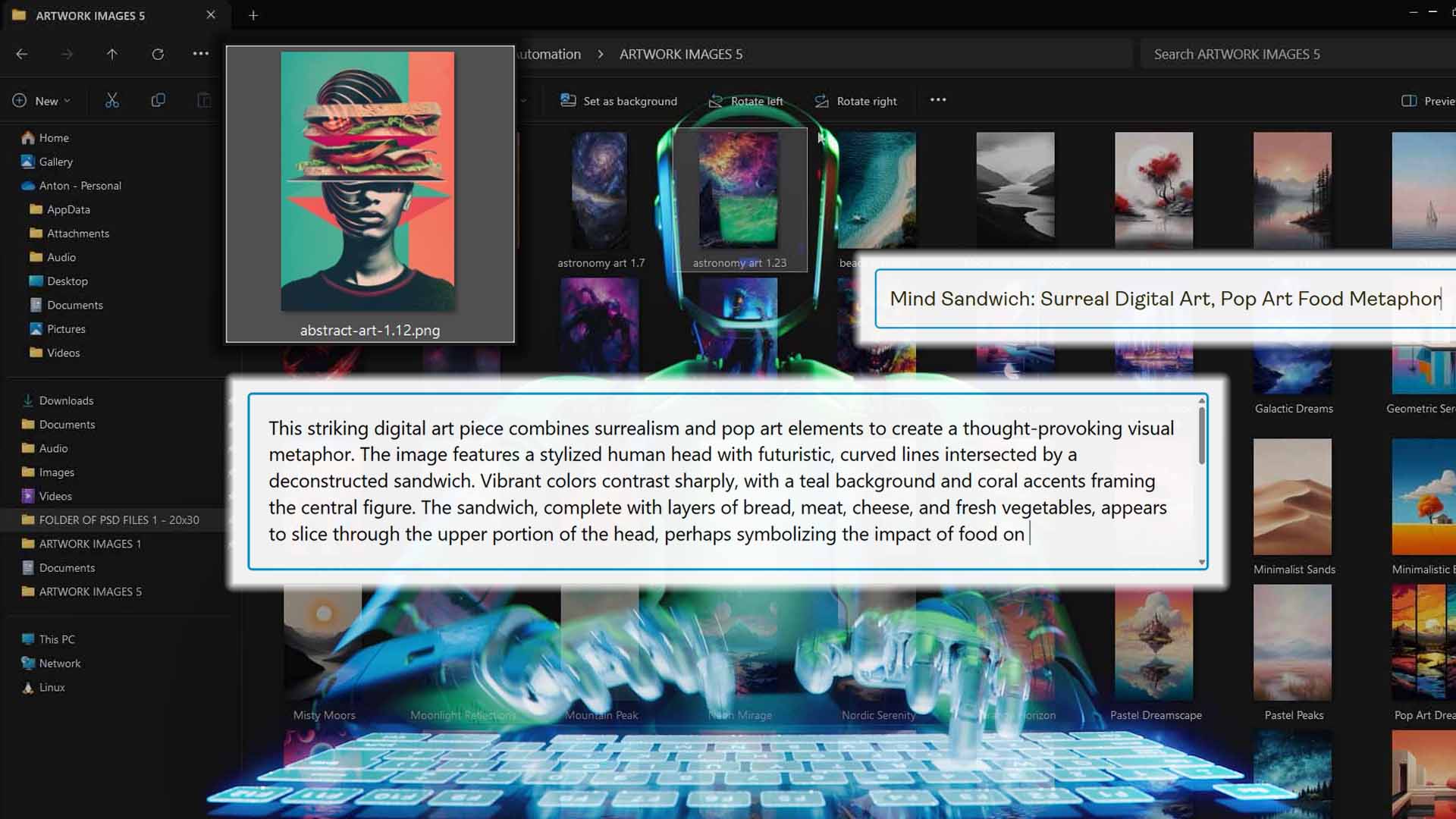
Because every asset is generated from the actual image, you avoid generic copy and duplication. Each listing becomes its own semantic target—distinct enough to rank for niche queries, but consistent enough in quality and structure to scale.
The Bulk Operation Run: From Image Folders to Fully Built POD Products
Now to tie the AI writing to the end-to-end bulk creation:
-
Select a batch of artwork images.
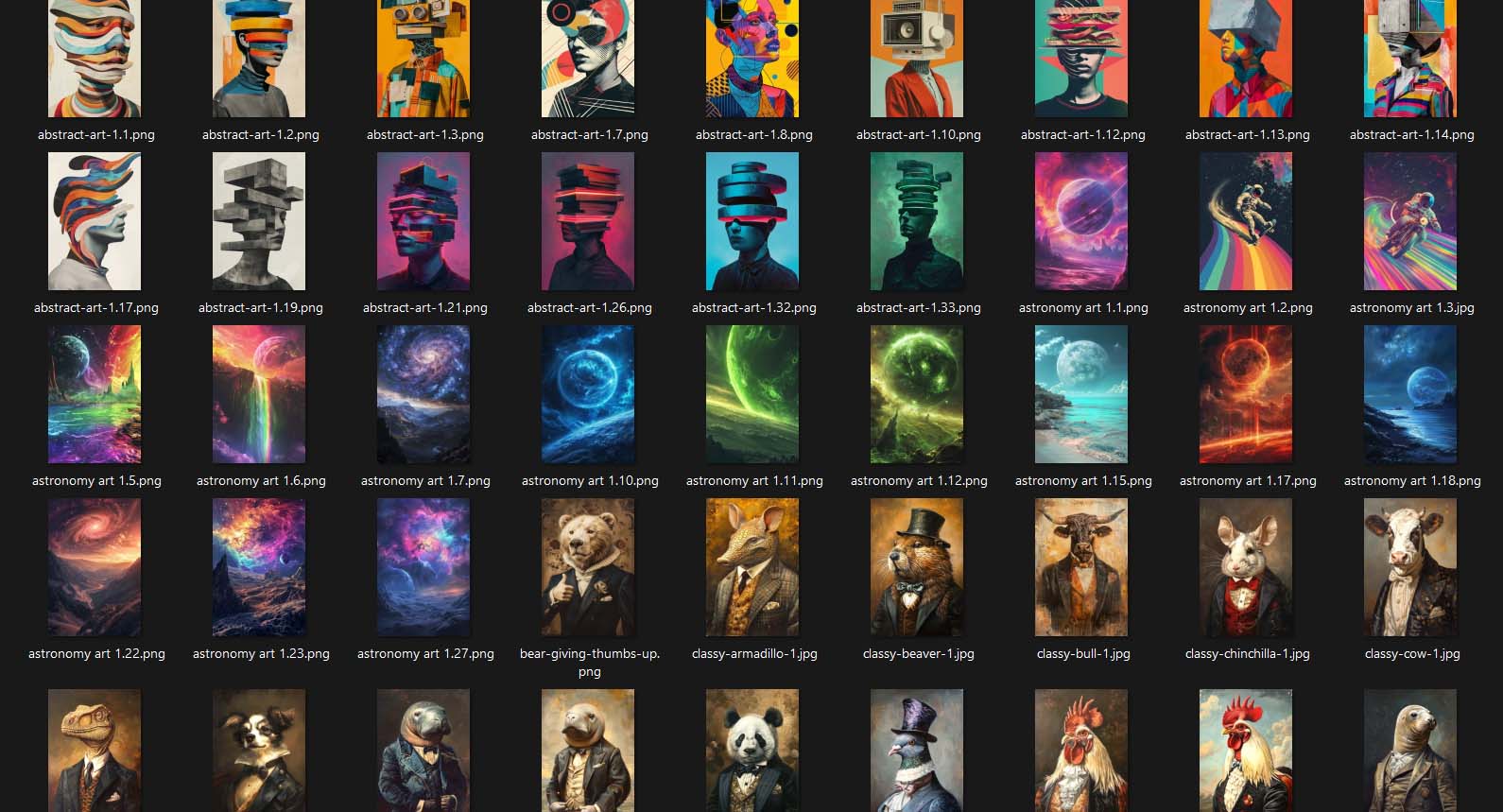
Drop in a folder of designs you want to publish. The system records each file’s dimensions and aspect ratio for correct print-area handling later.

-
Choose your Example Product (the blueprint).
Pick one existing product that has your ideal setup—product type, variants, pricing, and placement configuration. This becomes the role model. The system will create more products like this—one per artwork—replicating variants, prices, and placement rules reliably.

-
Set your New Product Creation Rules.
Before running the operation, configure how each newly created product will generate its title, description, and tags. You can toggle “Generate Using AI” to enable automatic SEO writing for every item in the batch.

- When toggled on, the AI analyzes each artwork image individually to generate accurate, descriptive metadata — including the title, description, and tags.
- You can also apply your custom prefix/suffix text or reusable HTML description block to maintain consistent product-level information across your catalog.
- This configuration step determines how your store balances automation and control: pure AI-driven SEO, or AI + your branded custom additions.
-
Run the operation.
The system creates real POD products on your provider backend (so they sync with Shopify for fulfillment). For each print-on-demand product, it passes the corresponding artwork image to the AI, which generates the title, description, and tags tailored to that image.

-
Finish with consistent, SEO-ready listings at scale.
You end up with a large batch of fully configured products—variants, prices, and placements cloned from your Example Product—plus unique, image-accurate SEO copy generated automatically. Each listing becomes a fresh landing page that can capture a distinct slice of long-tail demand.
This workflow is what turns an “SEO product info generator” from a nice idea into a traffic-compounding engine: you don’t just create products—you create searchable products at scale, each mapped to what buyers actually look for.
Why the AI-Generated Outputs Are Better for Print-on-Demand SEO Than Your Manual Writing
Let’s be brutally honest: no human can compete with the AI here. Not in scale, not in consistency, not in quality.
Writing SEO-optimized product titles, descriptions, and tags for hundreds of designs is not an act of creativity—it’s an act of endurance. And endurance is exactly where humans fall short and automation wins every single time. The AI doesn’t just match human performance—it obliterates it across every relevant metric.
Below, we’ll break down the three biggest reasons why—and how each one directly translates into more traffic for your POD store.
1. The AI Is Vastly More Knowledgeable
AI has a vocabulary and contextual understanding no single human can match. It recognizes the subtle differences between “line art,” “etching,” “engraving,” and “stippling.” It knows when to call something “minimalist abstract composition” versus “geometric Bauhaus-inspired print.”
That linguistic precision matters for SEO. When a buyer searches “black and white minimalist landscape art”—not “cool poster of trees”—the AI-written title and description will hit those exact search terms. Humans, on the other hand, fall into repetitive phrasing patterns and limited vocabularies, especially after dozens of similar listings.
How This Translates Into More Traffic
Every listing becomes a micro-optimized search target. Instead of 100 near-identical products competing against each other, you get 100 distinct entries that collectively capture a broader range of long-tail keyword variations.
This gives your Shopify store a lattice of highly specific landing pages that each attract small but cumulatively powerful streams of organic traffic.
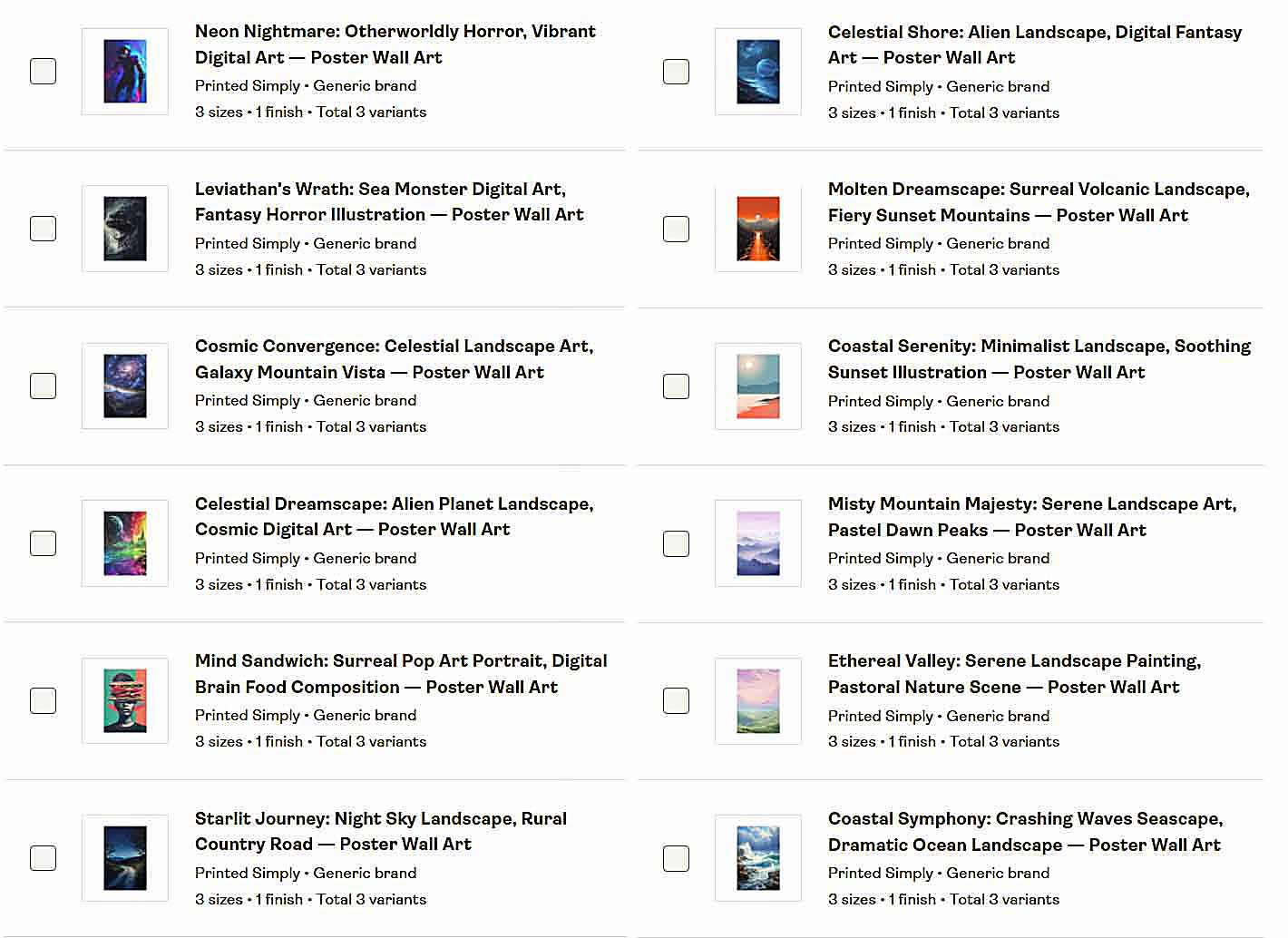
2. The AI Is Exponentially Faster (and Mathematically Unbeatable)
Even if you type fast—say you can craft a polished, keyword-rich description in 5 minutes—that’s 12 per hour. To write for 1,000 products, you’d need over 80 hours of nonstop work. Realistically, that’s two weeks of full-time effort for a single batch.
The AI can handle that in one automated run while you sleep. It’s not “instant,” but it’s still orders of magnitude faster than any human team could ever sustain. And it maintains total consistency—no skipped variants, no mispriced listings, no typos, no missing punctuation.
How This Translates Into More Traffic
Because you can publish more products, you can cover more searchable ground.
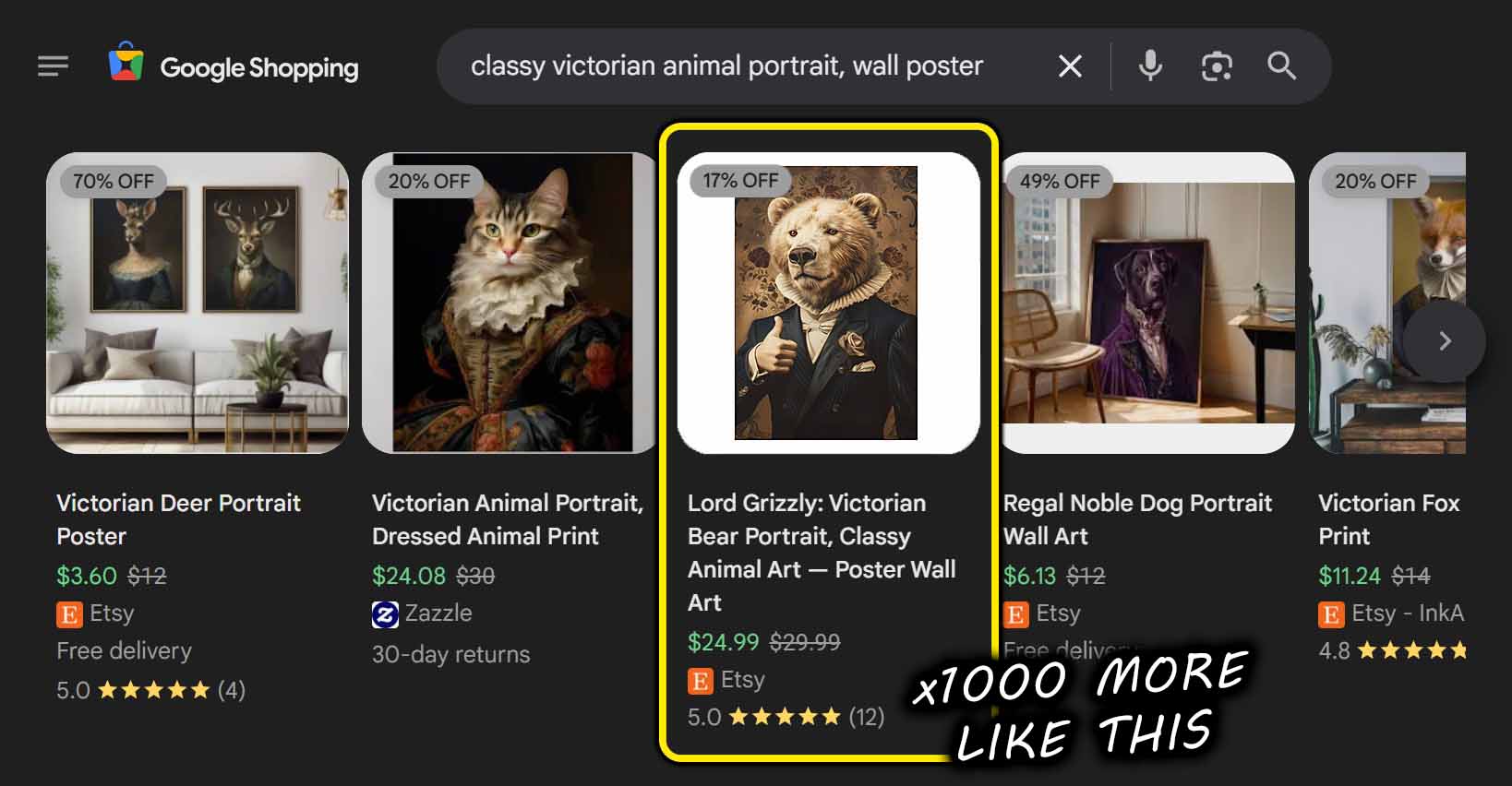
Each new product = one more indexed URL on Google.
Each indexed URL = one more chance to rank for a new keyword cluster.
When you go from 50 listings to 500, you multiply your traffic surface area tenfold. And you do it without multiplying your workload.
3. The AI Never Gets Tired, Bored, or Lazy
Humans have limits. No matter how disciplined you are, your focus fades after a few dozen repetitive tasks. The quality of your writing drops off somewhere around listing #100—and by listing #400, you’re phoning it in, writing bare-minimum blurbs just to finish.
AI doesn’t fatigue. It doesn’t procrastinate. It doesn’t say, “I’ll rewrite that later.”
Every product, whether it’s the first or the thousandth, gets the same level of attention and accuracy.
How This Translates Into More Traffic
Search engines reward consistency and completeness.
When every product in your store has clean, descriptive metadata, your entire catalog becomes more crawlable, indexable, and rank-ready. Instead of a few polished listings surrounded by filler, you get an entire storefront of strong performers—each one capable of ranking for its own micro-niche.
This not only boosts traffic but also improves click-through rate and average session duration, since buyers find what they’re actually looking for and explore more listings on your site.
Conclusion — Embrace the Inevitable Upgrade
Manual SEO writing had its place a decade ago. But today, the POD landscape has evolved. The stores dominating Shopify search are the ones publishing hundreds of unique, AI-written, SEO-optimized products at scale.
The Bulk POD Product Creator isn’t a shortcut—it’s a competitive necessity.
It combines image recognition, linguistic depth, and automation to give your artwork the visibility it deserves.
You can try to out-write it manually, but you’ll lose on time, consistency, and reach.
Or you can embrace it—and let the machine handle the repetition so you can focus on creating, strategizing, and scaling.
The choice is simple:
Keep grinding manually, or publish at scale with AI and watch your Shopify POD traffic grow exponentially.