
How To Increase Traffic To Your Etsy Print-on-Demand Shop & Product Listings
Overview: A practical framework for growing Etsy traffic to print-on-demand listings. This guide shows how to (1) build a data-driven keyword plan with Google’s Keyword Planner (so your strategy is focused around keywords with strong traffic potential), (2) scale POD listing volume by publishing an enormous number of SEO-optimized products using automation (thus exploding traffic since each product has its own unique landing page), and (3) leverage an Etsy-specific research tool to align with in-market demand.
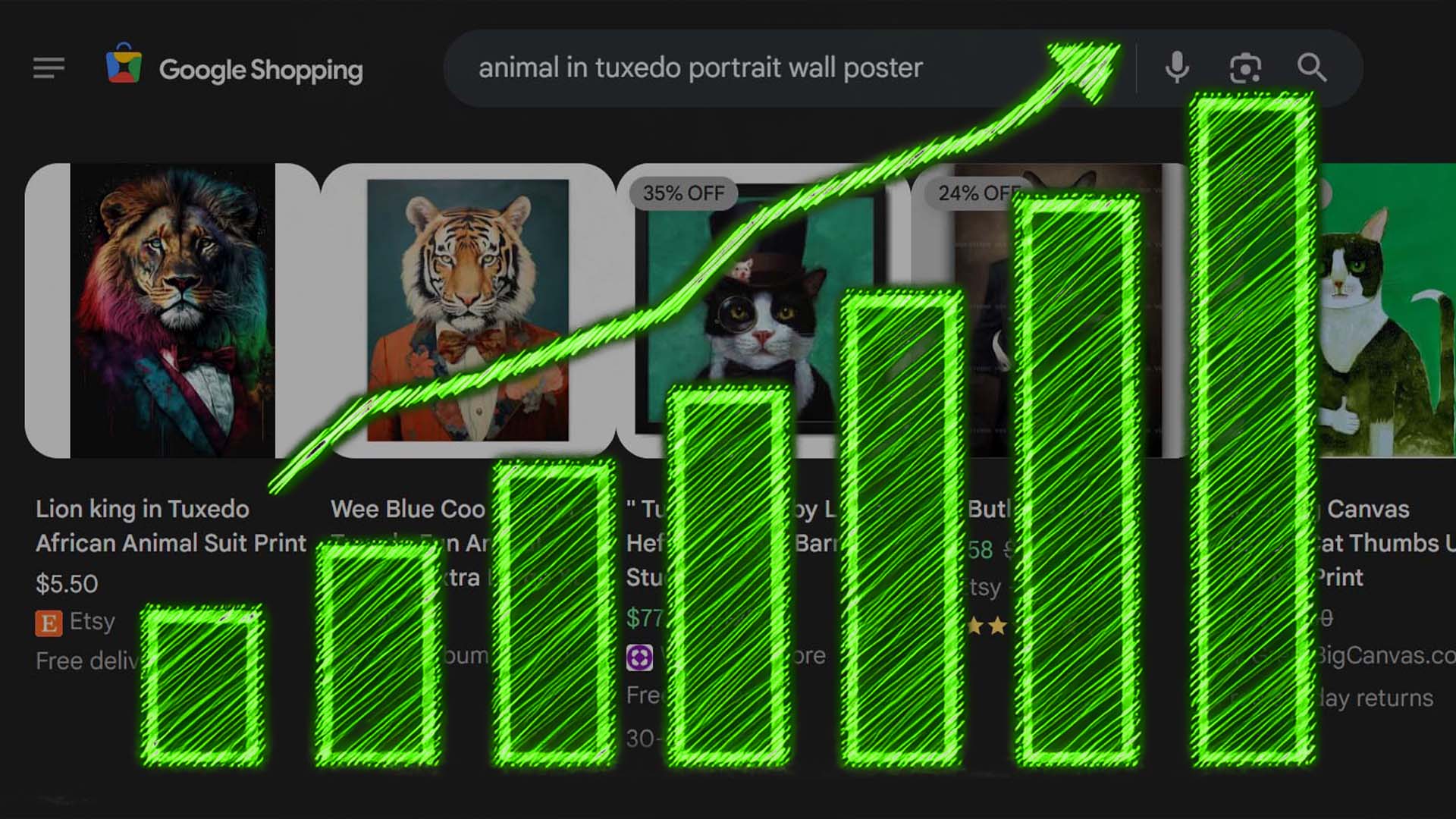
Introduction: Why More Traffic = More Etsy Print-on-Demand Sales
For Etsy print-on-demand sellers, traffic is the lifeblood of the entire business. Every visitor who lands on your shop or product page represents a potential sale — and the more qualified visitors you attract, the higher your total revenue climbs. It’s simple math. Even if you changed nothing else about your shop — no new designs, no fancy ads, no extra discounts — a sustained increase in traffic alone would almost certainly translate into more sales.
The relationship between traffic and sales is statistical in nature: every product page converts a predictable percentage of visitors. Double the number of visitors, and your total orders rise proportionally. That’s why growing traffic is such a high-leverage activity — it multiplies the effectiveness of everything else you’ve already built.

But the benefits of driving more traffic extend well beyond the immediate boost in orders. More visitors accelerate your learning curve as a seller. With more traffic flowing through your Etsy listings, you get faster feedback loops on:
- Which products actually sell. Instead of waiting months to see which listings perform, you can identify winning designs within weeks — then double down on them while discontinuing weak performers.
- Which titles, tags, and thumbnail styles drive clicks. Etsy’s internal search system (and Google’s external one) both favor listings that get engagement. More traffic means more data to test what captures attention and what gets ignored.
- Which pricing and promotional strategies work. When you’re only getting a trickle of visitors, A/B testing is slow and inconclusive. When you’re getting hundreds or thousands of visitors per day, you can rapidly test and refine price points, free-shipping thresholds, or bundled offers to discover what maximizes profit.
- Which categories and styles attract repeat buyers. Increased exposure reveals which customer niches respond best to your store’s aesthetic. You can then expand into those sub-niches with more designs, related products, or complementary artwork styles.
In short, traffic doesn’t just bring more sales — it brings smarter sales. It allows you to make data-driven decisions about your products, your branding, your copywriting, and even your long-term strategy.
And there’s another compounding benefit: Etsy’s algorithm itself rewards engagement. When your listings start generating more clicks, longer view times, and stronger conversion rates, Etsy interprets that as a signal of quality — and in turn, pushes your listings higher in both the Etsy search results and the Google results where many Etsy listings also appear.
So as your visibility grows, your engagement grows, your rankings rise further, and the cycle reinforces itself. That’s the beauty of traffic: once you start compounding it through consistent action, it builds its own momentum.
Over the next sections, we’ll walk through several specific, actionable strategies for Etsy print-on-demand sellers to increase traffic — not just in theory, but in concrete, measurable ways. From smart keyword research to bulk product creation and automation, these are the techniques that drive discoverability, scalability, and long-term growth for your Etsy shop.
Traffic-Boosting Technique #1: Use Google’s Keyword Planner Tool to Build a Data-Driven Product Keyword Strategy
Important note before we begin: we are not talking about using Google’s Keyword Planner for running paid ads. The focus here is entirely on using it for SEO, keyword research, and search volume discovery — not PPC campaigns.
With that clarified, let’s get into why this tool is such a game-changer for Etsy print-on-demand sellers who want to increase organic traffic to their shops and listings.
What Google’s Keyword Planner Actually Does
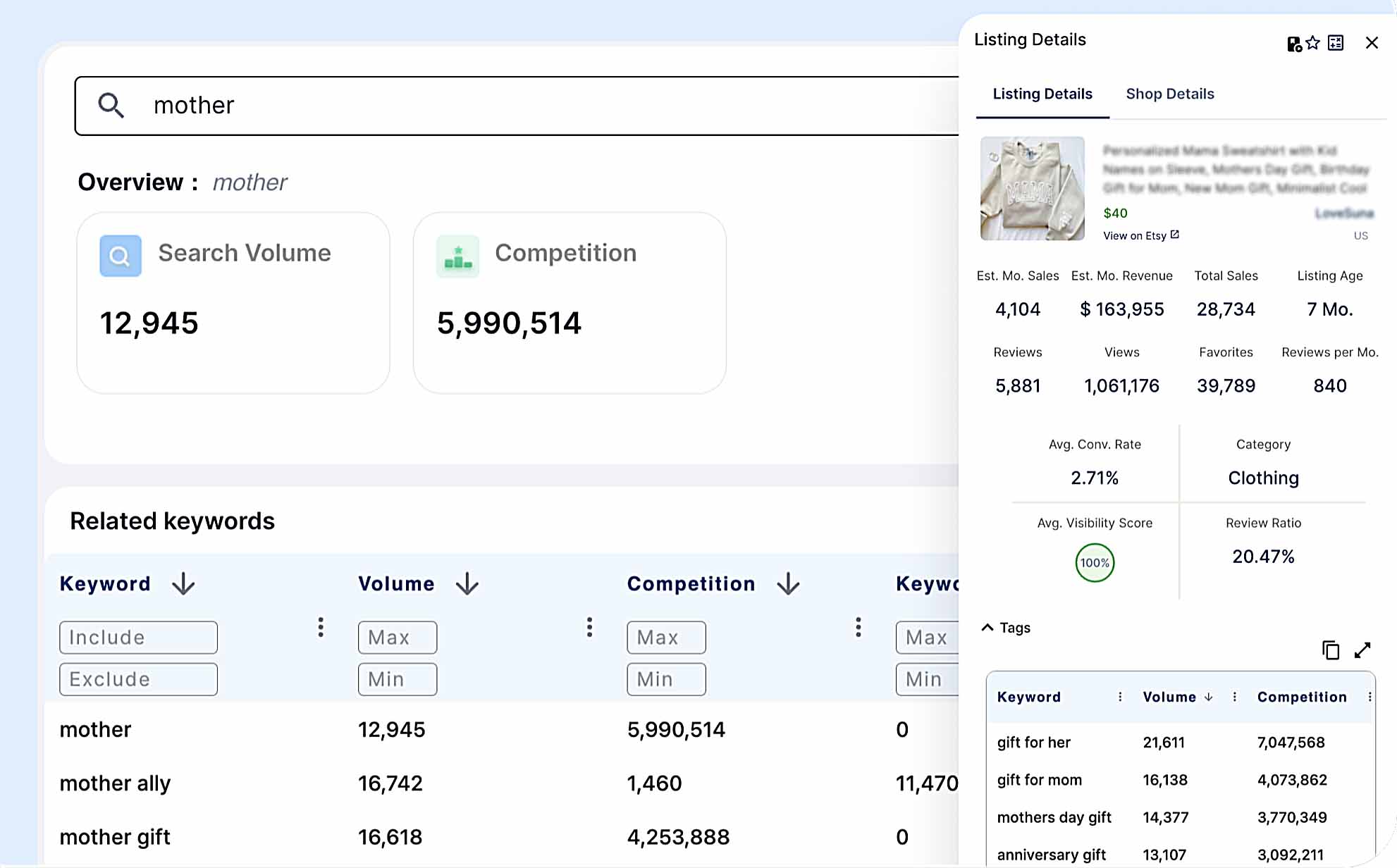
The Google Ads Keyword Planner allows you to type in any word or phrase and instantly see:
- How many searches per month that keyword receives (you can set the location to “Global” to see worldwide search volumes).
- A list of related keyword ideas — semantically similar phrases that real people are also searching for.
For example, if you enter “mother’s day gift,” the tool might show related searches such as “personalized mom necklace,” “custom family portrait,” or “engraved bracelet for mom.” Each of those variations comes with its own estimated monthly search volume.
For Etsy sellers, this is pure gold. You’re essentially peeking behind the curtain of global search behavior — seeing exactly what phrases people are typing into Google every month.
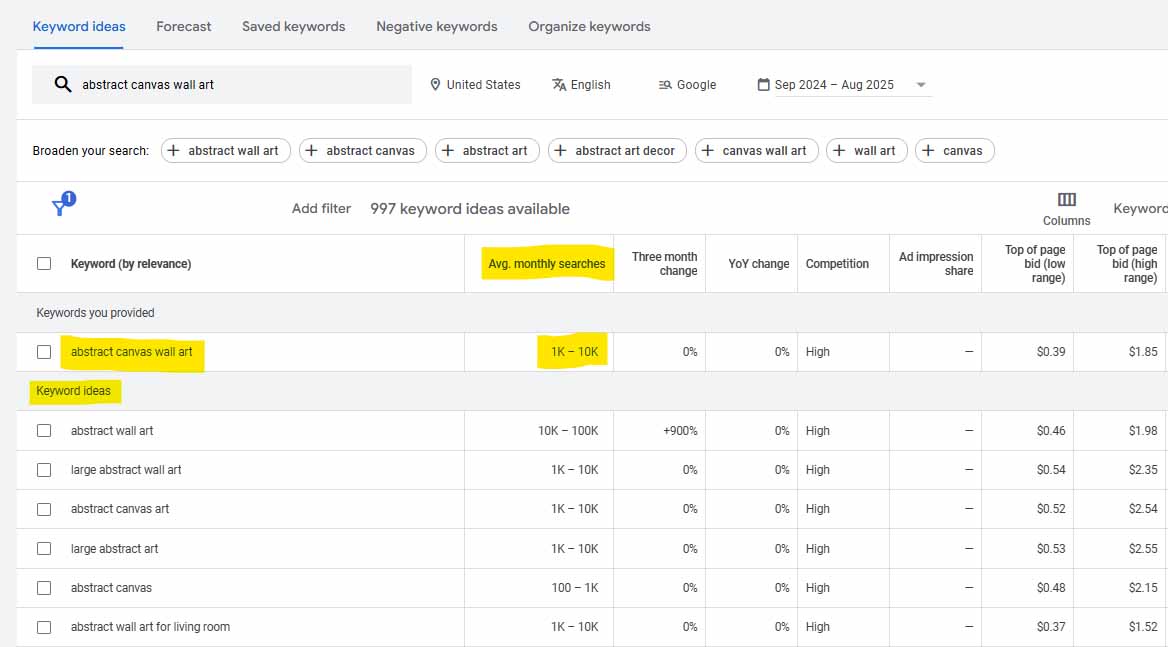
Why This Matters for Etsy Sellers
Etsy listings don’t only live inside the Etsy ecosystem. They’re also indexed and ranked by Google and other search engines. That means your product pages have the potential to show up not just within Etsy search results, but also directly in Google’s organic listings.
And the best part? Human search behavior is remarkably consistent across platforms. A keyword that’s searched frequently on Google is almost always searched frequently on Etsy too.
So instead of guessing which types of products or phrases people want, you can use hard data from Google to guide every decision you make about your shop.
This kind of insight helps you:
- Avoid wasting time on products no one is searching for. There’s nothing worse than spending hours designing and uploading a product that has zero demand.
- Focus your shop around verified demand. You’ll know with confidence that you’re targeting keywords that reflect active interest.
- Expand your catalog intelligently. Those related keyword ideas reveal additional niches and adjacent product types that you can branch into — allowing you to capture more traffic across different angles of the same audience intent.
- Refine your titles, tags, and descriptions. Once you identify the best-performing keywords, you can strategically include them in your Etsy listing titles and descriptions to maximize search alignment and discoverability.
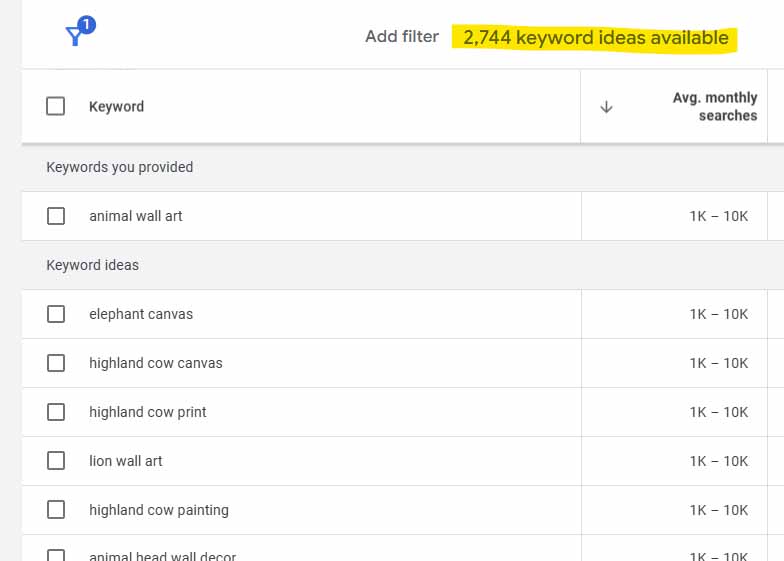
Example: Turning Keyword Data Into a Product Strategy
Let’s say the Keyword Planner shows strong global search volume for “black and white landscape wall art.” That tells you two things:
- It’s in demand. People are actively searching for that style.
- It’s a defined long-tail keyword — meaning it’s specific enough that the competition is manageable, yet popular enough to drive meaningful traffic.
Armed with that knowledge, you could then:
- Create a new collection of Etsy listings centered on that keyword.
- Use variations like “minimalist black and white landscape prints” or “modern monochrome mountain wall art” to capture similar long-tail search queries.
- Include the phrase directly in your product titles and descriptions (e.g., “Serene Mountain Vista — Black and White Landscape Wall Art, Minimalist Nature Print”).
By targeting these high-intent keyword clusters, you position your products to appear for a wider range of relevant searches — both on Etsy and across Google’s search network.
Why This Step Is So Critical
Many Etsy print-on-demand sellers skip this step entirely. They upload random designs based purely on taste or intuition, and then wonder why their traffic stays flat. The truth is, intuition isn’t data. You can’t out-guess the internet — but you can measure it.
Keyword research is what separates the sellers who scale from those who stall. It ensures that every listing you create, every title you write, and every product you design is backed by evidence of demand.
Yes, it’s not the most exciting part of the process — it’s research-heavy, and it won’t feel as creative as designing new artwork. But if you take the time to do it properly, you’ll have a strategic roadmap for building your Etsy shop that is grounded in what buyers actually want, not just what you hope they’ll want.
And once you’ve built that roadmap — once you know which categories, niches, and keyword phrases are worth attacking — then you’re ready to move into the next phase: creating a massive number of products around those keywords so you can start capturing that demand and ranking for dozens, or even hundreds, of long-tail search queries simultaneously.
That brings us to Traffic-Boosting Technique #2, where we’ll explore how scaling your product count exponentially increases your traffic, conversions, and overall shop performance.
Traffic-Boosting Technique #2: Publish a Gigantic Number of Etsy POD Listings
More listings → more unique product pages → more keyword coverage → more traffic opportunities. That’s the core growth equation for Etsy POD sellers. Every listing is its own landing page with its own title, tags, attributes, images, and engagement metrics. Each one can rank for a different cluster of search terms inside Etsy and in Google. If you did nothing else but consistently expand your catalog, your visibility would rise over time simply because you’re casting a wider, denser net across thousands of long-tail queries.

Here’s why scale matters so much on Etsy specifically:
-
Each listing targets its own long-tail demand.
“Blue abstract art print,” “minimalist black and white mountain poster,” “whimsical fox nursery wall decor” — these aren’t the same buyer intent. One strong listing can capture a few of these phrases, but hundreds of differentiated listings let you meet shoppers exactly where they are, in their own words. Multiply that across 500, 2,000, or 10,000 listings and you stop relying on a handful of competitive head terms and start harvesting thousands of lower-competition, high-intent searches. -
Bigger catalogs increase session depth and reduce bounce.
If your shop has 40–60 items, a visitor can skim everything in minutes, decide “nothing here is quite it,” and bounce. With 400, 1,000, or more, shoppers discover multiple pieces worth clicking, save favorites, and browse sections. Product pages link to “More from this shop,” related listings, and shop sections — all of which keep people circulating. Whether you call it dwell time, engagement, or click depth, Etsy’s ranking system rewards listings and shops that hold attention and convert views into actions. -
More choice raises conversion probability.
A small catalog forces shoppers to compromise. A large catalog increases the odds they’ll find the exact subject, color palette, and style they imagined — which naturally boosts add-to-cart and purchase rates. You win on fit, not gimmicks. -
Larger assortments lift average order value (AOV).
When a buyer lands on “the one,” they’re primed to spot a second or third complementary piece (triptychs, coordinated colorways, seasonal variants). Robust “you may also like” carousels become meaningful only when you have true depth to recommend from. -
Depth creates pricing power.
When a listing nails a shopper’s precise taste, price sensitivity drops. Broad selection increases the chance of that perfect match, letting you hold healthier margins without depressing conversion. -
Scale fuels social proof and momentum.
More listings mean more chances to accumulate favorites, reviews, and sales — the very signals Etsy surfaces in search and on product pages. That flywheel (favorites → visibility → sales → reviews → more visibility) spins faster when your shop has many high-quality entries in the market.
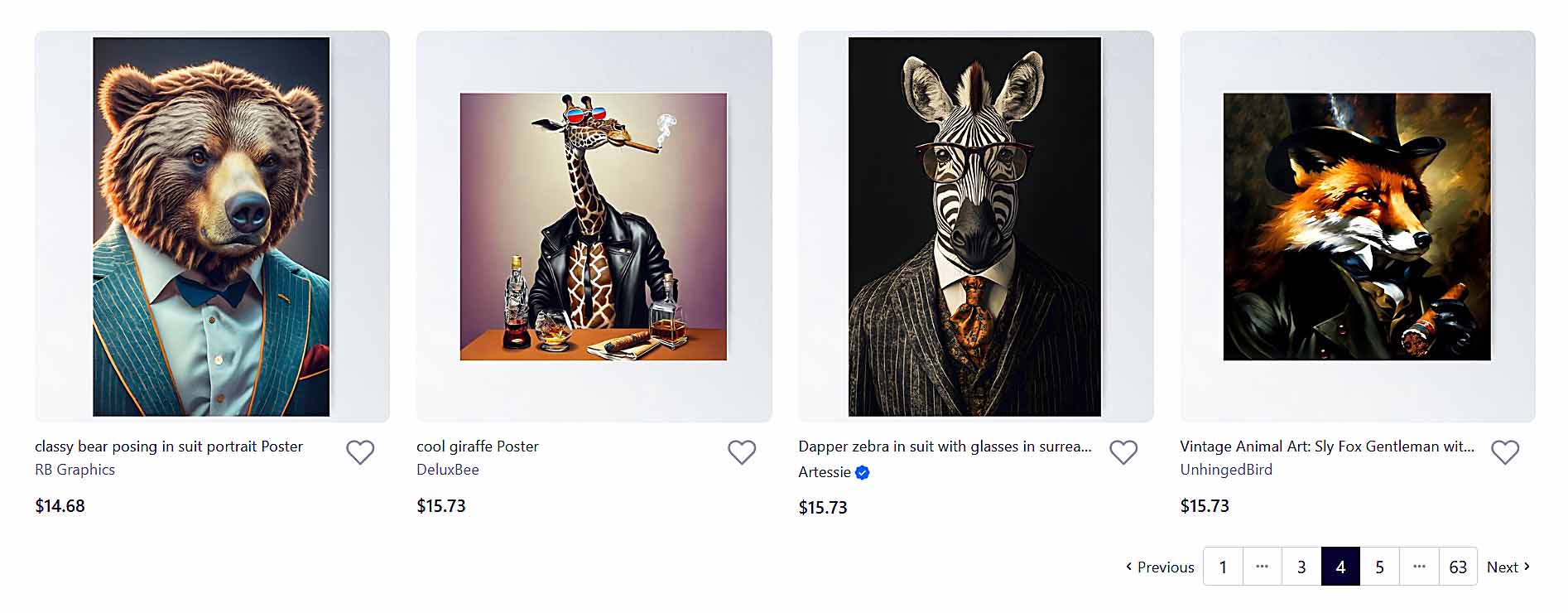
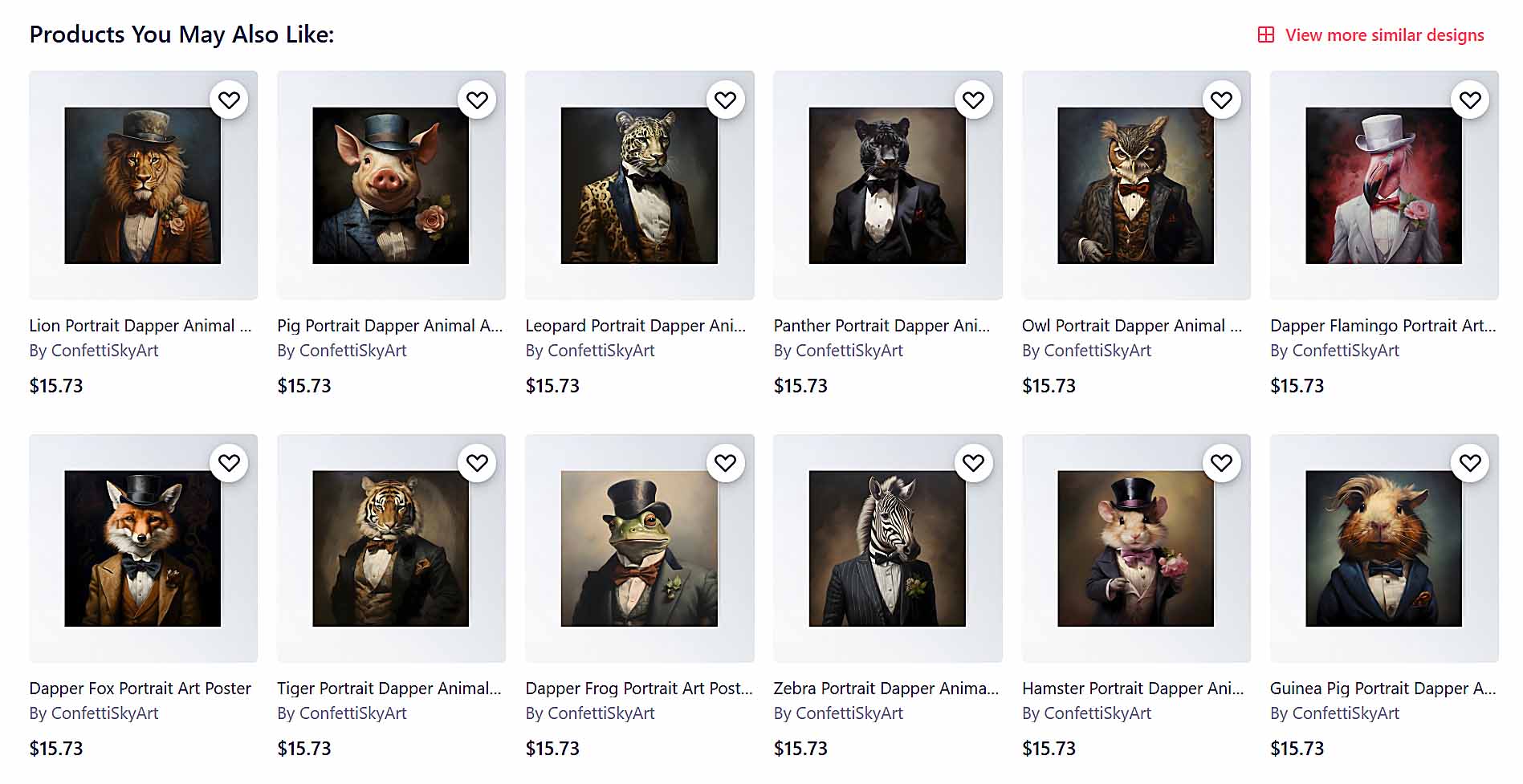
Put together, the causal chain is straightforward:
More listings → more entry points in Etsy and Google search → longer, deeper browsing → higher conversions and AOV → stronger engagement signals (favorites, reviews, add-to-carts) → algorithmic lift → even more traffic.
This isn’t about flooding Etsy with filler. It’s about offering a genuinely comprehensive selection so that for a wide range of highly specific tastes and queries, your shop has an exact match worth staying for. Even if all you did this quarter was expand your catalog thoughtfully and consistently around validated keyword themes, you would meaningfully increase traffic and sales. And unlike many tactics that spike and fade, catalog growth compounds: every net-new listing is a durable asset — another page working 24/7, another set of long-tail queries you can rank for, another opportunity to convert a browser into a buyer and a buyer into a repeat customer.
Use The Bulk POD Product Creator to Scale Your Etsy Shop via Automation
By now, it’s clear that the fastest path to more traffic is a bigger, better-optimized catalog. But here’s the challenge every Etsy seller runs into: creating that catalog manually is brutally time-consuming. Uploading images one by one, typing titles, writing descriptions, adding tags — it’s hours of repetitive clicking even for a small batch of listings. Multiply that by hundreds or thousands of products, and you hit a wall.
That’s exactly where the Bulk POD Product Creator comes in.
It’s a full-scale automation tool that lets you create hundreds — even thousands — of new print-on-demand listings quickly, accurately, and with built-in SEO intelligence. Instead of spending days creating products manually, you can do it in a single operation.

How It Works — Step by Step
Step 1: Select your artwork images and placement rules.
Start by uploading or connecting the artwork images you want to turn into products. Then choose your preferred placement mode — whether you want each image to stretch and fill the print area or preserve its original aspect ratio. You can also lock in consistent placement logic across multiple product types, so every listing looks clean and standardized from the start.

Step 2: Choose your Example Product.
Your Example Product acts as the blueprint for everything that follows. The software reads the Example Product’s settings — sizes, variants, pricing, and print specifications — and automatically replicates those configurations across all your new products. In other words, you can say “create more of these,” and the system does exactly that for every artwork image you selected.

Step 3: Apply AI-powered product creation rules.
Here’s where the real SEO magic happens. Each artwork image is analyzed through AI image recognition to automatically generate:
- A highly descriptive, keyword-rich title
- A unique, SEO-optimized product description
- A set of precise, artwork-specific tags
These aren’t random filler keywords. The AI understands what’s visually in your image — composition, style, objects, color palette — and produces text that accurately reflects those details using long-tail search terms buyers actually use. Each product becomes a new opportunity to rank for dozens of relevant keyword combinations.

Why This Automation Directly Boosts Etsy Traffic
Search visibility on Etsy and Google is driven by keyword alignment and content relevance. Every AI-generated title, description, and tag expands your keyword footprint across countless long-tail queries.
Let’s say your artwork shows a stylized astronaut skateboarding through space. A human might call it “Cool Space Artwork.” The AI, however, will produce something like:
“Astronaut Riding Skateboard: Outer Space Fantasy Art, Retro Sci-Fi Scene.”
That difference matters — because when someone searches Etsy for “astronaut riding skateboard art print”, your listing precisely matches that query, increasing the likelihood it appears near the top of results.

You can take this even further using the Custom Text feature. If you want to attack a specific high-volume keyword angle you discovered through keyword research — say “blue abstract art” — you can append it to all your titles automatically. For example:
“Geometric Ocean Horizon: Abstract Minimalism, Serene Surrealist Painting — Blue Abstract Art, Poster Wall Prints.”
That kind of exact-match phrasing signals maximum relevance to Etsy’s and Google’s search algorithms, amplifying your ranking potential and, by extension, your traffic.
Why AI Outperforms Manual SEO
The underlying language model driving the Bulk POD Product Creator has a near-encyclopedic understanding of descriptive language. It recognizes nuanced stylistic terms, from “mid-century minimalist” to “Japanese ink landscape,” and generates unique phrasing for every image. That diversity does two crucial things:
- Avoids repetitive wording across listings, which Etsy penalizes.
- Covers more keyword territory than a human could manage manually — surfacing your listings for hundreds of ultra-specific searches like “black-and-white surreal desert photography print” or “gold line abstract female portrait art.”
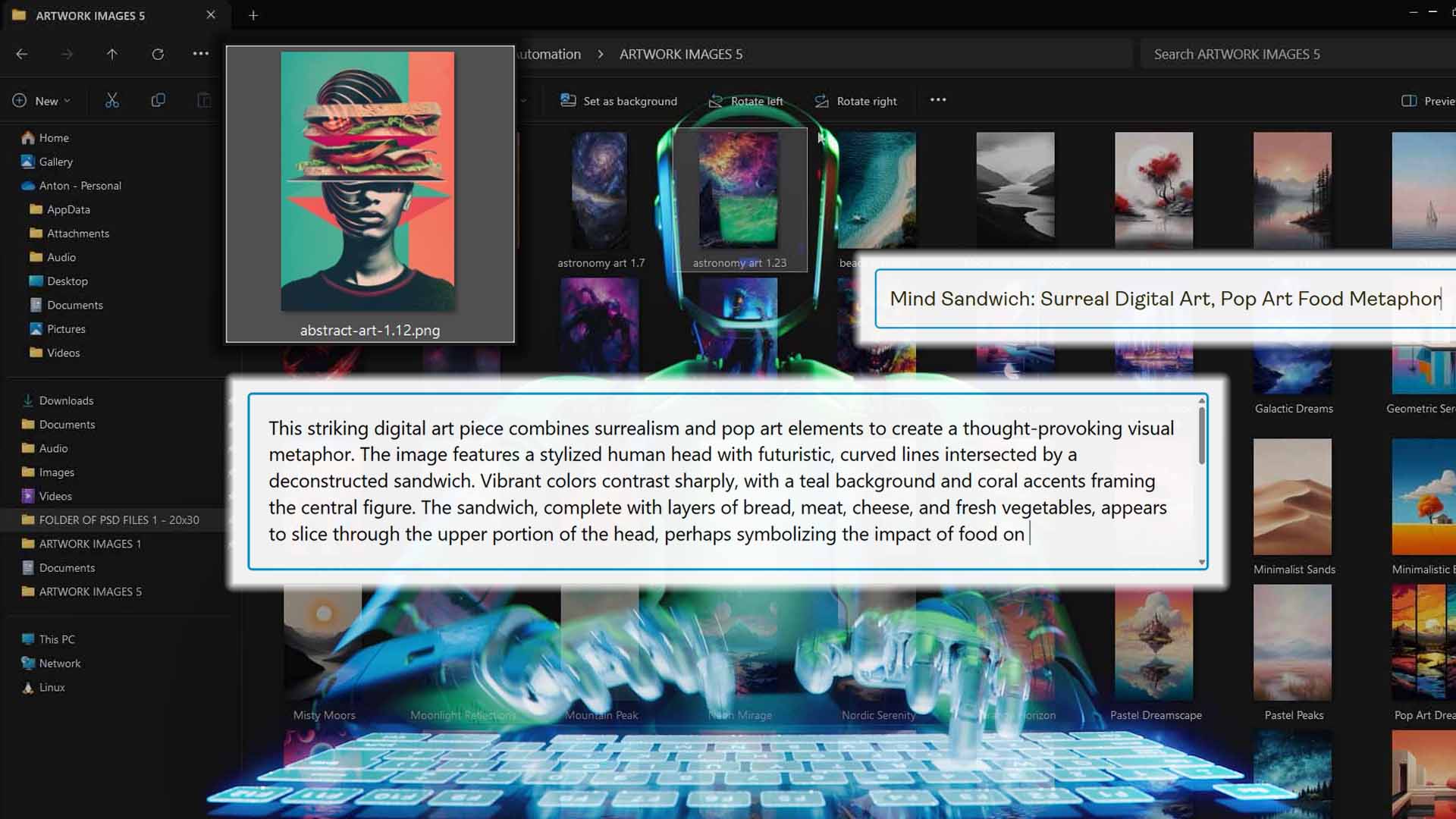
Even though each of those long-tail searches might only have a few hundred monthly queries, competition for them is extremely low. The result: a large collection of listings that rank high for niche, buyer-ready searches where conversions are strongest.
Additional Customization for SEO Precision
Beyond titles and descriptions, the software allows:
- Custom HTML description blocks for appending standardized product information (e.g., materials, dimensions, shipping info, or care details).
- Custom tags that blend your target keywords with AI-generated tags for full control.
- Dynamic suffixes and prefixes that let you append product-level context (like “Canvas Wall Print” or “Art Poster for Living Room”) to every listing automatically.
This means you can fully tailor your Etsy SEO strategy — from the macro level (targeting entire keyword clusters) down to the micro level (individual artwork optimization).
Why This Approach Outperforms Manual Listing Creation
The average Etsy seller might create 10 to 20 new listings in a week. Using this tool, you can generate hundreds in a single afternoon — each with SEO-rich content aligned with the exact keyword strategy you validated through research. The result is exponential coverage: more listings, more keywords, more traffic, and more opportunities for conversion.

And because each listing is intelligently written and accurately tagged, this isn’t “spammy bulk upload” growth — it’s structured, data-driven expansion that builds a durable foundation for long-term organic traffic growth.
Bottom Line
The Bulk POD Product Creator isn’t just a timesaver — it’s a traffic-generation engine.
By automating the labor-intensive parts of print-on-demand product creation and coupling that with sophisticated AI-driven SEO generation, it allows Etsy sellers to:
- Launch massive numbers of listings quickly.
- Ensure every listing is keyword-optimized and unique.
- Dominate more long-tail search results with less effort.
For sellers serious about increasing organic visibility, sales, and overall store momentum, this is how you build a shop that doesn’t just grow — it compounds.
Create Massive Volumes of High-Quality AI Artwork Images for Your Etsy POD Store
At this point, you’ve already built a smart keyword plan and understand that more products mean more traffic, more engagement, and ultimately more sales. You’ve also seen how the Bulk POD Product Creator automates the creation of huge batches of SEO-optimized listings.
Now it’s time to take this strategy one step further — by giving yourself a never-ending supply of new artwork to turn into products. That’s where AI artwork generation comes in.
How Midjourney Works — AI Image Generation in a Nutshell
Midjourney is one of the most advanced AI image generation tools available today. At its core, it takes a text prompt — a short description of what you want to see — and turns that into a finished digital artwork image.

For example:
“vibrant watercolor painting of a mountain sunrise, minimalist style, soft gradients, serene atmosphere.”
Type that into Midjourney, and it will render four completely original artworks based on that description. Each image can be refined further, upscaled for higher resolution, or regenerated until you achieve the perfect visual.
Behind the scenes, Midjourney uses machine learning models trained on millions of artistic examples to understand texture, lighting, composition, and stylistic nuance. The result is artwork that feels handcrafted — but is generated in seconds.
You can also specify aspect ratios directly within your prompts to make your images perfectly formatted for print-on-demand products. For example:
--ar 2:3for 20x30 poster prints--ar 1:1for square canvas art--ar 3:4for vertical framed prints
By generating images in the right aspect ratio from the start, you’ll save enormous time later when creating your actual POD products.
Bulk-Generating Hundreds of AI Artwork Images
The real power of Midjourney lies in scale. Each prompt produces four images, and depending on your plan level, you can run multiple generations concurrently. That means within a few hours of focused work, you can easily create hundreds of high-quality, print-ready artwork images.
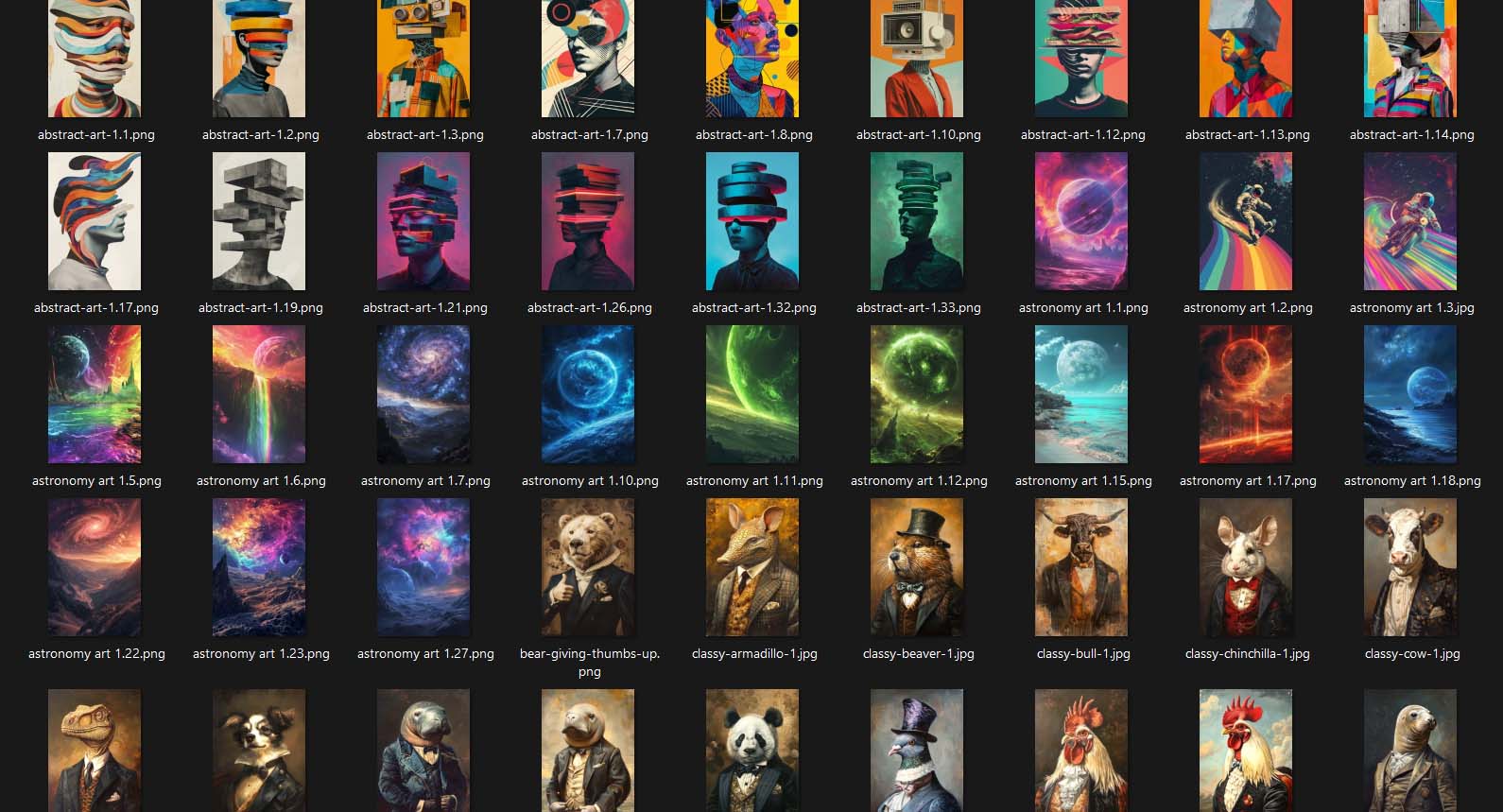
A simple workflow might look like this:
- Write a batch of prompts related to your Etsy store’s theme (for instance, “boho botanical wall art,” “minimalist line drawings,” “retro travel posters”).
- Queue up several prompt generations at once.
- Curate the best outputs, upscale them for maximum quality, and download them for product creation.
Once you get into a rhythm, this process feels less like manual work and more like creative exploration — generating dozens of stunning images in a fraction of the time traditional design would take.
Using ChatGPT to Bulk-Generate Text Prompts for Midjourney
If coming up with hundreds of prompts sounds exhausting, there’s a shortcut: use ChatGPT to generate them for you.
Here’s how to do it:
- Identify a few successful prompts that consistently create great images for your niche.
- Paste those examples into ChatGPT and ask it to create hundreds of similar variations — changing subject matter, style, color schemes, and descriptors while staying within your product niche.
- Export the generated prompts into a spreadsheet.
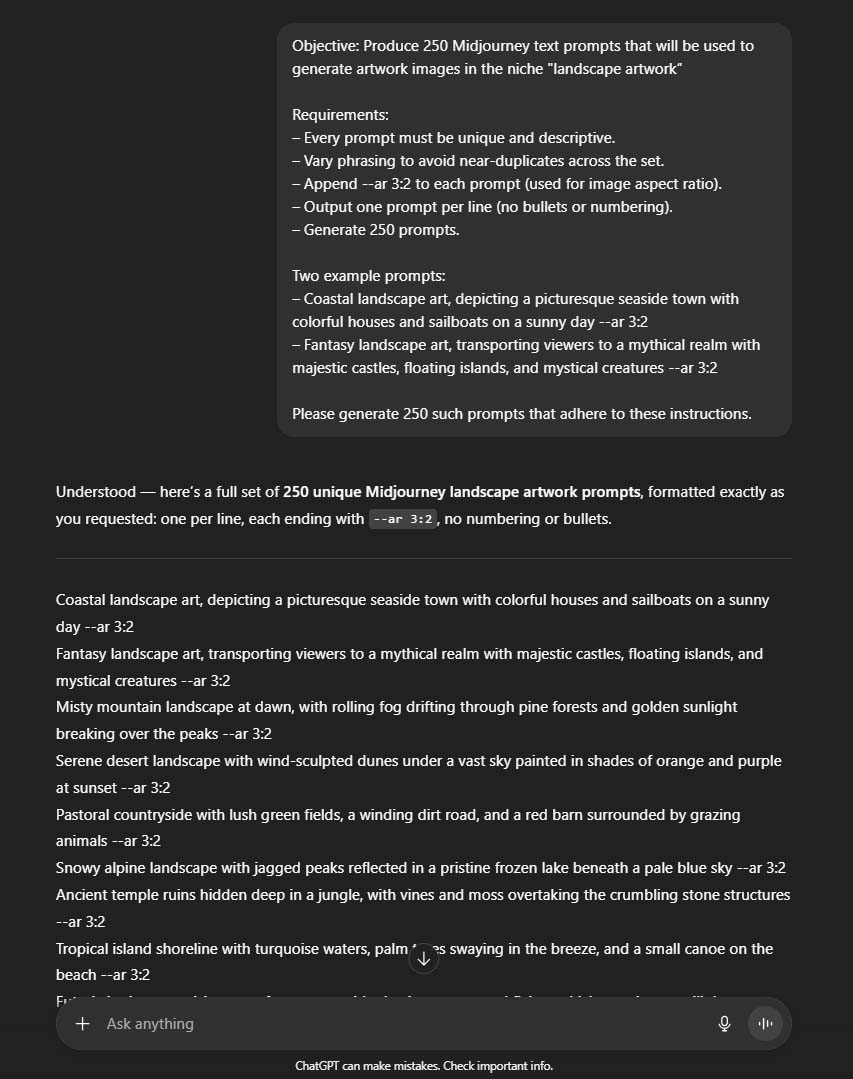
From there, simply open Midjourney on one half of your screen and your spreadsheet on the other. Copy-paste through your prompts, and in a single sitting you can produce hundreds of high-quality, diverse artworks.
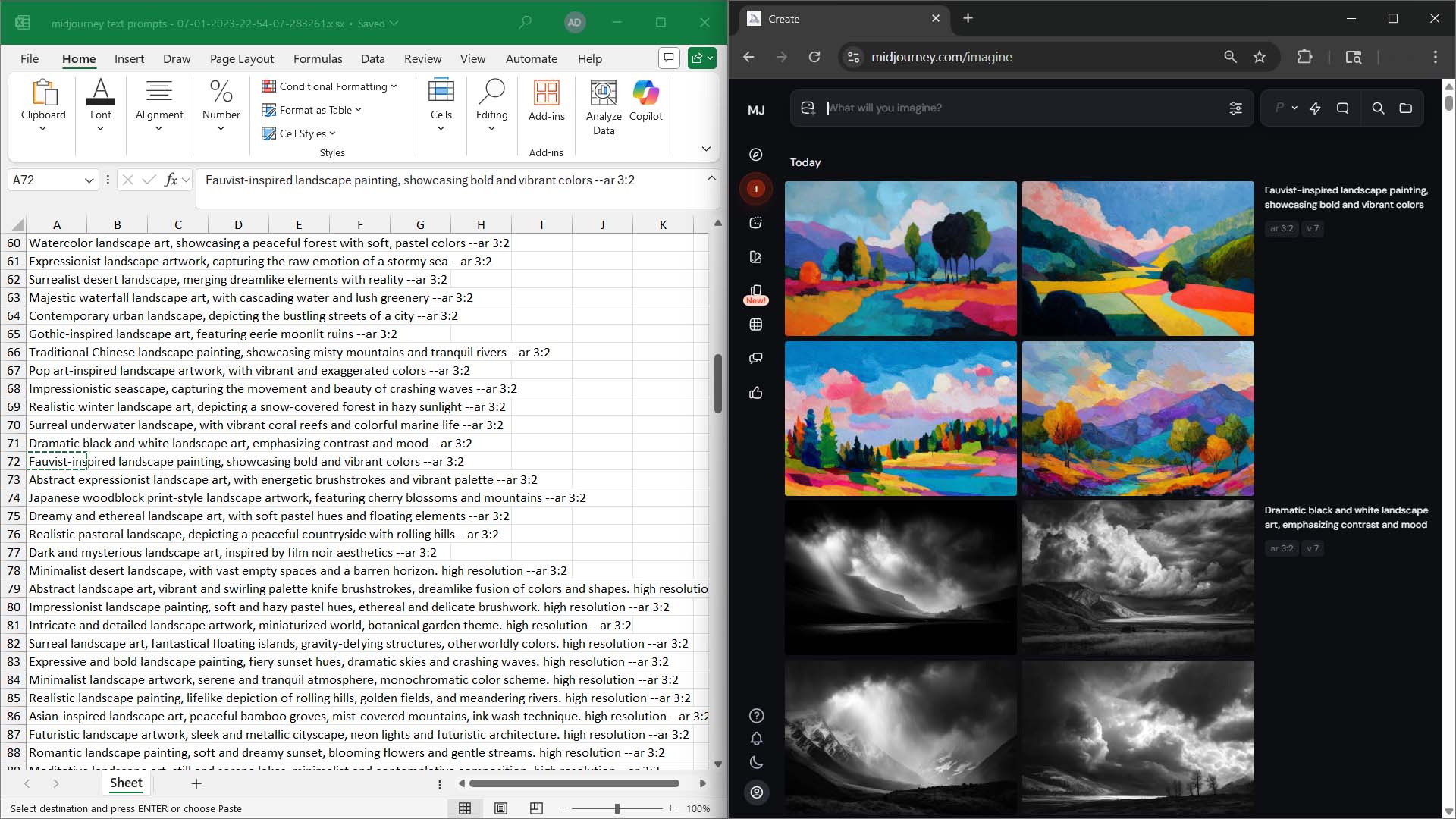
If your keyword research earlier revealed strong demand for certain themes — like “blue abstract art” or “vintage travel photography” — this is where you double down. Generate massive image batches that target those specific content areas, ensuring every new artwork you create directly supports a validated SEO opportunity for your Etsy shop.
Combining Midjourney + Bulk POD Product Creator = the Ultimate Traffic Engine
Once you’ve generated your artwork library, the next step is pure automation.
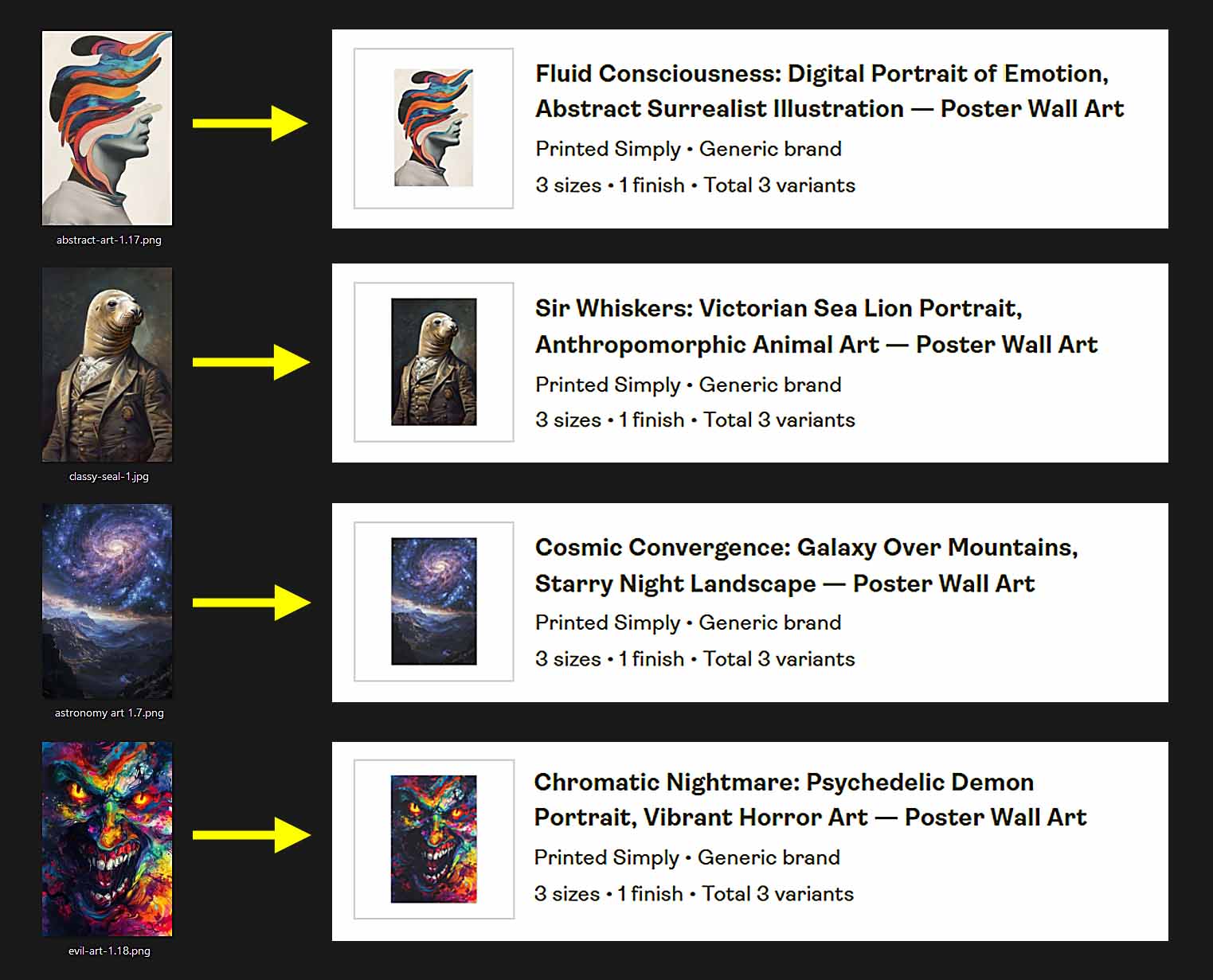
Feed all those new AI-generated images directly into the Bulk POD Product Creator — and it will instantly turn them into full Etsy listings with:
- SEO-optimized titles, descriptions, and tags (auto-generated via AI image recognition)
- Automatically replicated variants, prices, and product configurations (from your Example Product)
- Optional appended custom text to target specific keyword clusters you researched earlier
Within a single afternoon, you could go from zero to hundreds of new Etsy listings, each representing a new opportunity to rank for dozens of long-tail search queries.
That’s the power-combo workflow:
- Use ChatGPT to bulk-generate prompts.
- Use Midjourney to create hundreds of beautiful, on-theme artwork images.
- Use the Bulk POD Product Creator to instantly turn those images into fully optimized, publish-ready Etsy listings.
The Compounding Effect of Automation
When you combine AI artwork generation with automated print-on-demand product creation, your catalog expands at a pace that’s nearly impossible for competitors to match. Every new artwork image becomes a new product. Every new product becomes a new page with fresh SEO potential.
And as your store’s product volume grows, your visibility across Etsy’s search algorithm and Google’s index grows with it — leading to more visitors, longer session times, higher average order values, and ultimately, far more sales.
That’s how you turn creative automation into compounding growth.
Traffic-Boosting Technique #3: Use an Etsy-Specific Marketplace Research Tool (EverBee)
Before you start mass-producing hundreds of new listings, it’s worth confirming that the products and keyword ideas you’re targeting are actually generating sales within the Etsy ecosystem.
In Technique #1, we covered how to use Google’s Keyword Planner Tool to uncover what shoppers are searching for broadly across the web. That’s an excellent starting point because it reveals organic demand trends across global search data — but Google’s metrics alone don’t tell you what’s selling on Etsy specifically.
That’s where EverBee comes in.
What EverBee Does and Why It Matters
EverBee is an Etsy-specific research platform that analyzes real Etsy listings and surfaces key performance data for each one.
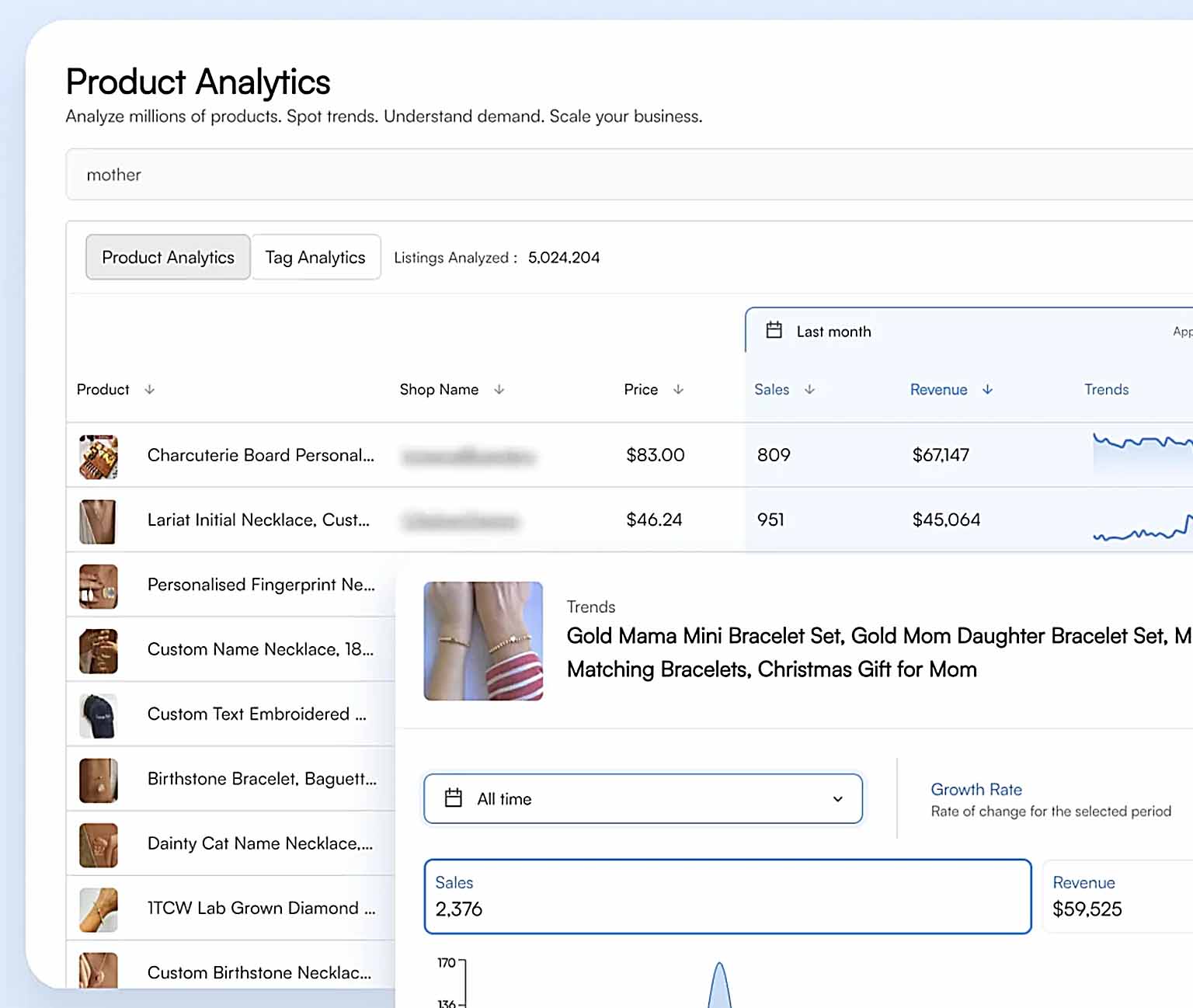
You can type in any keyword — for example, “boho wall art,” “blue abstract painting,” or “funny coffee mug” — and EverBee will display a list of the top Etsy listings using those keywords, along with powerful insights such as:
- The number of sales each product has made
- The current listing price
- The estimated monthly revenue
- The date of listing creation (helpful to gauge velocity and longevity)
In other words, it lets you see — at a glance — which products are not just being searched for, but are actually converting into sales. The attached screenshot illustrates this functionality clearly: for every product that matches your query, you’ll see a breakdown of units sold, total estimated revenue, and other marketplace metrics that remove the guesswork from Etsy strategy.
Why This Data Is So Valuable for Etsy POD Sellers
When you combine Google Keyword Planner insights with EverBee’s Etsy-specific data, you create a two-layer validation system:
- Google Keyword Planner tells you what’s in demand across the web — the types of queries people type into search engines, how often they’re searched, and which related phrases also carry meaningful volume.
- EverBee then confirms which of those same product types and keyword angles actually produce sales within Etsy itself — at what price points, in what quantities, and how consistently.
This combination is extremely powerful because it bridges the gap between search intent and purchase behavior. You’re no longer guessing whether your product ideas “might work” — you’re backing them with real data.
For example:
Suppose Keyword Planner shows strong search volume for “geometric abstract wall art.”
You check EverBee and find multiple listings using that keyword phrase, each with thousands of lifetime sales and stable pricing around $30–$40.
That tells you two crucial things:
- The term has broad search demand.
- It has proven buyer traction and acceptable margins within Etsy’s marketplace.
Now you’re building your Etsy shop strategy around verifiable, high-probability opportunities rather than speculation.
Using EverBee as a Strategic Filter
Conversely, if your research shows the opposite pattern — for instance, a niche with almost no sales, or listings priced so low that your profit margin would vanish — that’s an early red flag. It’s not necessarily failure; it’s pre-validation that saves you from wasting weeks or months creating products that no one buys.
Armed with this knowledge, you can pivot strategically by:
- Choosing a different target demographic
- Adjusting your artwork themes and keyword clusters
- Focusing on POD products with better pricing flexibility and profit potential
The Compounding Effect of Dual Validation
Stacking both methods — Google’s macro-level keyword data and EverBee’s Etsy-specific sales validation — gives you near-total visibility into where the real money is. You’ll know which search queries drive traffic and which product types convert that traffic into actual sales.
That kind of evidence-based confidence changes everything:
You’re no longer creating products “hoping” they’ll sell — you’re executing a data-driven plan grounded in demand and proven performance.
With that foundation in place, you can move forward and begin mass-producing Etsy listings with clarity and purpose — knowing your creative and marketing energy is aimed squarely at opportunities with real traction.
Conclusion: The Compounding Power of Executing Every Traffic-Boosting Strategy Together
Individually, each of these traffic-boosting techniques — keyword research, large-scale product creation, SEO optimization, image automation, marketplace validation, and feed distribution — can deliver measurable results on its own. But when executed together, systematically and consistently, their impact doesn’t just add up — it multiplies.
That’s because traffic growth in print-on-demand doesn’t scale linearly. It compounds.
Every new product you create, every keyword you target, every platform you syndicate to, and every improvement you make to your site’s speed and SEO forms an interconnected system — one that gradually builds unstoppable momentum for your store.
How the Compounding Effect Works
When you combine keyword intelligence from Google Keyword Planner and EverBee, you’re no longer guessing what to create — you’re producing products aligned with real search demand and real sales data. That strategic alignment ensures every hour you invest in product creation has maximum ROI potential.
Then, when you use automation tools like the Bulk POD Product Creator to scale your production and fill your print-on-demand shop with hundreds of listings — each with SEO-rich, artwork-specific titles, descriptions, and tags — you unlock exponential growth in traffic channels. Every new listing becomes another landing page indexed by search engines and Etsy’s internal algorithm, each capable of ranking for unique, high-intent longtail queries.
Add to that the AI image-generation workflow, where Midjourney and ChatGPT streamline your creative process — and suddenly, your bottleneck isn’t creativity or time; it’s how quickly you can upload your new designs. Your store evolves from a handful of listings into an expansive, professional-grade catalog.
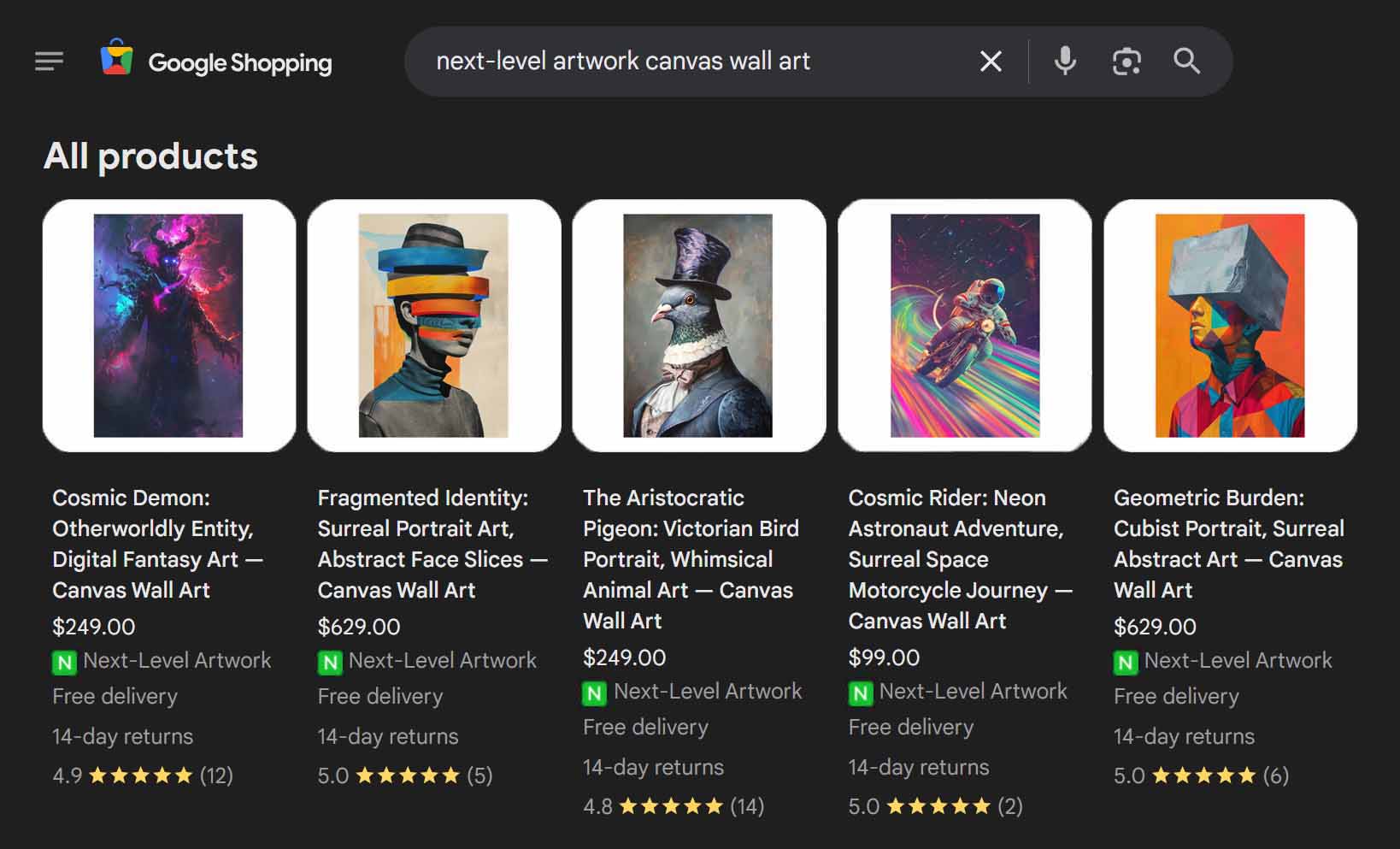
From there, techniques like Google Shopping Feed integration and automatic Pinterest pin creation multiply your exposure across additional discovery platforms, bringing in entirely new streams of visitors who would’ve never found your shop otherwise.
The Results of an Integrated Approach
By executing these strategies in concert, you create what’s essentially a self-reinforcing feedback loop:
- More listings → more indexed pages → more search impressions
- More impressions → more visitors → longer session times
- Longer session times → better rankings → even more organic visibility
- More organic visibility → more sales → more positive engagement metrics
- More data and revenue → more informed product creation → higher efficiency
This cyclical growth dynamic is what separates stagnant POD shops from thriving, high-traffic, high-revenue operations.
Why Partial Effort Doesn’t Work
Many Etsy sellers stagnate because they execute one or two of these techniques in isolation.
They might research keywords but never scale product creation.
They might create products but ignore SEO fundamentals.
Or they might have great listings but zero exposure outside Etsy’s internal algorithm.
The result: slow, limited growth that never compounds.
To achieve real, sustained results, all components must be firing together — research, automation, SEO, syndication, and performance optimization. That’s how you turn a modest Etsy shop into a serious traffic-generating engine.
The Takeaway
When you go all-in on these strategies — not piecemeal, not half-heartedly, but with deliberate consistency — the outcome isn’t just “a bit more traffic.” It’s an entirely different growth trajectory.
You’ll attract far more visitors, rank higher for more search queries, convert more buyers, and build a store that continues to grow even while you sleep — because it’s powered by data, automation, and compounding discoverability.
That’s the ultimate advantage of leveraging every tool, every insight, and every automation method at your disposal. It’s not just about working harder — it’s about building a system that works for you, amplifying every ounce of effort into sustained, scalable, long-term success.