
How To Bulk-Create AI Titles, Descriptions & Tags For POD Products on Shopify
Overview: This guide shows Shopify sellers how to generate SEO-optimized POD product titles, descriptions, and tags automatically without manual rewriting. We outline a practical, no-code workflow using the Bulk POD Product Creator: batch image selection, Example Product templating, AI image recognition for precise copy, and advanced controls for title/description/tag structure. You’ll also see how saved operations enable repeatable launches and why AI-generated product info outperforms manual writing for traffic and conversions.
How Manually Writing Your Shopify Print-on-Demand Product Titles, Descriptions, and Tags Slows Your Business Growth
Every Shopify print-on-demand seller reaches the same wall sooner or later: writing product titles, descriptions, and tags one by one becomes the bottleneck that stalls your entire business.
It’s deceptively simple work — just words on a page — but the time cost is brutal. You upload a new artwork design, fill out the title, write a short description, add a few tags... and then repeat that process dozens or hundreds of times. Hours vanish. Your focus splinters. The creative energy that should go into new ideas instead gets burned up doing tedious metadata entry.
What makes this so painful is the contradiction: this step is absolutely essential for SEO and sales performance, yet it’s also repetitive, slow, and mentally exhausting. Writing accurate, keyword-rich copy for one listing feels fine; doing it for 200 becomes mind-numbing. You start recycling the same adjectives and descriptors over and over — “modern,” “minimalist,” “colorful,” “vintage.” When your artwork follows a consistent theme or aesthetic, the repetition compounds even faster, and every product begins to blur together.

This isn’t just a creative problem; it’s a visibility problem. Search engines reward distinct and accurate metadata. If multiple listings reuse the same handful of keywords, they begin competing against each other — you’re cannibalizing your own rankings instead of broadening your reach. The irony is that the harder you work, the more your results flatten out.
And even when you try to write every product description uniquely, you hit a human limitation. Crafting SEO-effective text requires focus and precision — skills that erode fast when you’re doing the same type of micro-writing for hours on end. For many Shopify sellers, the process becomes the single largest drag on their output:
- You either rush through the copy to save time (and sacrifice SEO quality), or
- You do it properly and end up publishing only a fraction of the products you could have.
Either way, growth stalls. You can’t scale your product catalog without scaling your ability to produce accurate, descriptive, SEO-optimized copy — and doing that manually simply doesn’t scale.

The result? A Shopify store filled with under-optimized listings, inconsistent descriptions, and thousands of hours of human labor that could have been spent designing, marketing, or running ads. The very act of typing out titles and tags by hand becomes the hidden tax on your business growth.
The Solution: Automatically Generate SEO-Optimized Titles, Descriptions, and Tags Using AI
Fortunately, this bottleneck can now be removed entirely using the Bulk POD Product Creator.
The Bulk POD Product Creator automates the entire process of writing SEO-optimized product information for your print-on-demand catalog — and does it at a scale no human team could match. It’s designed specifically for Shopify POD sellers who want to grow their collections efficiently while keeping every listing keyword-accurate, visually descriptive, and SEO-ready.
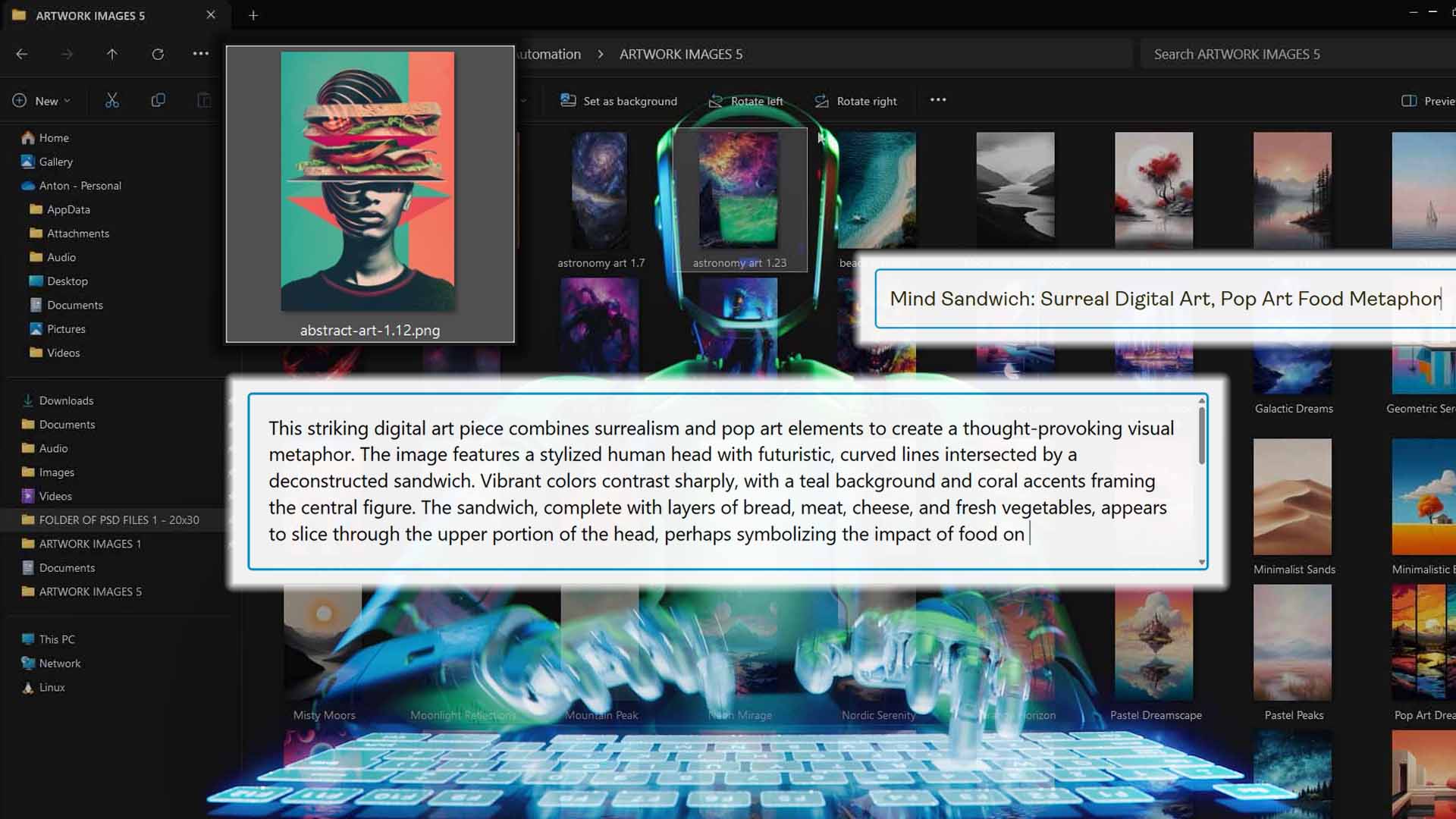
Here’s the high-level picture of how it works:
- The tool uses AI image recognition to analyze each of your uploaded artwork images — understanding what’s visually present (subjects, colors, style, mood, even embedded text).
- It then generates highly detailed, search-optimized titles, descriptions, and tags based on that visual understanding.
- Finally, it combines this image-specific language with product-level data — such as product type, materials, or sizing — to create richly targeted SEO phrases that match exactly what potential buyers search for.
This dual input — artwork intelligence plus product metadata — forms a powerful one-two SEO strategy. Each listing becomes a perfect semantic match between the artwork you’re selling and the type of product it’s printed on. Instead of writing generic lines like “Cool Abstract Poster,” you get listings such as “Warm Sunset Over Mountains: Minimalist Landscape Canvas Print.” The AI handles the descriptive accuracy, while you maintain full control over your product framing.
And that’s not all. The Bulk POD Product Creator doesn’t just write your titles and descriptions — it also creates the full POD products themselves on your store.

From start to finish, the workflow looks like this:
- Upload your artwork images in bulk.
- The system automatically places and resizes them on your chosen product template according to your selected placement rule (stretch to fill, preserve aspect ratio, or exact match).
- It replicates your preferred Example Product setup — applying the same product type, variants, and pricing configuration.
- It writes and attaches AI-generated SEO titles, descriptions, and tags for each new product.
- It pushes the finished listings directly into your Shopify-connected POD store.
What used to take hours of manual uploading, typing, and formatting now takes minutes. You can launch a hundred fully written, SEO-ready products faster than you could manually finish one.
The result: instead of spending your evenings writing descriptions and tags, you spend them designing new artwork, refining your product mix, and focusing on high-leverage business growth tasks.
This is automation at its most practical — turning a once-grueling step into a near-instant operation that actually improves your SEO outcomes while freeing you from the keyboard grind.
How To Use The AI Tool and Run Automated Bulk Operations
The Bulk POD Product Creator keeps the process simple but powerful.
Each operation follows a three-step sequence — choose your artwork, define your Example Product, and have AI write and populate your POD product titles, descriptions, and tags automatically. Every part of this workflow is designed to eliminate repetitive tasks while maintaining absolute consistency across your entire Shopify catalog.
Step 1 — Select the Artwork Images You Want To Turn Into Products
Everything begins with your artwork batch. You start by selecting the images that you want to publish as new products on your Shopify print-on-demand store. For every individual image you include, the system will generate a distinct product — one image equals one listing.
So, if you feed in a folder of 75 finished designs, you’ll get 75 separate Shopify-ready products created in one automated run.

Once your batch is loaded, you choose how each image should be positioned within the product’s print area by selecting a placement rule. The placement mode ensures your images display correctly across all variants without manual adjustment. You can pick from:
- Stretch Images To Fit Print Area(s): expands artwork edge-to-edge for complete coverage, perfect when uniform fill is the priority.
- Preserve Aspect Ratio & Center: maintains the artwork’s proportions, centering it neatly without distortion.
- Exactly Match Example Image(s): duplicates the precise placement and sizing of your chosen Example Product, guaranteeing pixel-accurate consistency across your catalog.
After Step 1, your artwork assets are queued and formatted. No cropping, no resizing, no tedious visual adjustments — the software handles all of it automatically and prepares you for Step 2.
Step 2 — Connect to Your Store and Choose an Example Product
Next, you tell the system what kind of product to create for each image.
You simply connect the Bulk POD Product Creator to your Shopify store and select an Example Product. This Example Product acts as your master template — it defines the exact parameters every new listing should replicate.

Your Example Product provides all the crucial information:
- Product Type: which item to create (e.g., canvas print, hoodie, T-shirt, tote bag, etc.).
- Print Provider and Fulfillment Method: so each generated listing uses the same trusted backend.
- Variants and Options: sizes, colors, orientations, or style variations.
- Pricing Structure: base price and margins for every variant.
Once this Example Product is selected, the tool duplicates its structure automatically for each artwork image. Every new listing will share the same variant configuration, pricing, and fulfillment details — only the artwork and text data differ.
This guarantees your storefront looks consistent, cohesive, and professionally organized across hundreds of products. It also eliminates setup errors like mismatched prices or missing sizes that commonly appear when creating products manually.
Step 3 — Generate AI Titles, Descriptions, and Tags
With your artwork and Example Product in place, you can now activate the AI generation features — the heart of the automation process.

When you click “Generate Using AI,” the system runs an advanced visual analysis on every uploaded image. It doesn’t rely on filenames or user guesses; it understands the contents of the artwork. The AI recognizes and describes:
- Subjects and Objects (e.g., city skyline, tiger portrait, floral bouquet)
- Colors and Palette (e.g., warm neutrals, neon gradients, muted pastels)
- Artistic Style (e.g., watercolor, vector illustration, surreal digital art)
- Mood or Emotion (e.g., calm, playful, dramatic, retro)
- Any Visible Text or Lettering appearing in the design
Using that detailed visual understanding, the AI then writes accurate, long-tail, keyword-rich titles, descriptions, and tags for each product — all automatically. The phrasing isn’t generic filler; it’s descriptive language tuned to how real buyers search for products on Shopify and Google.
You end up with listings that read naturally, describe the product correctly, and align perfectly with search intent. This is the bridge between visual creativity and SEO precision — and it’s handled entirely by automation.
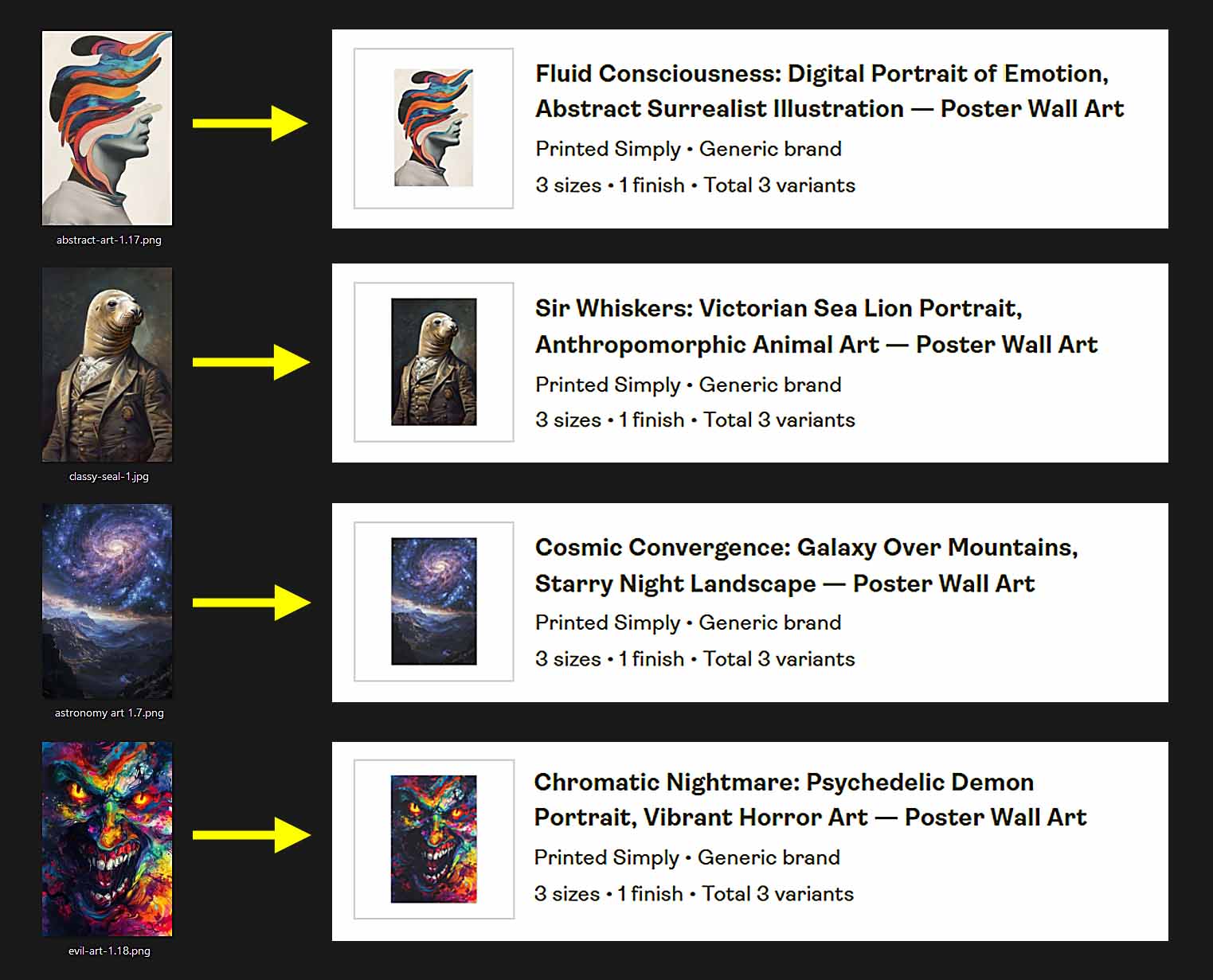
Fine-Tuning Your AI-Generated Titles, Descriptions, and Tags
The automatic generation already produces exceptional results, but you can go deeper.
The Bulk POD Product Creator lets you control the exact structure and style of every SEO element so you can fine-tune your optimization strategy for maximum impact.
AI-Generated Titles: Simple, Compound, and Customizable
Product titles carry the majority of your SEO weight — often 60 to 80 percent of your ranking power. The tool gives you flexible options for structuring these titles to balance brevity and keyword density.
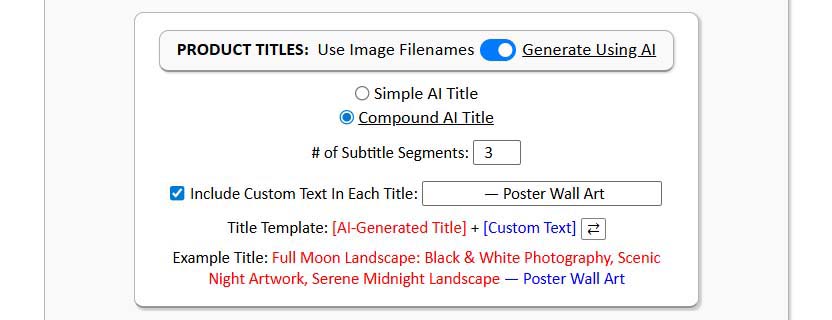
You can choose between:
- Simple Titles: concise AI-generated phrases focused solely on the artwork’s content (e.g., “Sunset Over Ocean Waves”).
- Compound Titles: richer multi-segment titles that expand on the simple version to capture broader search intent (e.g., “Sunset Over Ocean Waves: Calming Minimalist Seascape, Tranquil Scenery Art”).
You can also insert custom text either before or after the AI-generated segment.
For example:
- Prefix format → “Canvas Wall Art — [AI Artwork Title]”
- Suffix format → “[AI Artwork Title] — Premium Cotton T-Shirt”
Combining artwork descriptors with product-specific keywords is pure SEO gold.
You’re matching both halves of the buyer’s query — the visual subject and the product form. This is what produces those “bullseye” search results, such as:
- “retro sunset graphic tee”
- “geometric mountain canvas print”
- “black and white cityscape photo poster”
Each title positions your product exactly where it belongs in organic search results — squarely in front of the shoppers looking for that precise combination of artwork and product type.

AI-Generated Descriptions: Depth, Detail, and Optional HTML Additions
For product descriptions, the AI can generate between one and three paragraphs of detailed copy for every listing. These aren’t boilerplate blurbs; they’re contextually rich descriptions written to highlight what makes each artwork distinctive.

You can also append your own reusable HTML block after the AI text — perfect for adding product-specific information such as materials, sizing, or care instructions.
That structure lets you seamlessly combine visual descriptors with technical product details. For example:
“A whimsical digital painting of an astronaut riding a motorcycle through space, printed on a 20×30 matte poster for gallery-quality finish.”
In one sentence, the AI and your appended block together cover both the artwork’s imagery and the product’s specifications — which gives you excellent keyword coverage for queries like:
- “20x30 matte poster astronaut art”
- “space motorcycle wall print”
- “sci-fi digital art home decor”
That combination of long-tail relevance and product context is exactly what search engines reward.
AI-Generated Tags: Automatic Relevance With Custom Control
Finally, the tags system adds another layer of precision. The tool automatically generates up to 30 AI-derived tags per product, each one based on what’s visually detected in the artwork — terms like “space art,” “motorcycle illustration,” “cosmic poster,” and “sci-fi decor.”
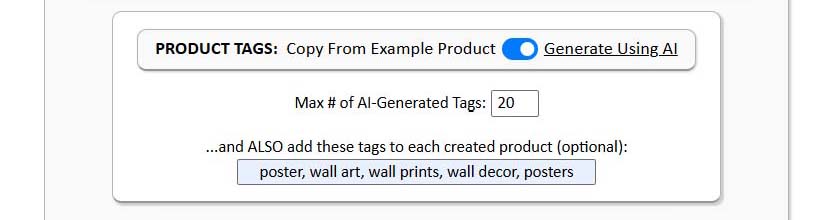
You can also append your own custom tag set to each batch to maintain storefront organization and collection logic. This is invaluable if you:
- Use tag-based collections on your Shopify store for sorting and filtering.
- Want to add thematic labels (e.g., “summer collection,” “minimalist series,” “limited edition 2025”).
- Need to preserve Etsy cross-posting compatibility for hybrid sellers who publish on multiple platforms.
By blending AI-generated relevance with human-defined taxonomy, your catalog remains searchable, neatly grouped, and SEO-friendly — all with minimal input on your end.
Save and Reuse Your SEO-Optimized Operations Quickly & Easily
Once you’ve built your ideal operation — the perfect Example Product, the right placement rule, your AI generation settings, and your title/description/tag structure — there’s no reason to start from scratch every time. The Bulk POD Product Creator allows you to save every configuration as a reusable operation preset.

Every detail is remembered: your product type, variant and pricing data, placement settings, AI generation parameters, custom title prefixes/suffixes, HTML append blocks, and even your custom tag lists. The next time you’re ready to publish a new batch of products, the workflow is almost laughably simple:
- Open the dropdown and select your saved operation.
- Click Load, and your entire configuration instantly reappears.
- Drop in your new artwork images.
- Hit Create My Products.
That’s it — in roughly ten seconds, you’ve set the stage for generating hundreds of fully optimized print-on-demand products on autopilot.
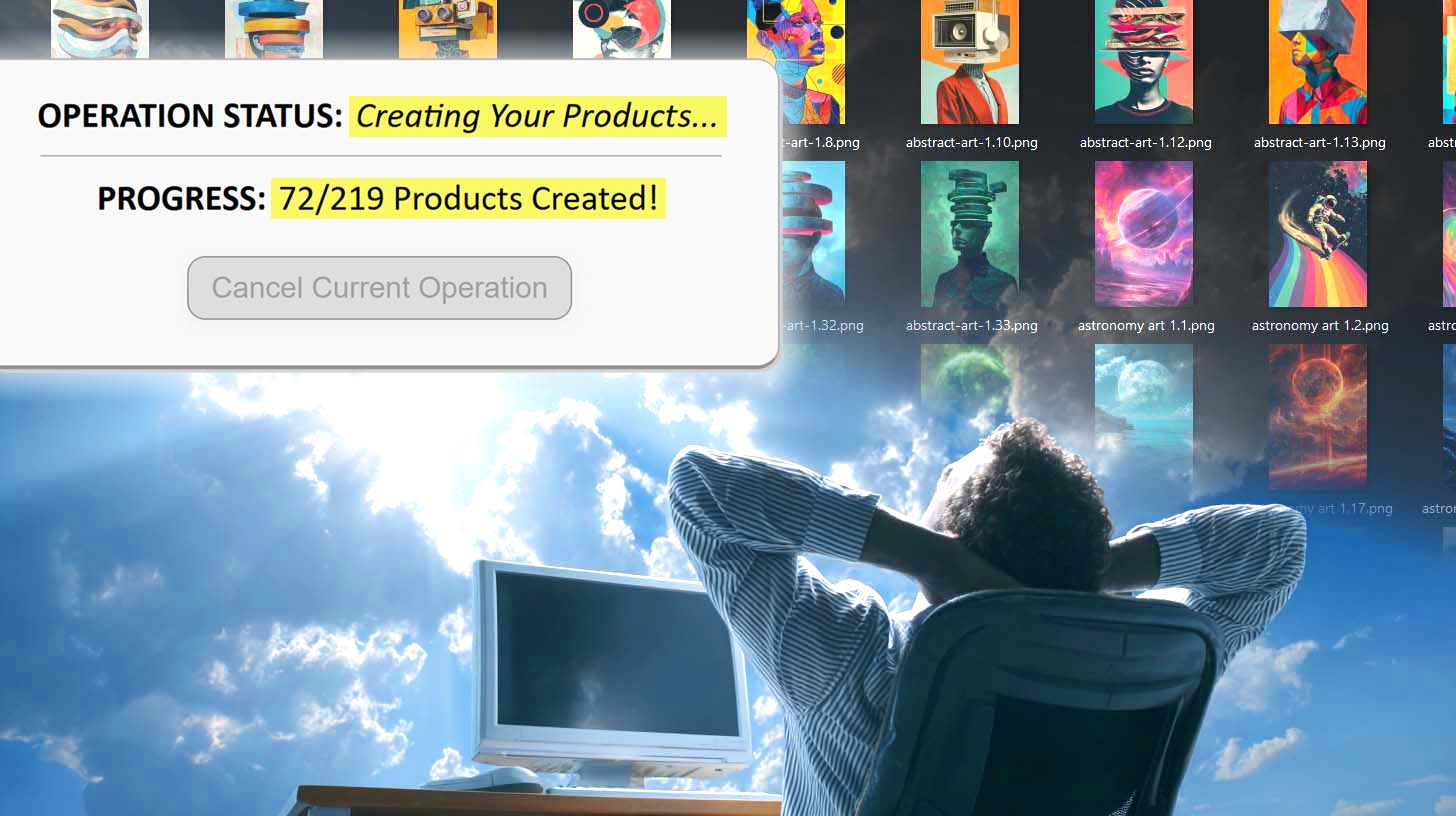
It’s one of those small features that quietly delivers massive leverage. Once your saved operations are established, they function like reusable “launch recipes” for your business — letting you mass-produce new products quickly, confidently, and consistently. The human error, repetition, and setup friction vanish, replaced by smooth scalability.
The result: your store operates like a professional-grade production pipeline rather than a time-draining creative hobby.
Why AI-Generated Product Information Outperforms Manual Writing
Automation isn’t just faster — it’s better. The AI-generated titles, descriptions, and tags produced by the Bulk POD Product Creator consistently outperform manually written ones for both efficiency and quality. Here’s why.
AI has a vastly superior linguistic range.
Large language models have absorbed millions of examples of product listings, artistic descriptors, and search queries. They understand how buyers phrase their intent — the vocabulary, the emotional tone, the modifiers people use when searching. No individual seller (or even an entire copywriting team) can rival that lexical depth.
AI doesn’t burn out or cut corners.
When a human has written their 80th product description of the day, quality drops. Sentences shorten, adjectives repeat, phrasing gets lazy. The AI, by contrast, produces its hundredth product description with the same precision as its first. Every line is fresh, consistent, and SEO-calibrated.
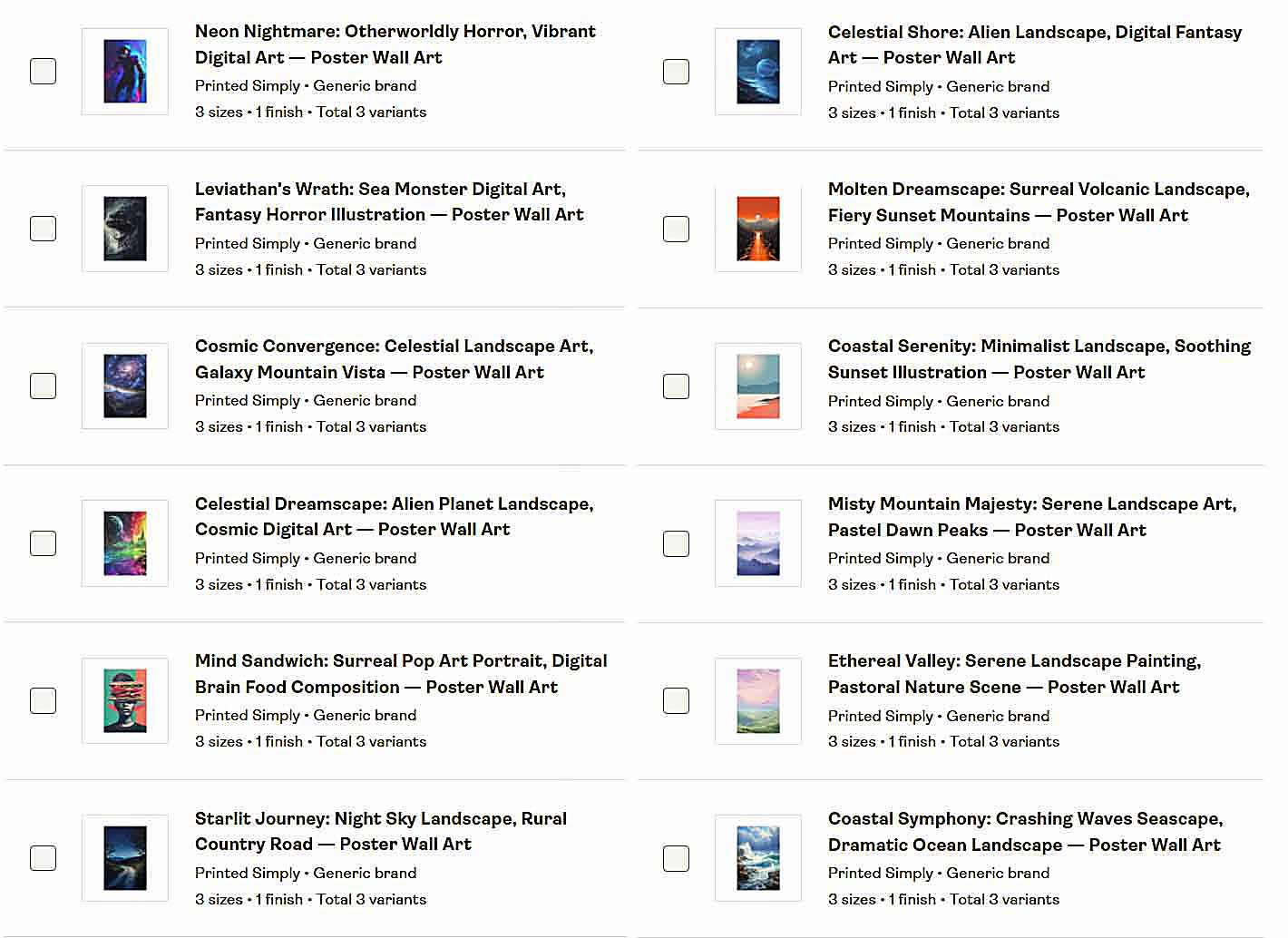
AI enforces structural consistency across the entire catalog.
Titles follow the same logical pattern, descriptions share similar formatting, and tags adhere to a uniform standard. The end result is a professional storefront that looks deliberate and polished — without requiring you to micro-manage formatting details.
AI scales instantly.
Generating product copy manually is a linear process: more products mean more hours. With the AI system, time spent stays roughly constant regardless of volume. Whether you’re producing 20 listings or 2,000, the workload remains the same.
AI frees you to focus on high-impact work.
Instead of describing individual images, you can concentrate on strategic decisions — keyword research, new design directions, seasonal promotions, or identifying product-market fit. The repetitive grind disappears, leaving you to do the parts of the business that actually grow revenue.
In short, AI isn’t merely a convenience tool; it’s an intelligence amplifier. It ensures that every product you publish is written at a professional standard of clarity, accuracy, and search optimization — something even experienced sellers struggle to maintain at scale.
The difference shows up in both your workload and your results: more listings, faster output, cleaner SEO, and higher sales conversion.
How Shopify POD Stores With SEO-Optimized Products Generate More Traffic and Sales
Here’s where everything connects.
Once your Shopify listings are built with well-structured, AI-optimized titles, descriptions, and tags, you create a self-reinforcing cycle of visibility and sales.
From a practical standpoint, SEO-optimized product data improves performance in several ways:
- Improved discoverability on search engines. Google and Bing prioritize listings with precise, semantically rich metadata. When your titles accurately describe both the artwork and the product type, they align perfectly with search intent — boosting impressions for long-tail queries like “black-and-white city skyline wall art” or “retro sunburst t-shirt design.”
- Higher relevance within Shopify’s internal search. Shopify’s built-in search and collection filters also respond to well-tagged, descriptive listings. Your store becomes easier for customers to browse, which reduces bounce rates and increases session time — both positive ranking signals for organic visibility.
- More organic clicks. Clear, well-written titles and meta snippets encourage clicks. A listing titled “Minimalist Mountain Scene — Modern Canvas Wall Art” simply outperforms “Cool Landscape Print” in both professionalism and conversion appeal.
- Better conversion rates. When customers land on a product page that perfectly matches the search they typed, the buying decision happens faster. Detailed descriptions establish trust and reduce uncertainty — especially when paired with the right imagery and pricing.
- Compounding growth over time. Every optimized product becomes another “doorway” into your store. As you create more listings, you expand your keyword footprint and long-tail coverage, steadily increasing the number of search queries that can lead to your site.

In short: SEO optimization doesn’t just help you get found — it helps you get chosen.
A Shopify POD store that invests in accurate, richly descriptive product metadata builds authority in the eyes of both search engines and buyers. Over time, this translates directly into more traffic, more trust, and more sales.
Conclusion
Scaling a Shopify print-on-demand business is ultimately a game of leverage. The more products you can publish — while keeping quality high and SEO strong — the faster your growth compounds.
Manually writing every title, description, and tag by hand is the antithesis of leverage. It’s slow, mentally draining, and impossible to scale.
The Bulk POD Product Creator changes that equation entirely. By combining AI image recognition, automated copy generation, and full product creation workflows, it allows you to produce hundreds of perfectly optimized listings in the time it used to take to finish one.
You no longer have to choose between quality and volume — you get both.
Your titles are descriptive, your tags are relevant, your descriptions read naturally, and your store fills with SEO-ready products that attract high-intent traffic.
It’s the difference between working in your business and scaling beyond it.
If you’re serious about growing your Shopify store efficiently, automating your print-on-demand product creation and SEO optimization isn’t just an upgrade — it’s the turning point that transforms your entire operation from manual to momentum-driven.