Can ChatGPT Agent Mode Write POD Product Titles, Descriptions & Tags For You?
Overview: This post examines whether ChatGPT Agent Mode can realistically automate writing product titles, descriptions, and tags for print-on-demand (POD) platforms, why browser-driven workflows tend to be fragile, and how the Bulk POD Product Creator delivers reliable, automated, AI-powered SEO output for POD sellers.
Writing POD Titles, Descriptions & Tags Manually Is a Productivity Killer
Anyone who’s built a print-on-demand store knows how excruciating it can be to manually write product titles, descriptions, and tags—over and over again—for hundreds of listings. It’s tedious, time-consuming, and creatively draining. After about the 20th listing, the mental fatigue sets in. By the 100th, you’re on autopilot, reusing the same recycled phrasing just to get through it.
The problem isn’t just the boredom. It’s the opportunity cost. Every hour spent typing out repetitive metadata is an hour not spent designing, marketing, or scaling your business.
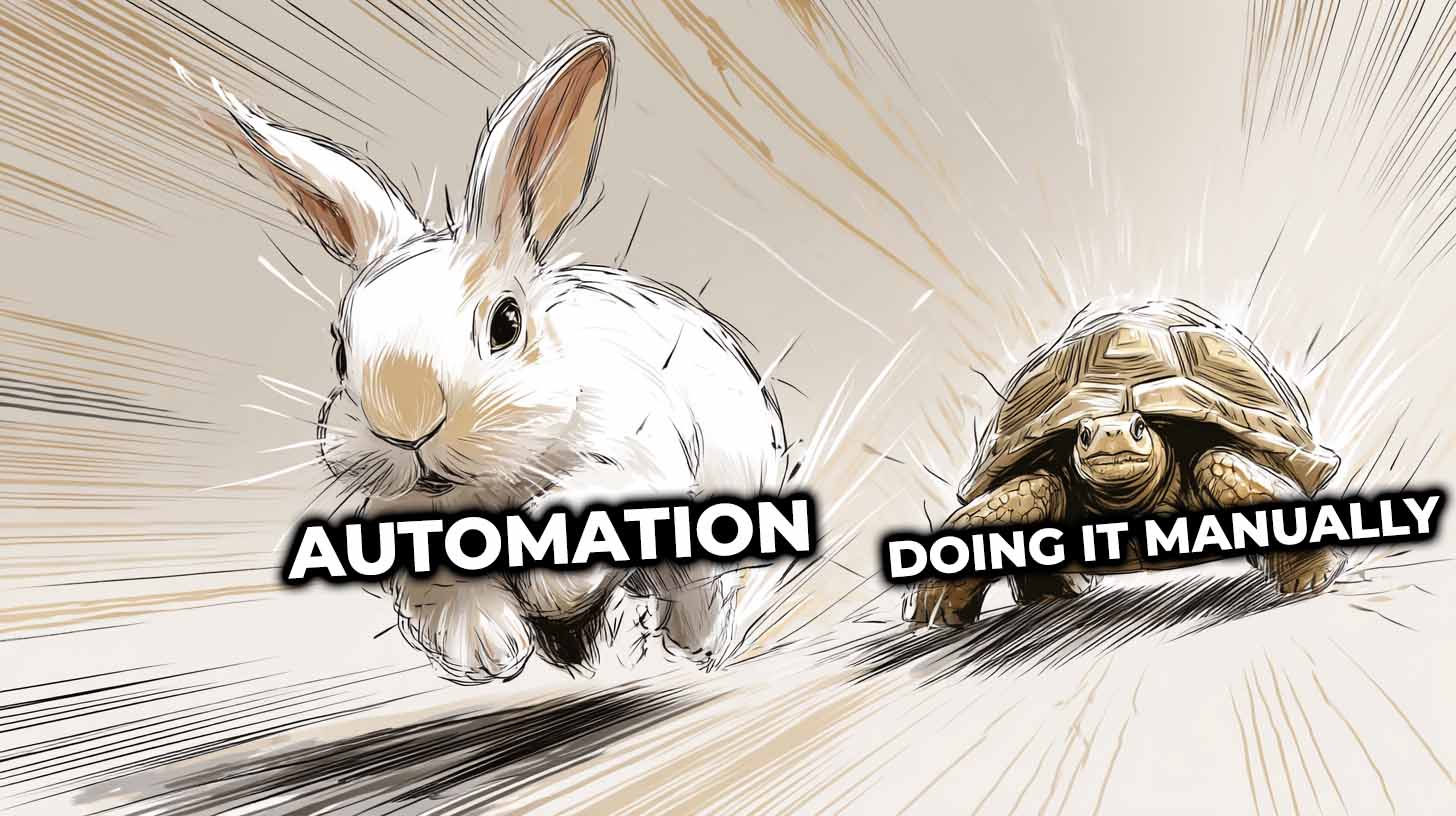
That’s why so many sellers turn to automation and AI for help—to eliminate this repetitive grunt work and make the entire process faster, smarter, and more consistent.
Here are a few clear reasons why AI + automation is a better approach:
- It saves massive amounts of time. You can generate hundreds of SEO-oriented product titles, descriptions, and tags with just a few minutes of work instead of wasting hours or days.
- It ensures consistency. AI-generated copy maintains a consistent structure and tone across your catalog, improving brand coherence and professionalism.
- It boosts SEO performance. Well-trained AI can surface keyword-reflective phrasing patterns naturally—something that’s hard to sustain manually at scale.
- It eliminates burnout. You can stop dreading the “content writing” part of listing creation and focus your energy on designing and growing your business.
- It scales infinitely. AI doesn’t get tired. Whether you have 50 products or 5,000, it produces consistent, polished results every single time.
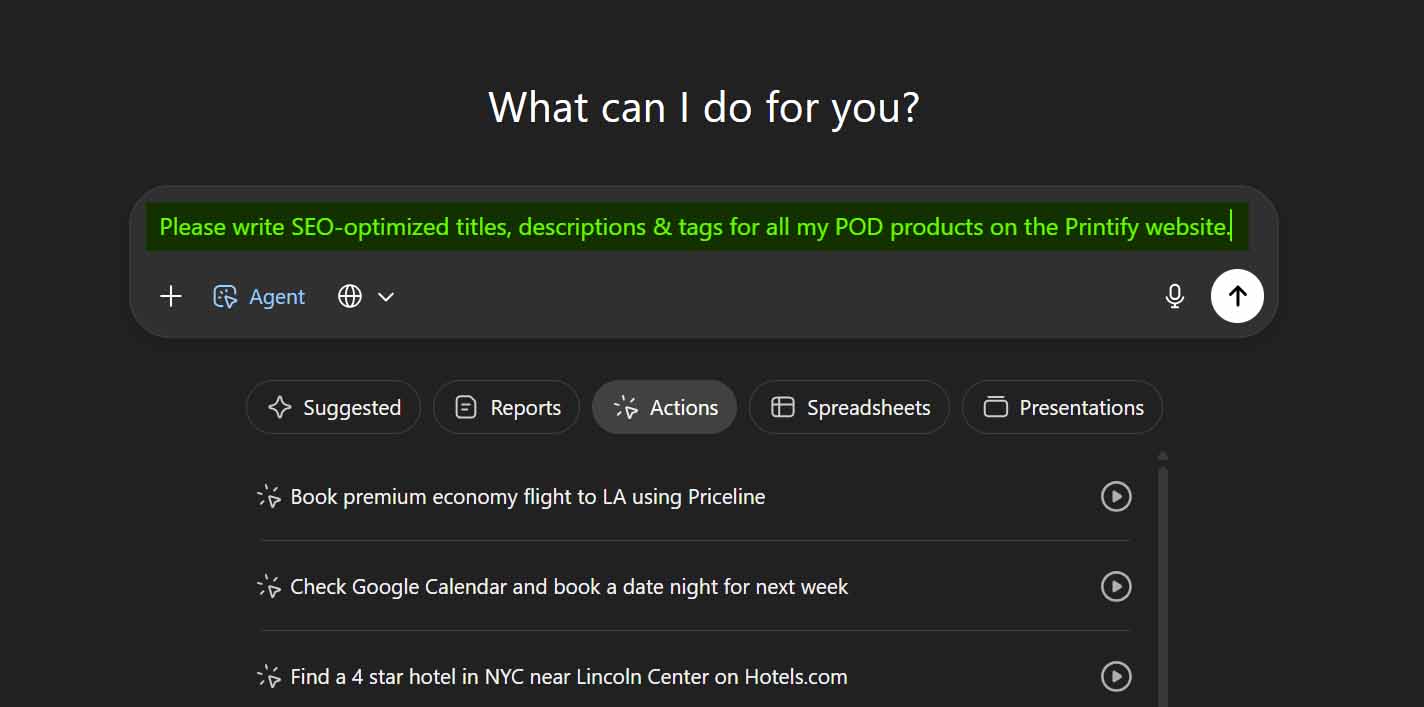
But of course, how you automate matters. Some sellers look to tools like ChatGPT’s Agent Mode as a possible solution—reasoning that, if it can click around a browser and type like a human, maybe it could just handle all this tedious product-copy writing on its own.
Unfortunately, that’s not the best route. While it might sound appealing, “browser automation” via ChatGPT Agent Mode is an incredibly fragile, unreliable way to handle something as important as your POD SEO and product copy.
A much better approach—and one aimed at this exact bottleneck—is using the Bulk POD Product Creator, which automates all of this properly by working with official platform APIs (e.g., Printify) instead of brittle browser scripts. It’s clean, efficient, and purpose-built for generating AI-driven titles, descriptions, and tags for your POD products—without any “control my browser” hacks.
Can ChatGPT Agent Mode Write POD Titles, Descriptions & Tags?
Technically speaking, you might be able to rig ChatGPT’s Agent Mode to interact with a POD platform’s web interface—but that doesn’t mean it’s a practical or reliable solution. In theory, an Agent could click its way into each product page, locate the title and description boxes, and paste in generated text. But in reality, this is a recipe for frustration.
Here’s why:
- Captchas and security barriers. Major platforms (e.g., Printify, Printful, Gooten, Gelato) use Cloudflare and other protection systems to detect automated browser activity. Trying to run large-scale automation through Agent Mode will almost certainly trigger those defenses, resulting in blocked sessions or errors mid-run.
- Dynamic product listings. Dashboards often reorder or refresh as you edit products or change filters. That makes it hard for a browser agent to reliably track which listings have been updated versus which still need edits.
- Complex multi-step workflows. Even a seemingly simple task like updating a product description involves several page loads, field validations, modals, and save operations. Any minor UI tweak by the platform can shift element positions and break the sequence.
- Unreliable context retention. Browser automations frequently lose context when the interface lags, a confirmation dialog appears, or an unexpected element loads—all of which are common on complex sites.
- It would need to map and analyze artwork images. To write relevant, accurate SEO titles, descriptions, and tags, the Agent would have to find the artwork for each listing (often stored in a separate area), correlate the correct image to the correct product, open/process the image, analyze its content, and then generate text that reflects it. That’s a lot of interlinked logic across multiple dynamic pages—and one mismatch can derail the entire run.
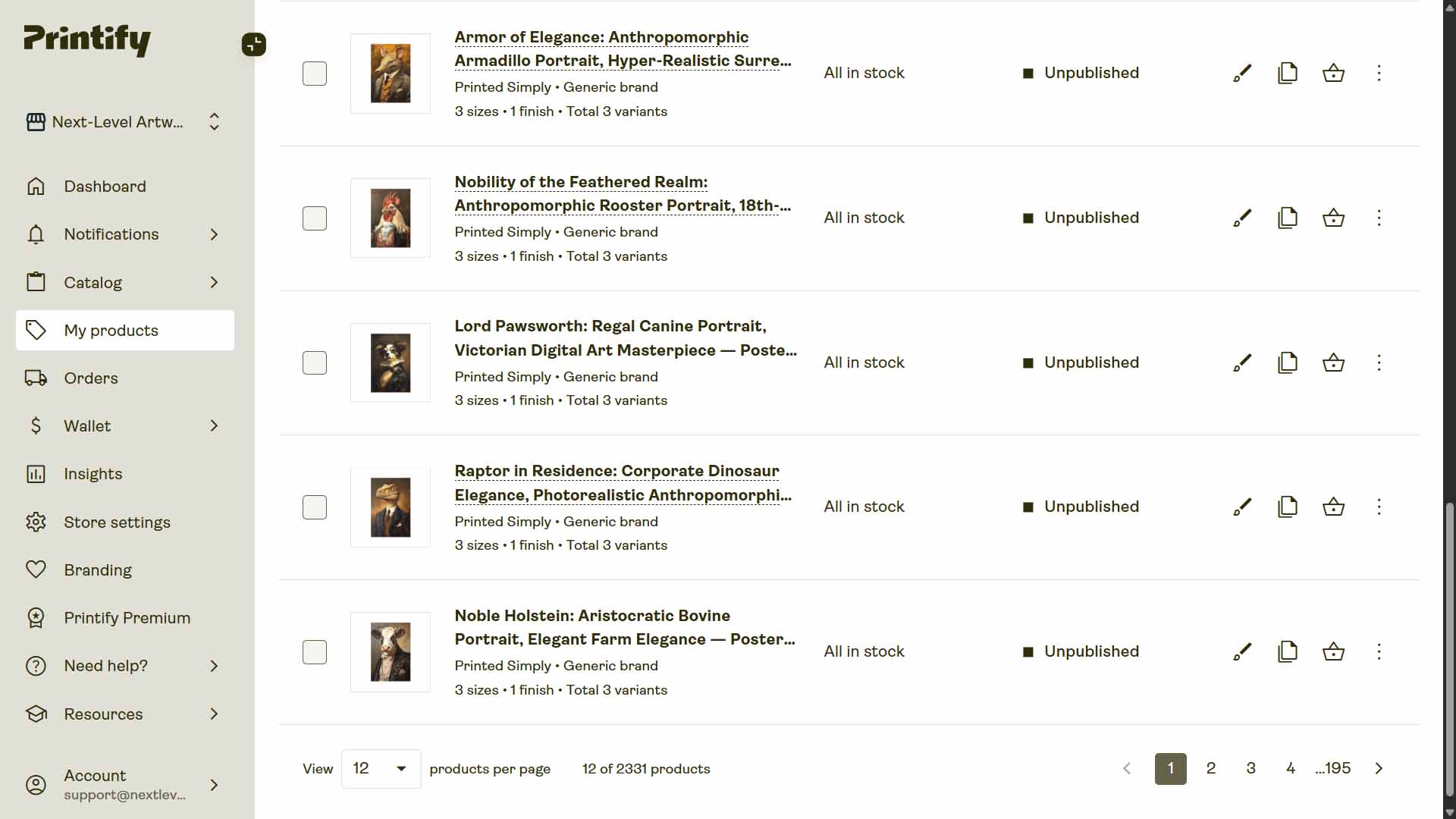
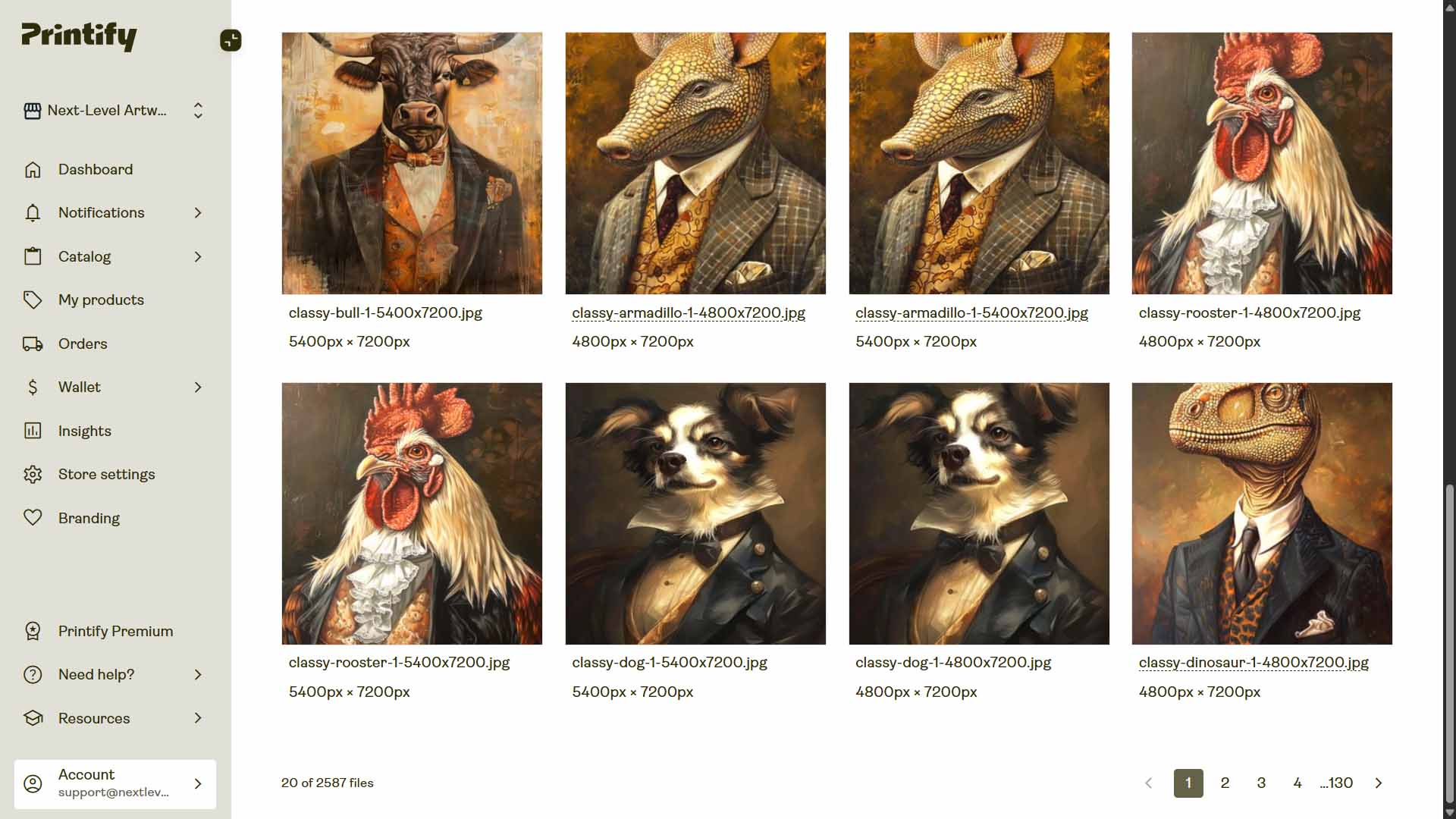
Even if you got all this working, it would be fragile and prone to breaking whenever a platform makes small interface changes. You’d spend more time debugging than you’d save.
In short: yes, it’s theoretically possible—but practically useless for any real business workflow.
That’s why the Bulk POD Product Creator takes a different approach. It doesn’t “click around” pretending to be a human; it works directly with official platform APIs (e.g., Printify). It maps and analyzes artwork images to generate AI-written, SEO-minded text and assembles complete listings without relying on brittle browser scripting. It’s the professional, scalable way to achieve what Agent Mode tries (and fails) to do.
Why This Is an Amateur-Hour Automation Attempt
Let’s paint a picture to show how unreasonable this setup really is.
Imagine Jeff Bezos sitting at a desk, with Amazon’s entire product pipeline hinging on a single laptop running ChatGPT Agent Mode. The AI is literally moving the mouse, clicking buttons, typing descriptions, and he’s shouting, “Nobody touch that laptop! It’s uploading our next batch of Amazon listings!”

That’s what using browser-controlled automation for your POD platform looks like.
It’s fragile, inefficient, and one small misclick away from chaos. This approach ties your operations to the quirks of a local browser—as if your e-commerce success depends on Chrome not freezing. It’s the opposite of what serious, scalable automation should be.
Business-grade automation doesn’t simulate human clicks. It uses official APIs—stable, secure, supported interfaces designed for programmatic control across platforms like Printify, Printful, Gooten, and Gelato.
That’s why tools like the Bulk POD Product Creator exist: to give you real automation without the amateur-hour fragility of browser bots.
Meet the Bulk POD Product Creator: The Smarter Way to Automate Printify SEO
If you’re serious about scaling your print-on-demand business, the Bulk POD Product Creator is the right way to do it.
Instead of making ChatGPT “pretend to be you” in a browser—clicking, typing, and hoping nothing breaks—this tool communicates through official platform APIs (e.g., Printify) to execute every command cleanly, securely, and reliably.
It’s not a hacky workaround. It’s real automation software that connects to your store, creates POD products on your behalf, and uses AI to handle the repetitive print-on-demand SEO tasks that used to consume hours.

In other words, it does exactly what you wish ChatGPT Agent Mode could do—but correctly, safely, and at scale across modern POD platforms.
Step 1 & 2: Upload Your Artwork and Select an Example Product
When setting up an operation, start by uploading your artwork batch and selecting an existing product from your POD platform account (e.g., Printify, Printful, Gooten, Gelato) to act as the Example Product.
This single product defines the structural settings your new listings will mirror—everything from variant selections and pricing to mockup orientation and print-area placement.
Here’s how these two steps work together:
- Upload your artwork files. Drop in your designs—whether ten files or a thousand. The tool automatically queues and prepares them for bulk generation, saving you from renaming, reordering, or organizing them manually.
- Select your Example Product. This tells the system exactly what kind of product you want to replicate. For example, if your Example Product is a black unisex T-shirt with a centered print area, every generated product will follow that blueprint—same print areas, variant settings, pricing, and placement alignment.


By pairing your artwork batch with a well-structured Example Product, you’re standardizing every output before it’s even created. That means consistent pricing, consistent mockup structure, and consistent listing quality across your catalog.
Why this matters for POD SEO:
Search engines reward predictability and structure. When listings follow a clean, standardized pattern, they’re easier for crawlers to interpret and rank. The Bulk POD Product Creator automates that consistency—something no brittle browser macro or ad-hoc agent can sustain across hundreds or thousands of listings.
Step 3: New Product Creation Rules—AI-Generated Titles, Descriptions & Tags
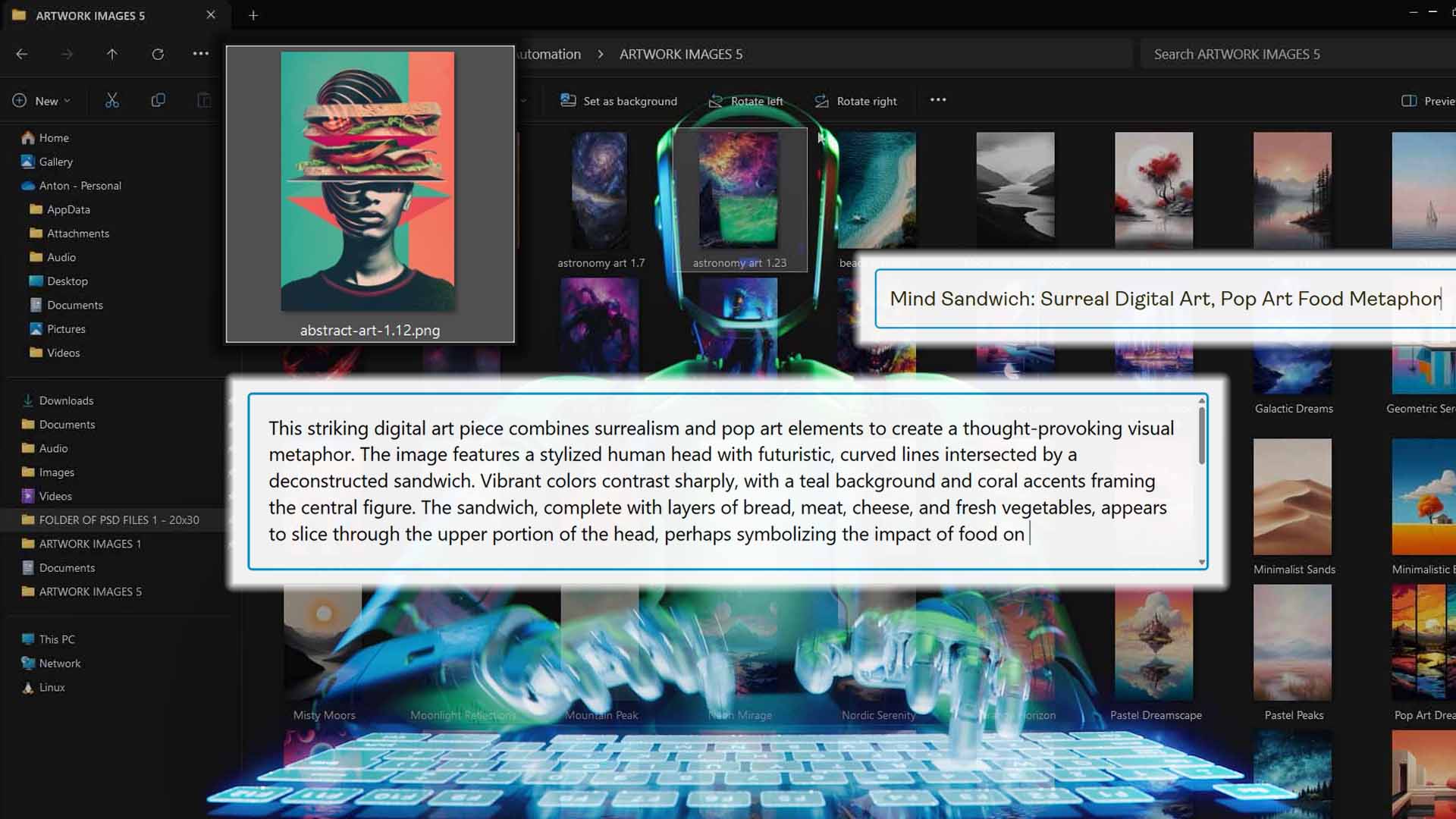
This is where the Bulk POD Product Creator truly shines. Step 3 is the heart of the interface—the SEO automation engine that uses AI to analyze each uploaded artwork image and generate titles, descriptions, and tags that actually make sense.

When you configure Step 3, you can define how your listings are written and standardized:
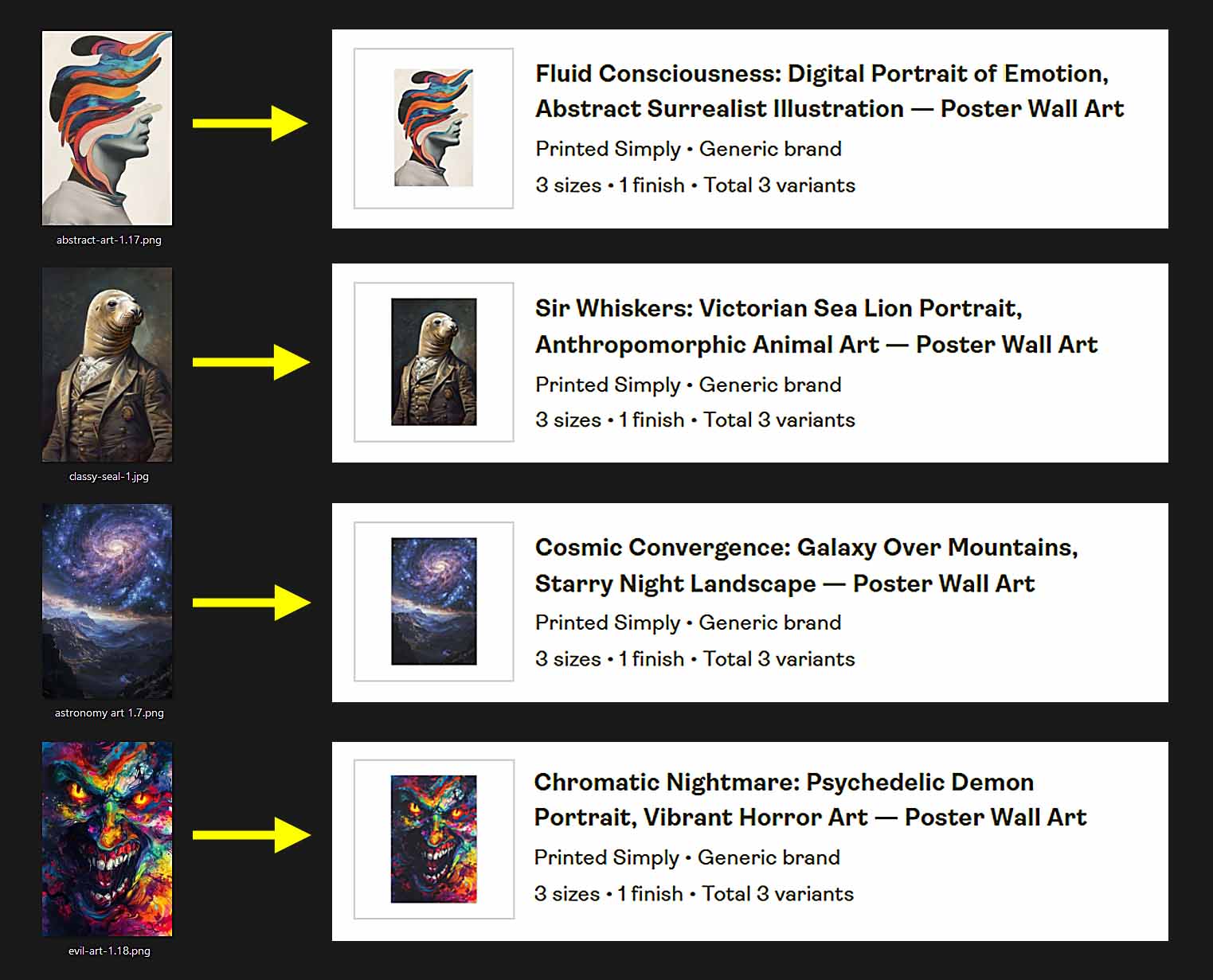
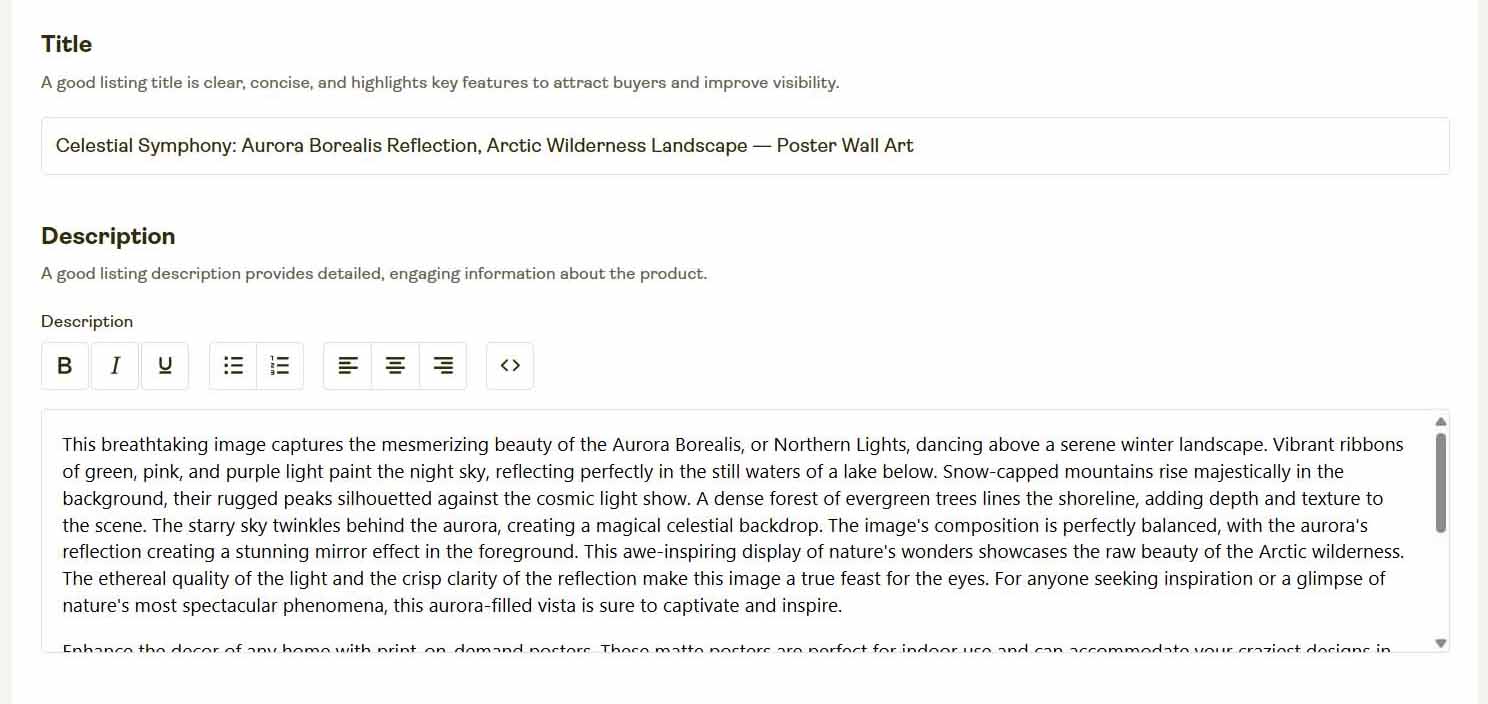
- Define your title format. Choose between Simple Titles (short, descriptive summaries) or Compound Titles (the AI-generated Simple Title plus a longer descriptive extension about the artwork). You can also add Custom Text prefixes or suffixes—for example, “—Canvas Wall Art”—to consistently append product-level context across listings.
- Generate AI-written product descriptions. The AI analyzes your uploaded artwork and produces well-structured, SEO-minded descriptions that capture the content and style of the artwork itself—without you manually brainstorming keywords or sentence flow.
- Create optimized tags automatically. The system outputs a set of relevant tags for each artwork, focusing purely on content descriptors—like “abstract landscape,” “minimalist flower,” or “retro typography”—so listings receive artwork-specific tags rather than generic duplicates.
- Standardize your outputs for maximum consistency. Every product generated under the same operation follows the same structural and stylistic conventions. This ensures your catalog reads coherently to customers and search engines, strengthening perceived professionalism and reinforcing predictable patterns that help with indexing.
Why this matters for POD SEO:
Step 3 removes the most tedious part of running a POD store—writing hundreds of listings by hand. Instead of typing titles and descriptions one by one, you define the logic once, click Run Operation, and the tool does the heavy lifting. You get accurate, artwork-aware AI text applied consistently across every product, in a fraction of the time.
This isn’t “ChatGPT inside your browser” guessing at what you need—it’s a tightly engineered system built to handle POD product creation intelligently, efficiently, and at scale.
Bulk POD Product Creator vs. ChatGPT Agent Mode: A Clear Winner
When you compare these two approaches side by side, it’s not even close. ChatGPT’s Agent Mode is an experimental tool that tries to simulate human actions inside a browser. The Bulk POD Product Creator is production-grade automation designed for modern POD workflows (including platforms like Printify, Printful, Gooten, and Gelato).
Here’s how they differ in practice:
- Execution Method: Agent Mode controls your browser like a human—clicking, typing, scrolling, and hoping nothing crashes mid-run. The Bulk POD Product Creator, by contrast, interacts directly with official platform APIs (e.g., Printify), executing actions programmatically and reliably every time.
- Stability: One minor layout change, a surprise modal, or a brief lag can derail Agent Mode completely. The Bulk POD Product Creator is resilient because it’s built on structured API requests, not fragile UI mimicry.
- Speed: Browser automation moves at human speed—one page load at a time. API-based automation runs rapidly, generating and optimizing POD listings in bulk while you focus on higher-value work.
- Scalability: Agent Mode struggles beyond small batches. The Bulk POD Product Creator is engineered for large-scale operations—stable, repeatable, and ready to handle entire product sets.
- Workflow Quality: Agent Mode can’t enforce consistent naming conventions or SEO patterns because it lacks built-in logic to standardize formatting. The Bulk POD Product Creator defines unified SEO structures for all listings, creating cohesion and predictability across your catalog.
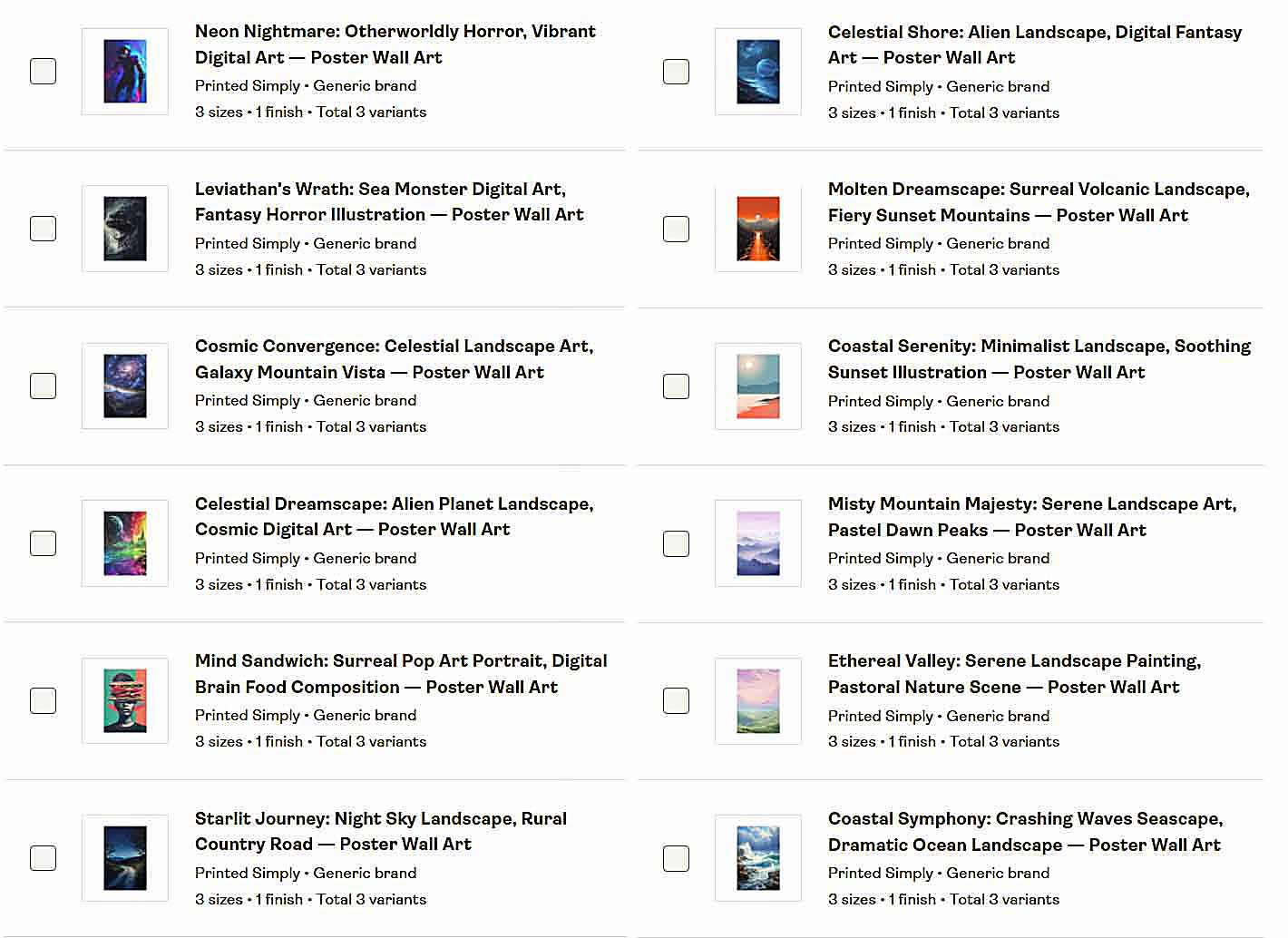
In short, Agent Mode imitates the work—our tool actually does the work.
Are the AI-Generated Titles, Descriptions & Tags Any Good?
Yes—they’re genuinely impressive.
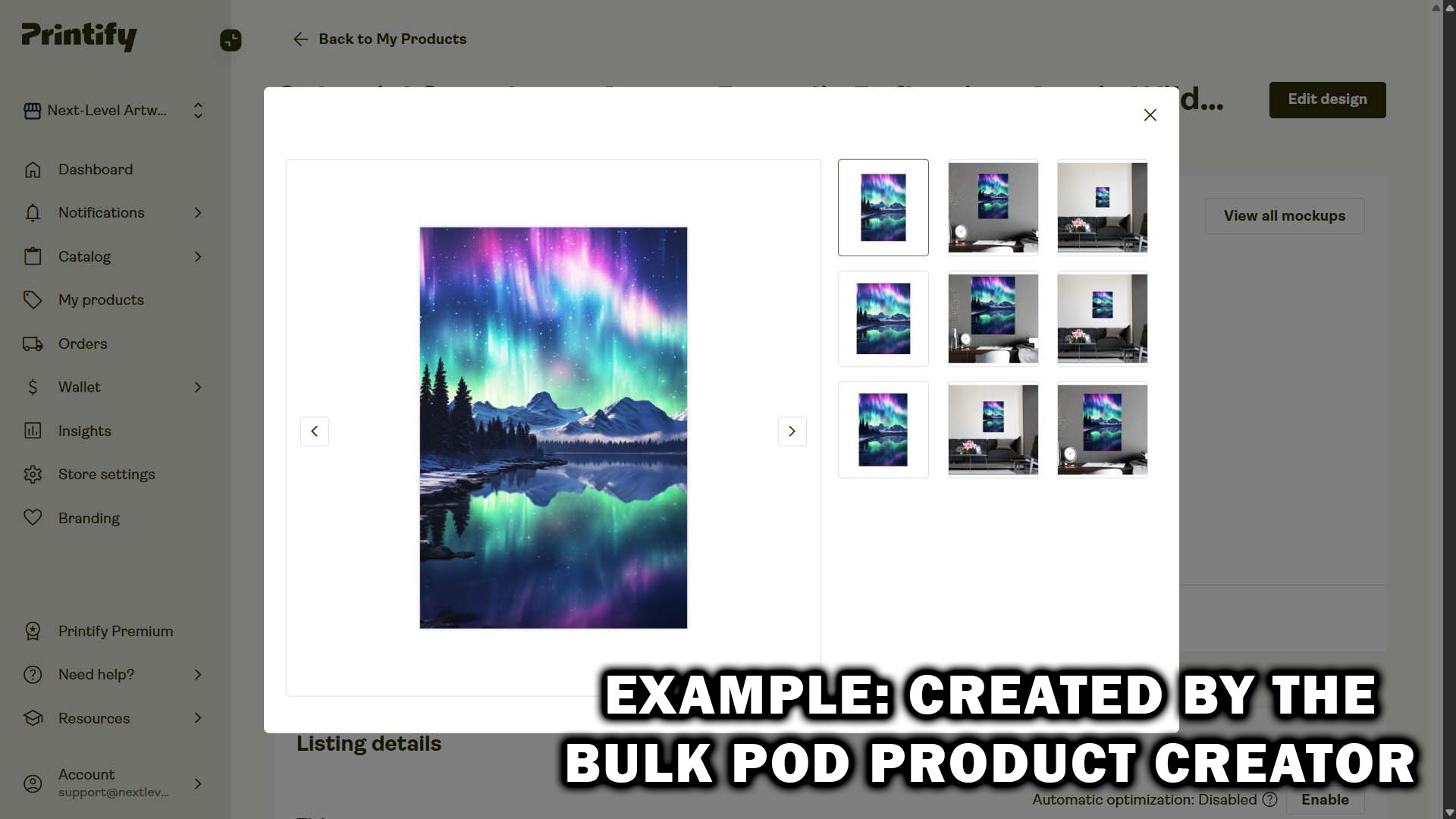
The AI system powering the Bulk POD Product Creator doesn’t just “guess” at keywords. It uses vision-driven analysis to understand what’s actually depicted in your uploaded artwork.
Here’s how that works in practice:
- Visual understanding of the artwork itself. Each uploaded image is analyzed to determine its core subject matter, visual style, and key descriptive traits. The model surfaces whether the artwork features objects, patterns, text elements, or themes like nature, space, abstract forms, quotes, animals, or people.
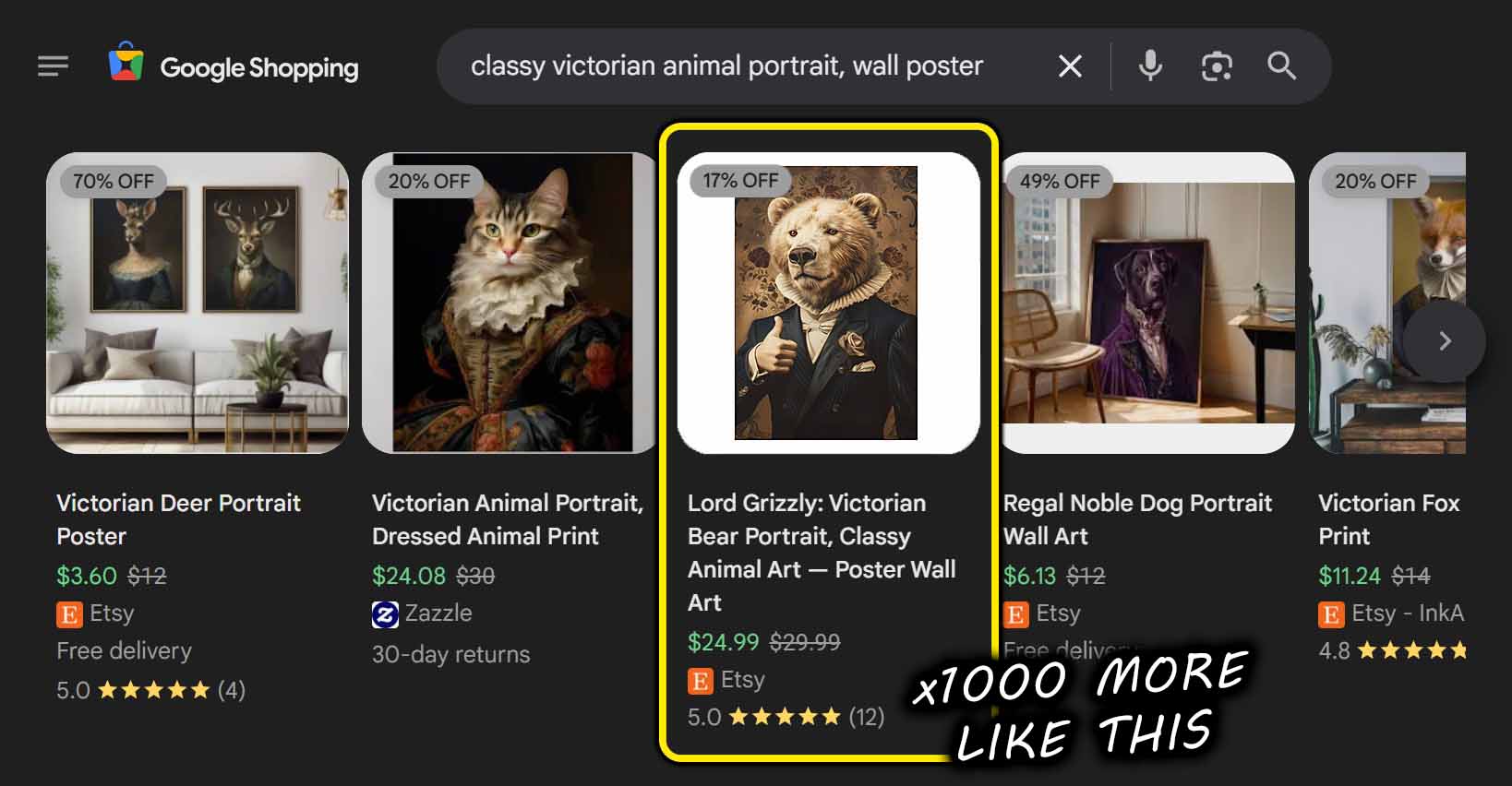
- Contextually accurate text generation. From that understanding, the AI writes SEO-minded titles, descriptions, and tags that describe the artwork itself. For example, if your image is a minimalist mountain silhouette, the output might be “Minimalist Mountain Landscape—Black & White Nature Art” rather than something generic like “Beautiful Design for Print-on-Demand.”
- Thoughtful handling of text-based designs. When the artwork visibly includes words (e.g., quote designs, typographic posters), the system can incorporate legible text cues into the phrasing and tag set—mirroring what a careful human writer would do, but far faster and with consistent formatting.
- Scalable consistency at human-level quality. Because the same structured logic is applied across your full artwork batch, outputs stay creative yet standardized. Tone, format, and keyword emphasis remain consistent across the store—something that’s hard to maintain manually at scale.
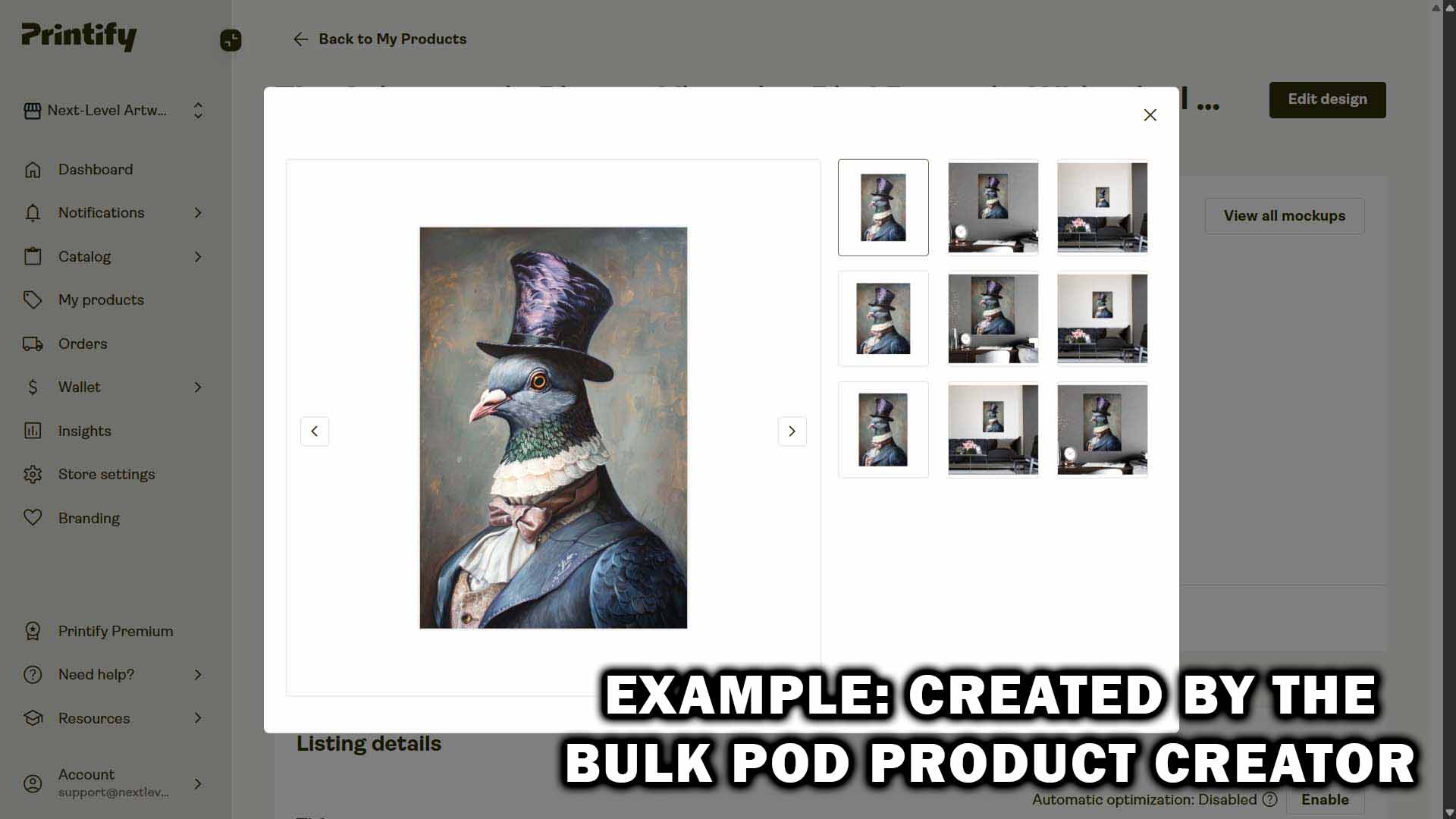
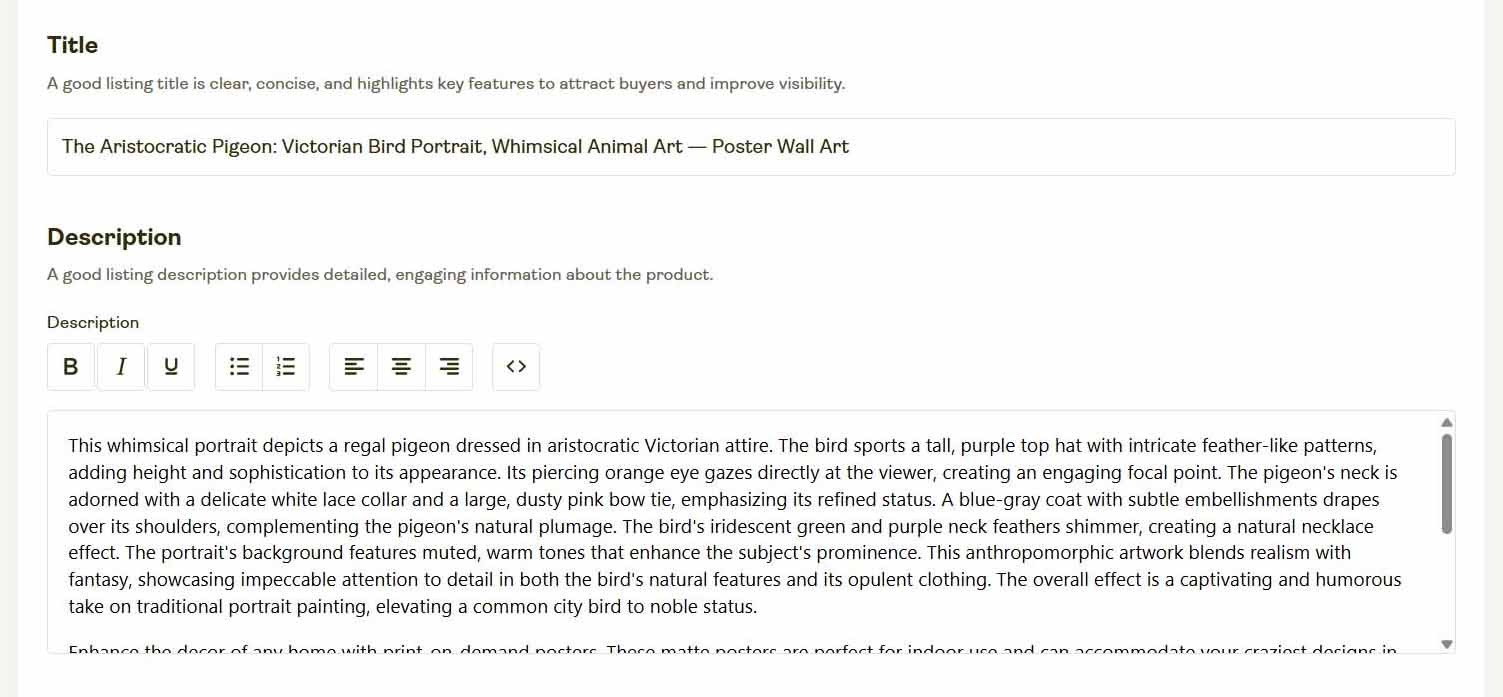
Simply put: combining artwork-aware AI with API-based automation delivers precision and scale that manual workflows can’t match.
Conclusion: The Smart Way to Automate POD SEO
Trying to use ChatGPT Agent Mode to manage listings is like trying to run a modern factory by moving the robotic arms manually. It’s a fun experiment—until it breaks, stalls, or wastes your time.
The Bulk POD Product Creator is the practical solution. It’s fast, stable, and purpose-built for print-on-demand sellers who want to stop grinding out listings by hand and start scaling efficiently. It connects to your store via official platform APIs (e.g., Printify), automates product creation, and uses AI to handle artwork-aware SEO—no browser scripts, no fragile automations, no wasted motion.
If your goal is to grow your POD business while freeing yourself from repetitive busywork, this is how you do it—by automating the right way, with the right tool.