Bulk Shopify POD Product Title/Description/Tag Writer Tool: Use AI To SEO-Optimize Your Listings Automatically
Overview: Discover how the Bulk POD Product Creator automates the writing of SEO-optimized titles, descriptions, and tags for Shopify print-on-demand products, enabling you to scale your store with hundreds of high-quality, search-ready listings—without manual effort.
Writing Titles, Descriptions, and Tags for All Your POD Products Is Boring. So Have AI Do It for You.
Let’s be honest—writing titles, descriptions, and tags for every single print-on-demand product is not creative work. It’s monotonous data entry with a light dusting of copywriting. It’s the same structure, the same thought process, over and over—only slightly rewritten to describe a new artwork image.
That’s not what most creators signed up for. You didn’t get into print-on-demand because you wanted to write 600 descriptions of “minimalist abstract landscape art.” You did it because you love creating, curating, and experimenting—because you want to build something that scales.
But scaling manually is impossible. Even the most dedicated sellers hit a wall: there are simply not enough hours in a week to do this kind of work at the level of thoroughness required to make it SEO-effective. That’s where automation comes in.
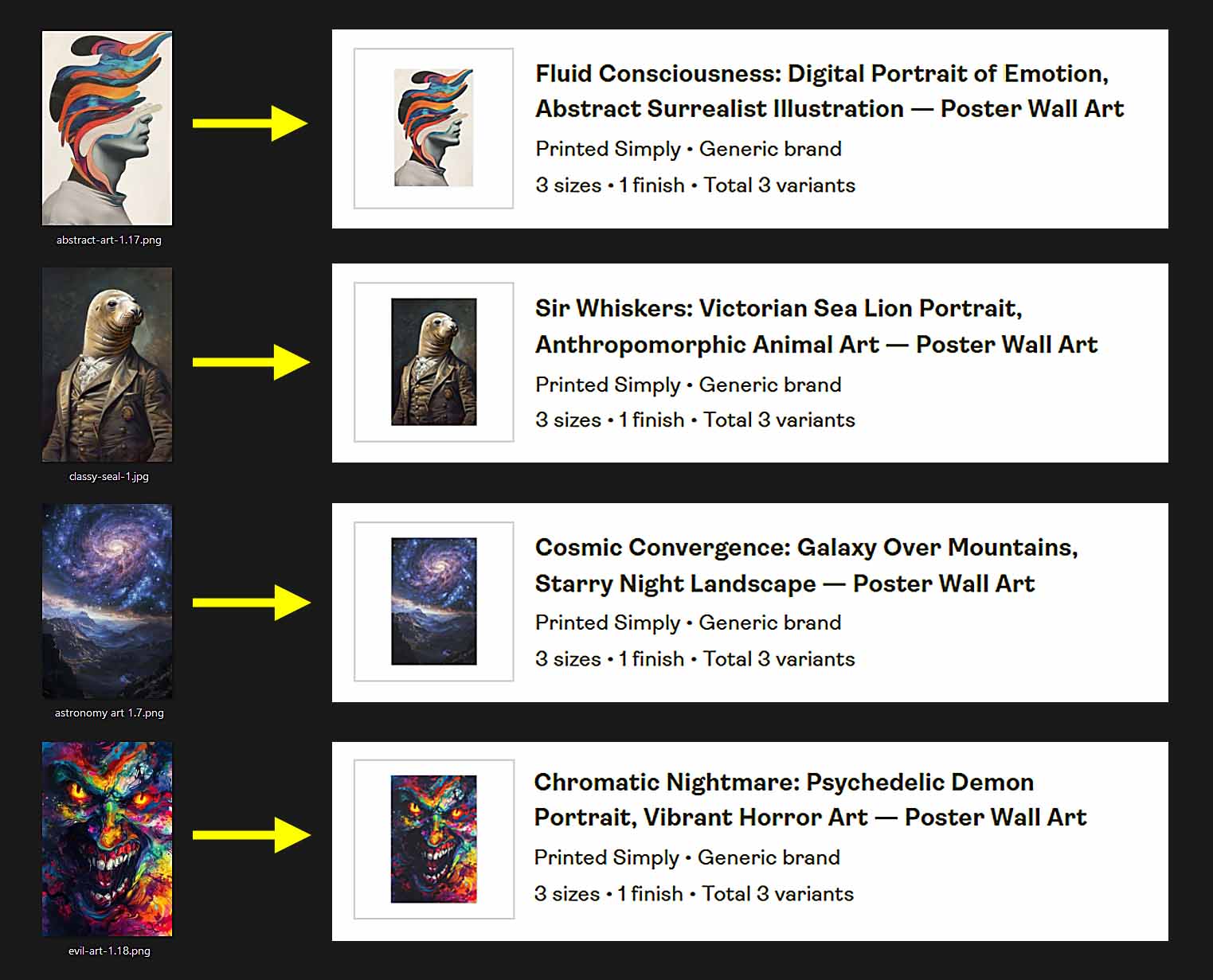
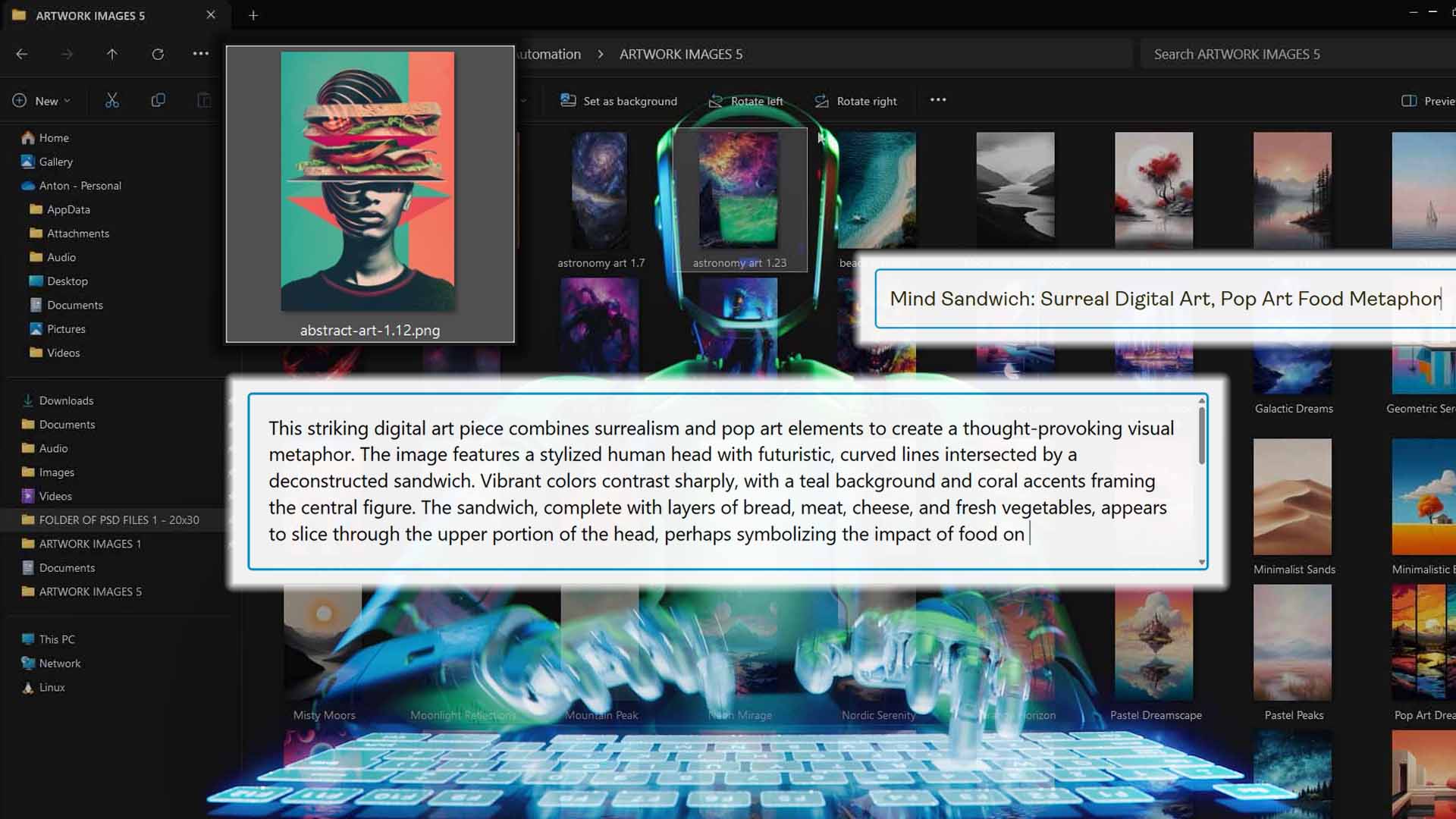
The Bulk POD Product Creator eliminates this bottleneck by automating the writing process entirely. It uses AI image recognition to analyze your artwork, then writes high-quality, SEO-optimized titles, descriptions, and tags for each POD product in bulk—all automatically. You no longer need to sit there typing, editing, and keyword-stuffing. The software does it for you.
The result:
- Hundreds of professionally written, search-ready product listings.
- Consistent quality and formatting across your entire store.
- Hours (or days) of work reclaimed instantly.
This is how serious Shopify POD sellers scale—by letting automation handle the tedious parts, so they can focus on creating, testing, and growing.
Accept That You Simply Cannot Compete Against AI + Automation. Embrace It Instead.
There’s no shame in admitting it: you cannot beat automation at this. No one can. Not even a full-time team of professional writers. And that’s not a bad thing—it’s liberation.
This kind of technology doesn’t replace your creativity; it amplifies it. It takes the repetitive, boring, grind-heavy work that drains your energy and turns it into a one-click background process. Let’s break down why that’s not only efficient—it’s the future.
1. The AI Knows More Than You Do (and That’s Okay)
It’s not humanly possible to memorize thousands of stylistic and descriptive terms for every imaginable art style, medium, and composition type. The AI, on the other hand, has linguistic reach across every corner of art and design terminology.
It understands when to describe something as “surreal dreamscape” versus “expressionist landscape.” It picks the right adjectives—“ethereal,” “vibrant,” “geometric,” “painterly”—without repeating the same few you’d naturally default to after product #40.
Why this matters: This richer, more precise language aligns perfectly with real search queries. When your titles and descriptions use the exact words buyers search for, you start ranking for those long-tail terms automatically. More visibility, more impressions, more organic traffic—all because the AI writes in the exact vocabulary your buyers use.

2. The AI Is Faster—Mathematically Faster
Let’s say you’re superhumanly fast and can write a strong SEO title, description, and tag set in five minutes. That’s 12 products an hour. A 600-product collection would take you 50 hours of uninterrupted work—and that’s before formatting, proofreading, or uploading.
The AI can generate those same 600 sets automatically. It doesn’t rest, it doesn’t procrastinate, and it doesn’t make copy-paste mistakes. You simply select your images, define your parameters, and click Run.
Why this matters: Because every product you create is another SEO landing page. The more you publish, the more keywords your store ranks for, and the more chances you have to get discovered by buyers searching for exactly what you sell. You can’t out-write or out-scale that—the math simply doesn’t work in your favor.
3. The AI Never Gets Tired, Bored, or Lazy
Here’s the brutal truth: by the time you’re writing description #273, you’re not “crafting” anymore—you’re surviving. Your brain’s on autopilot, your attention span is shot, and the quality plummets. You start copy-pasting, paraphrasing, skipping tags—anything to reach the finish line faster.
The AI doesn’t do that. Every single description, every single title, every single tag set gets the same maximum-effort treatment. It never cuts corners, never gets sloppy, and never phones it in.
Why this matters: Consistency across hundreds of listings leads to stronger SEO signals. When every page of your store has complete metadata, proper keyword coverage, and clean structure, it compounds. Search engines crawl it faster, index it better, and rank it higher. Meanwhile, your human-written competitors have 20 solid listings and 80 filler ones dragging down their averages.

4. The Bigger Picture: This Frees You Up for What Actually Matters
No one enjoys writing product description #723. No one. It’s soul-numbing busywork that doesn’t build real value beyond getting it done.
By offloading this to automation, you can redirect your mental energy to what actually grows your business:
- Researching trends and profitable niches.
- Designing better artwork and product lines.
- Improving your store layout and conversion funnel.
- Running smarter ad campaigns and testing creatives.
- Building your brand’s identity and loyal audience.
This is the power shift AI automation brings. You stop wasting creative bandwidth on repetitive, low-value tasks—and start using that energy on the work that multiplies your income.
How To Use This Tool To Automatically Create SEO-Optimized POD Product Listings
Now that you understand why AI + automation wins, let’s walk through how to actually use the tool to generate SEO-optimized listings in bulk.
Step 1: Select the Artwork Images You Want to Turn Into Products
Start by uploading or selecting the folder of artwork images you want the tool to process. Each image represents a potential new product—whether that’s a print, poster, t-shirt, canvas, or other POD item.

You can select dozens, hundreds, or even thousands of images in a single batch. The more you include, the greater the compounding effect once the operation runs—every image will become a unique product page with its own SEO-optimized title, description, and tags.
Step 2: Choose Your Example Product
Next, point the tool to one of your existing Shopify products—your Example Product. This acts as the “blueprint” for the new ones being created.

Whatever variants, prices, and print settings are attached to this Example Product (say, different poster sizes or apparel colors), the tool will automatically replicate them across every new product it generates.
So if your Example Product has eight size variants and a specific pricing structure, all the new ones will inherit those exact configurations—perfectly consistent, automatically standardized, zero manual setup required.
Step 3: Configure Titles, Descriptions, and Tags
This is where the print-on-demand SEO automation magic happens.
Once your Example Product is set, you’ll configure how the tool should generate the titles, descriptions, and tags for each of the products created during the operation. The tool gives you full control, while automating the bulk of the work.
Titles — Use AI or Your Existing Filenames
You have two core options here:
- Use image filenames as titles. Useful if you already have neatly named files (e.g., “Vintage Sunset Landscape.jpg”) or if you’re generating them programmatically. The tool will use those filenames as the base product titles for each image.
- Use AI-generated titles. Here, the AI examines the artwork image itself and generates a title automatically.
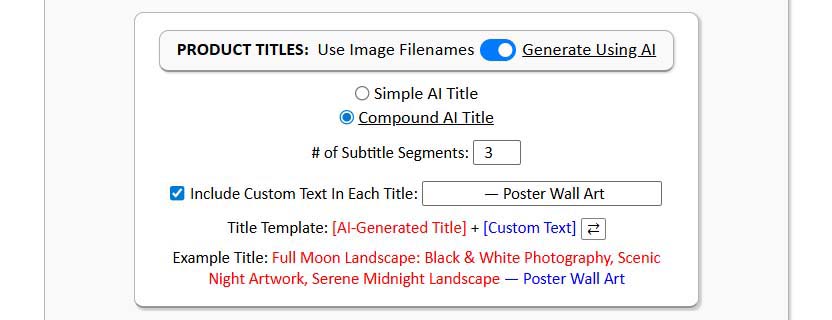
The AI can generate either of these:
- Simple titles — concise, artwork-only phrasing such as “Abstract Ocean Horizon.”
- Compound titles — a descriptive extension added by the AI for better keyword reach, e.g., “Abstract Ocean Horizon: Minimalist Blue Seascape Artwork.”
Either way, you can add your own custom prefix or suffix—for example, “— Premium Wall Art Print” or “— Framed Canvas Collection”—ensuring your branding or product-level context gets appended consistently across every listing.
Descriptions — AI-Powered and Extensible
The AI creates the product descriptions for you by analyzing the visual characteristics of each artwork. It describes what’s actually in the image—composition, mood, color, style, subject—in human-readable, naturally flowing text that’s keyword-rich but not keyword-stuffed.

You can optionally append or prepend your own custom HTML to every description. This lets you include standardized product information blocks like sizing, materials, or print specifications.
Example of appended HTML block:
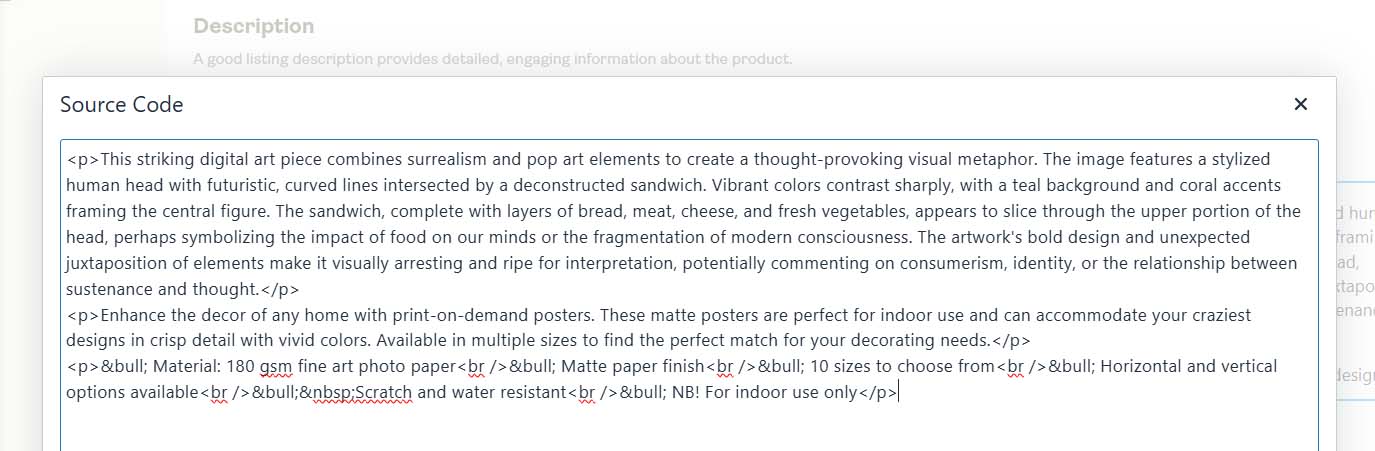
Appending content like this ensures your listings remain consistent, professional, and informative—while the AI handles all the unique, artwork-specific writing for you.
Tags — For SEO and Smart Shopify Collection Grouping
Finally, the AI generates a diverse set of relevant tags for each product. These tags are drawn directly from the artwork content—for instance, “space,” “astronaut,” “neon city,” “digital art,” “retro synthwave,” etc.
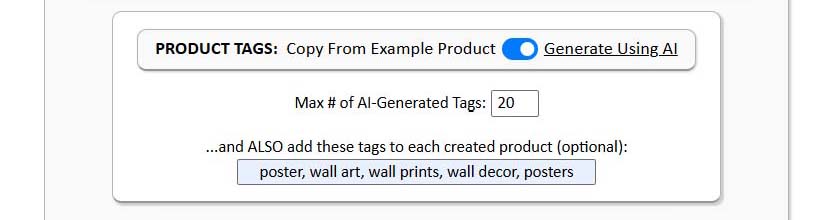
You can also add your own custom tags that automatically bucket products into Shopify’s tag-based collections. This feature is huge for workflow efficiency:
- If you create a batch of “floral abstract” artworks, you can include a tag like
"floral collection", and all of those products will instantly fall into your “Floral Abstract Art” collection in Shopify—no manual selection required.
The combination of AI-generated and custom tags gives you both precise SEO keyword coverage and automated storefront organization.
Step 4: Run the Operation to Generate SEO-Optimized POD Products In Bulk
Once all your configuration steps are complete—artwork selected, Example Product defined, and AI generation settings finalized—it’s time to launch the operation. This is where everything comes together: automation, AI, and your predefined rules.
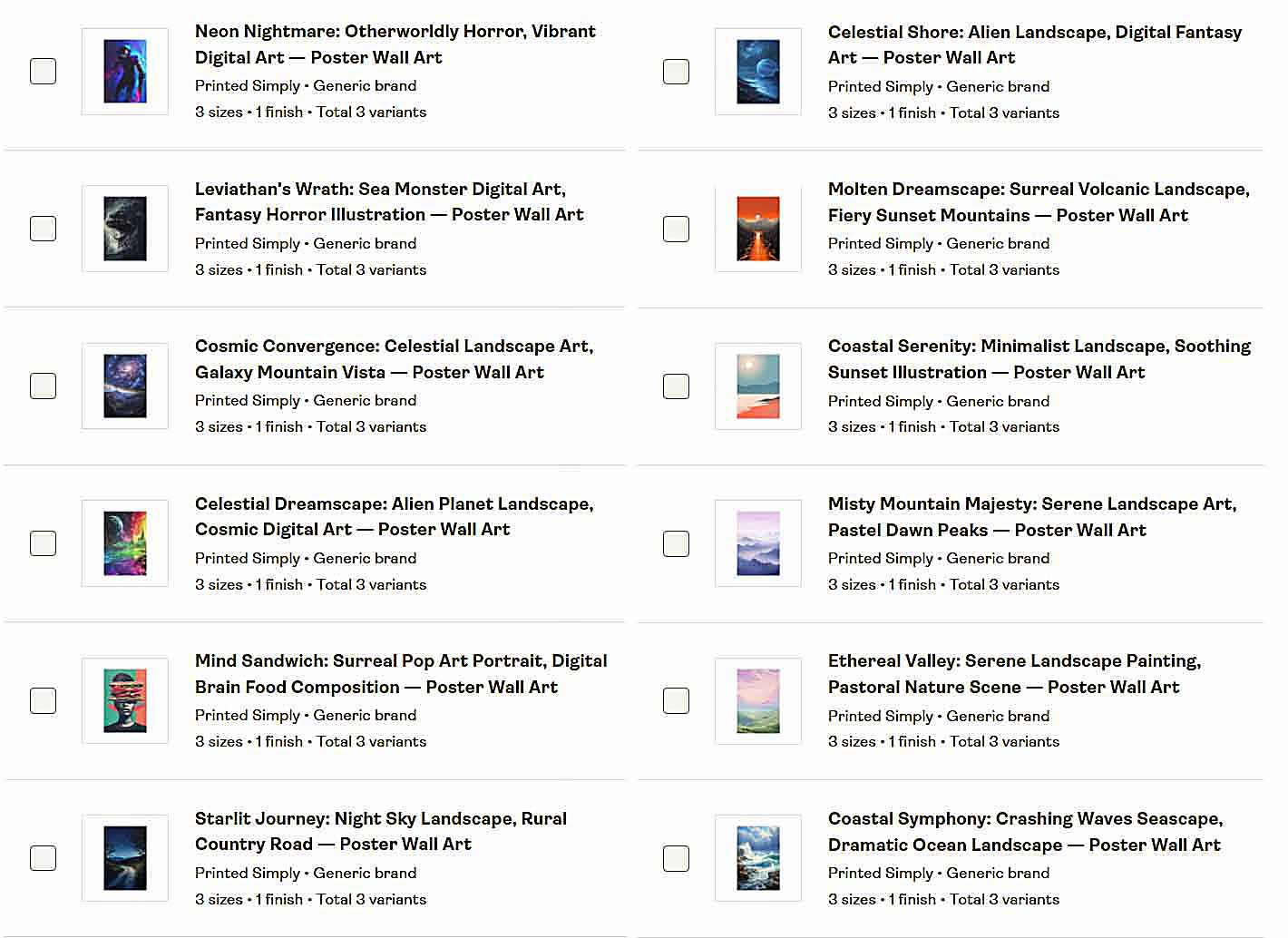
When you click Create My Products, the system begins processing your batch automatically. Each artwork image is paired with your Example Product’s configuration, and the AI immediately generates its SEO-optimized title, description, and tags.
- Every new product is created directly on your POD provider’s backend, fully synced for automated fulfillment through Shopify.
- Variants, prices, and print-area placements are cloned perfectly from your Example Product.
- Each listing includes unique AI-written metadata that reflects the image’s actual subject, color palette, and tone.

With a single button click, you’ll have a complete batch of new, SEO-ready Shopify print-on-demand listings—each one fully configured, keyword-rich, and visually consistent with your brand. No spreadsheets, no manual uploads, and no repetitive editing—just instant, automated scalability.
How This AI Automation Tool Brings More Search Traffic to Your POD Products
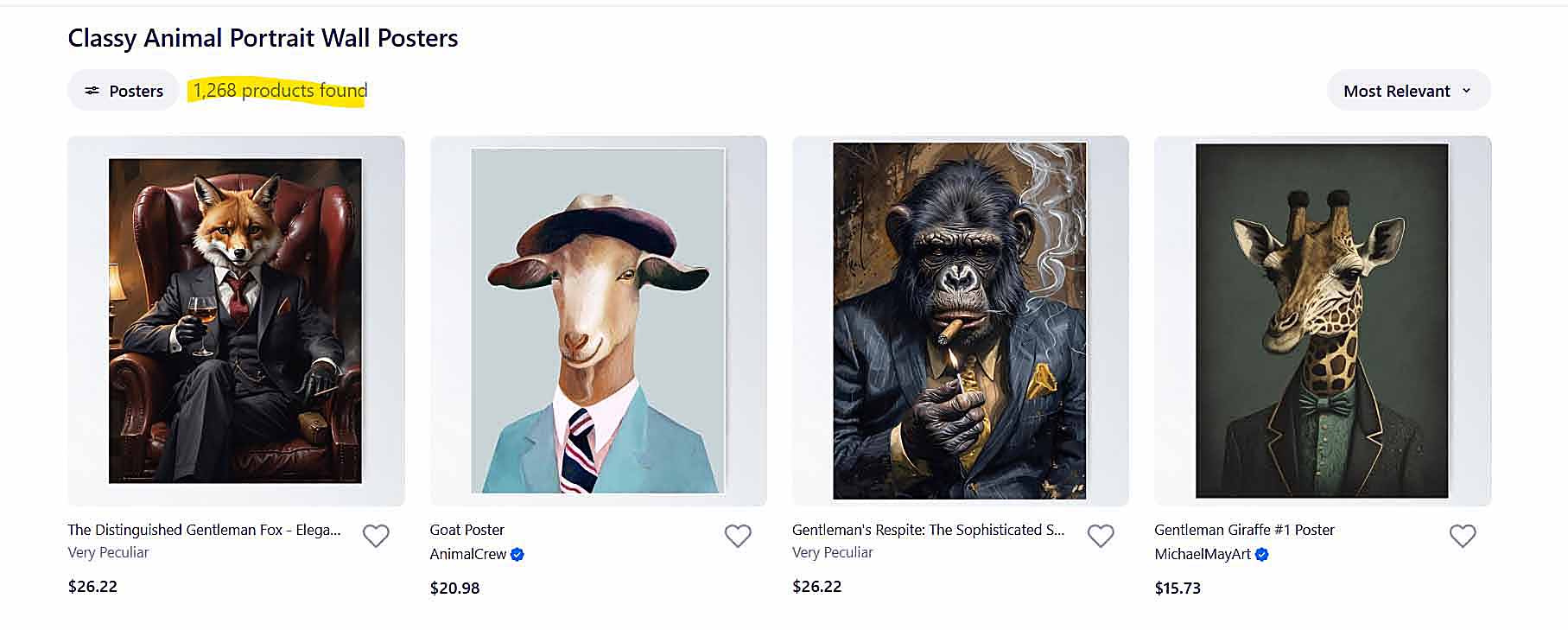
When you use this tool, you’re not just creating listings—you’re creating hundreds of unique landing pages, each one SEO-optimized for a distinct artwork and keyword profile. This structure has enormous traffic implications for your Shopify store.
1. Every Product Becomes a Search Entry Point
Each unique title, description, and tag combination produces a different set of long-tail keyword targets.
Instead of competing with yourself by publishing 50 nearly identical listings, you’re creating a semantic web of distinct content pieces—each optimized for slightly different but related searches.
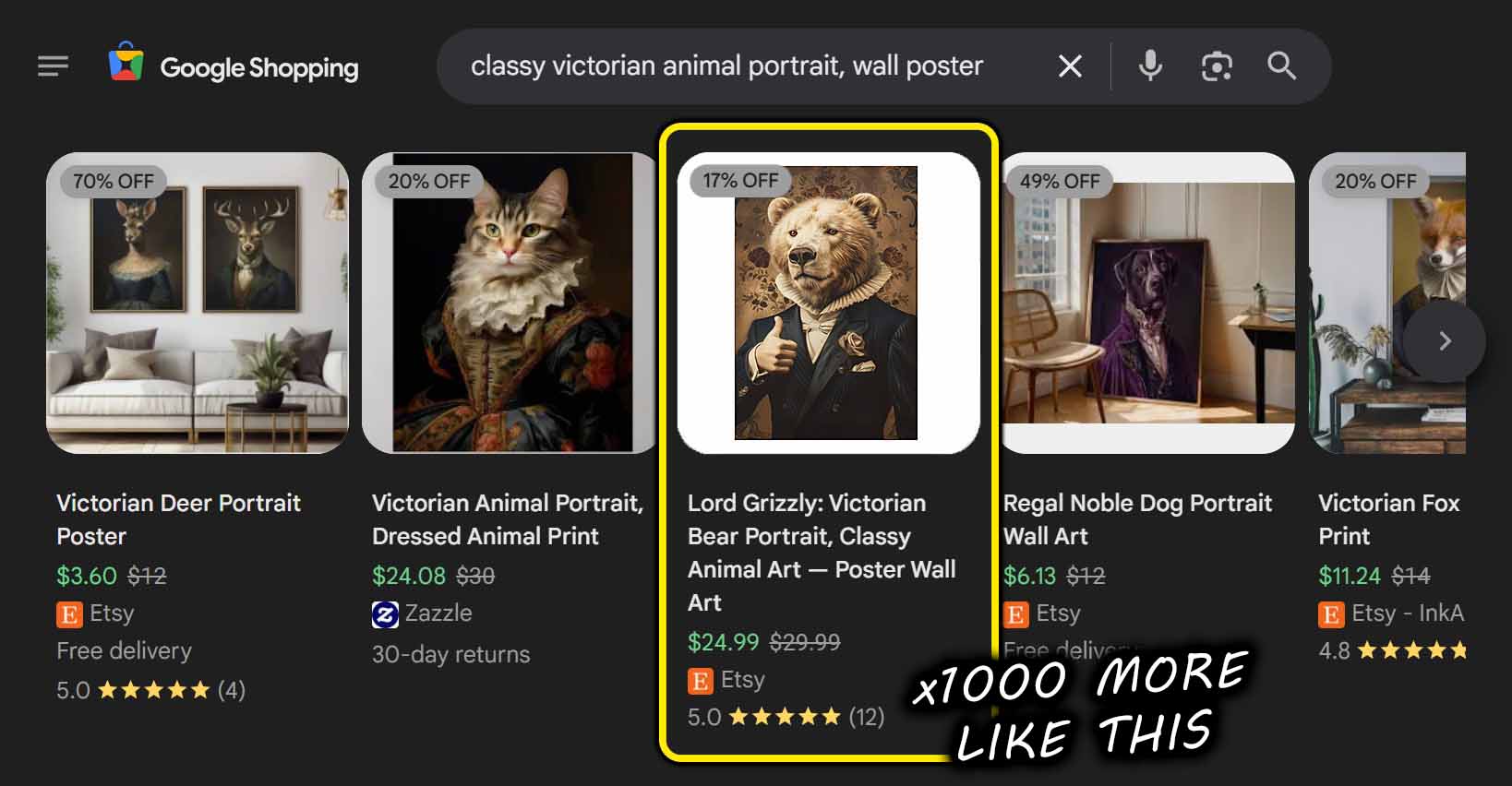
This dramatically increases your store’s total keyword footprint. The more products you publish, the more search queries you can appear for across Google and Shopify’s internal search systems.
2. Compounding SEO Momentum Over Time
Search engines reward large, active catalogs that continuously add fresh, high-quality content.
Because this tool lets you produce hundreds of SEO-optimized listings with consistent structure and meaningful variation, you naturally trigger ongoing indexing and ranking signals.
Each new batch of products further strengthens your site’s topical authority in the eyes of search algorithms—compounding your organic traffic over time, without you doing any manual SEO labor.
3. Higher User Engagement and Conversion Rates
More listings don’t just mean more impressions—they also mean longer average session durations and higher conversion rates.
Visitors stay longer when they can explore many products within the style or theme that initially caught their interest. They’re more likely to find something that feels “perfect,” which increases both purchase likelihood and average order value.
AI-optimized copy also helps here—rich, descriptive language instills buyer confidence by accurately describing what they’re getting, reducing bounce rates and returns.
4. Freed-Up Time = Higher ROI
The final SEO benefit isn’t technical—it’s operational.
Because you’re not burning time on repetitive writing or product setup, you can redirect that time to higher-value marketing work:
- Studying analytics to refine which collections perform best.
- Launching ad campaigns for top-performing designs.
- Improving product photography and store UX.
- Producing new designs that expand your catalog even further.
The time saved compounds just like your traffic—fueling a virtuous cycle of productivity, creativity, and growth.
Conclusion — Let Automation Do the Heavy Lifting
At the end of the day, your creative energy should go toward creating—not copywriting the 400th variation of “abstract minimalist wall art.”
The Bulk POD Product Creator lets you offload that grind completely. It analyzes your artwork, writes the SEO-rich titles, descriptions, and tags, and populates your Shopify store with ready-to-publish products—each one a new doorway for organic traffic.
This is the future of print-on-demand at scale: AI-driven efficiency, SEO-first automation, and unlimited creative throughput.
Stop doing boring work manually.
Start scaling intelligently—and let automation turn your ideas into hundreds of optimized, high-ranking Shopify listings.