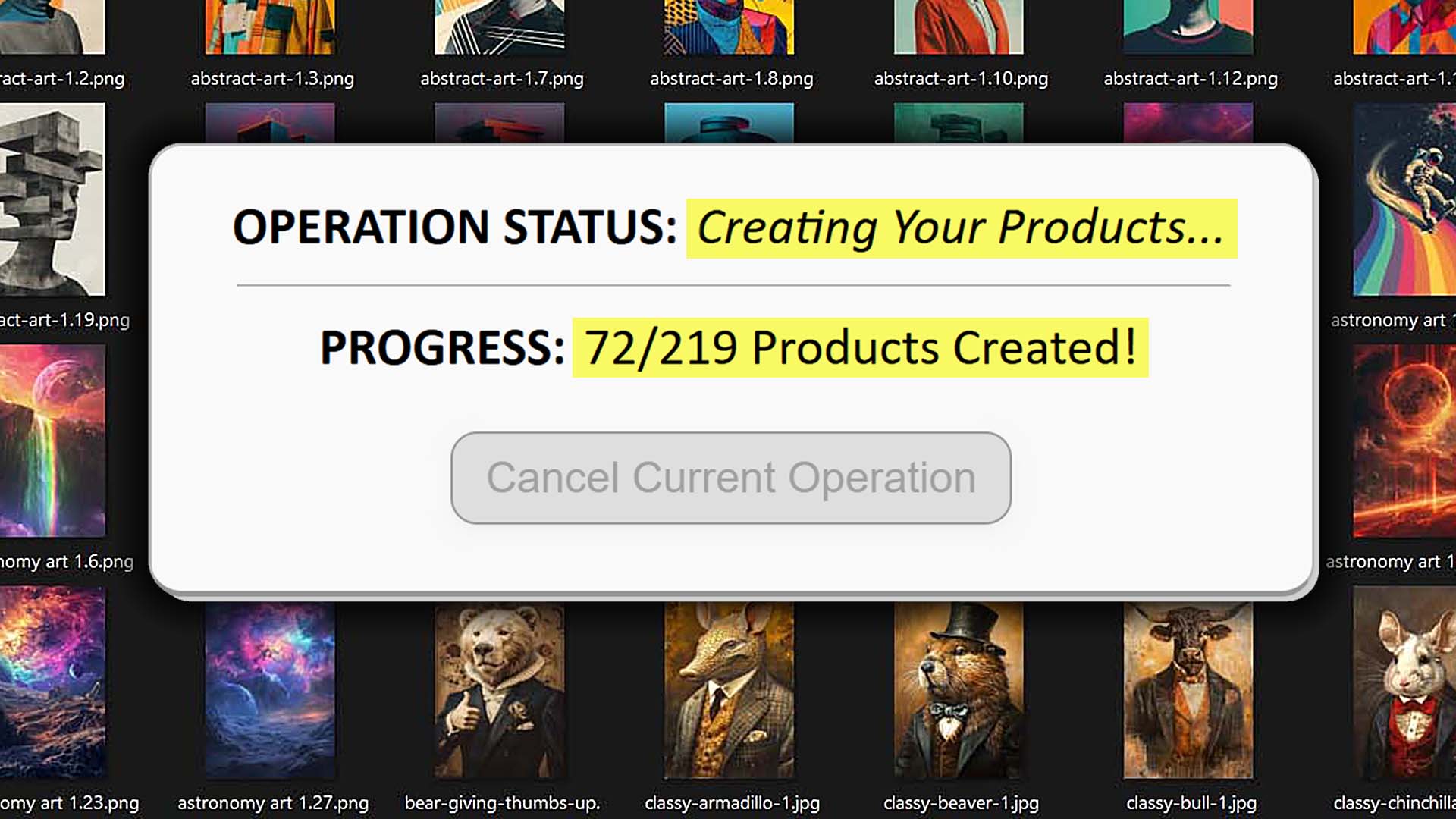
Automated Shopify POD Product SEO-Optimization Tool: Boost Organic Traffic From Search Engines With AI
Overview: Learn how the Bulk POD Product Creator uses AI-powered automation to generate SEO-optimized Shopify print-on-demand product listings at scale, boosting organic traffic and streamlining your workflow for maximum search visibility and sales.
Wouldn’t It Be Cool If You Could Automatically SEO-Optimize Your POD Products? (You Can.)
Every print-on-demand seller knows that visibility drives sales—but achieving it through SEO is exhausting.
Writing keyword-rich titles, crafting descriptive product copy, and tagging listings correctly takes hours per batch. Multiply that by hundreds or thousands of products, and you’re facing a workload that feels impossible for one person to sustain.
That’s the problem automation now solves.
With the right system in place, you can automatically generate SEO-optimized listings for your print-on-demand products—at scale. The days of typing repetitive copy line by line are over. Modern AI can analyze your artwork, understand what it depicts, and instantly produce accurate, search-optimized text that helps your products rank higher, faster.
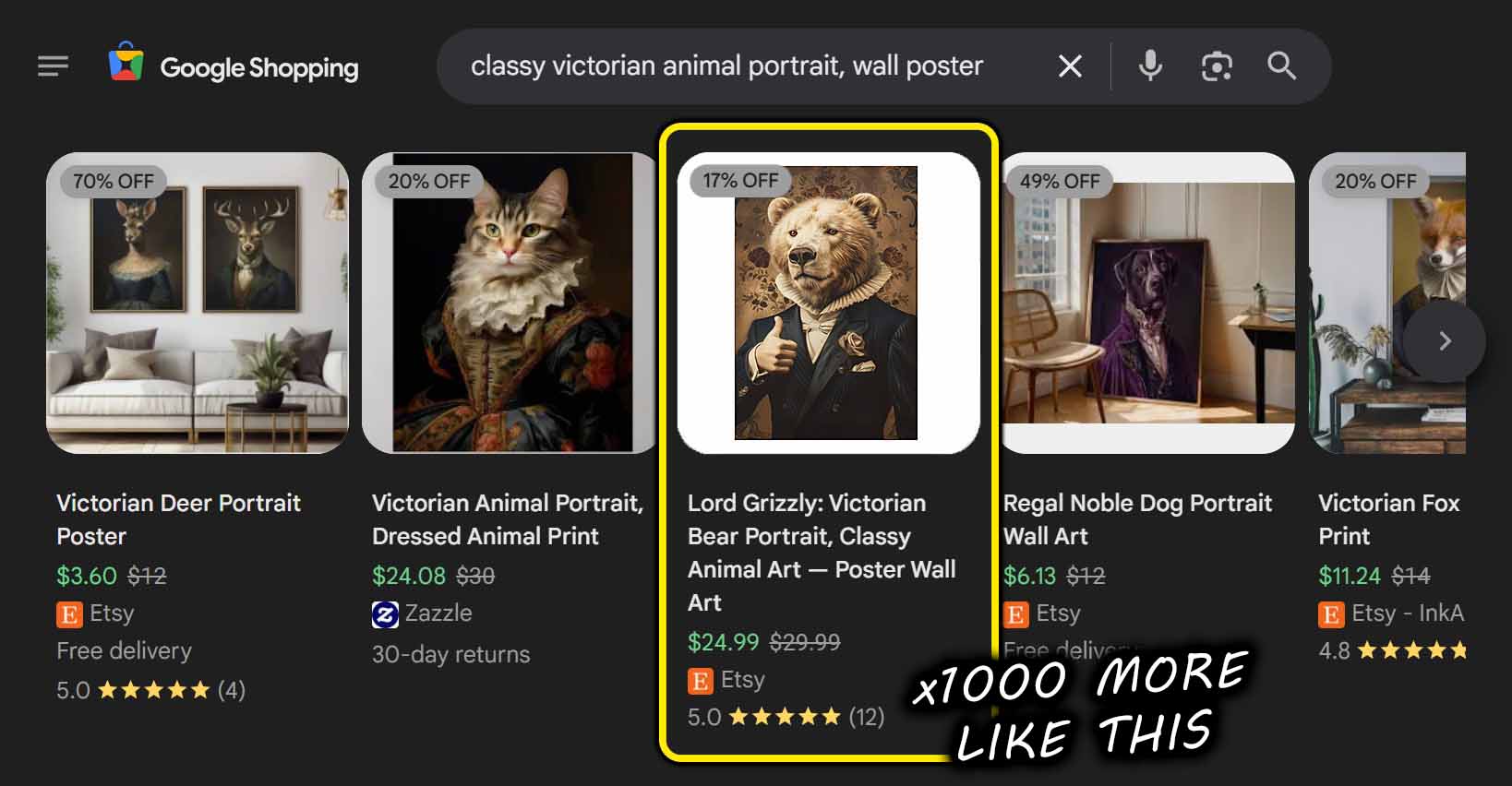
What once took days of tedious effort can now happen while you focus on something that actually moves your business forward—designing, strategizing, and selling.
How SEO Works for Shopify Print-on-Demand Products
To appreciate how automation changes the game, it’s worth understanding the mechanics of SEO for Shopify POD stores.
Search engines—whether Google, Bing, or Shopify’s own internal search—rely on structured, textual signals to determine what your product pages are about and who should see them.
If your listings lack those signals, they may as well be invisible.
Below are the foundational elements that shape how your Shopify POD products get discovered, ranked, and clicked.
1. Product Titles: Your Front-Line Ranking Signal
A well-written product title tells both humans and search algorithms exactly what the product represents. Titles influence:
- Keyword relevance—whether your listing matches a user’s query.
- Click-through rate—whether shoppers actually click it once they see it.

An effective title integrates descriptive language that reflects both the visual content of the artwork and the search terms buyers use. For example, a strong title captures what the artwork depicts (“vintage coastal landscape”) and how it might be used or styled (“modern wall decor,” added later via your custom text).
In short: titles are your primary SEO lever, and consistency across hundreds of products compounds over time into higher overall visibility.
2. Product Descriptions: Building Context for Search Engines
Search engines don’t “see” your artwork—they read your description.
Descriptions give your page semantic context: the surrounding words that clarify meaning.
An optimized description should contain varied, natural-sounding phrases related to the subject matter. The richer and more specific your description is, the better search algorithms understand what it represents—and the more likely your product is to surface for long-tail searches like “minimalist black-and-white line art illustration.”
Descriptions are also an opportunity to communicate quality and intent to the buyer. They bridge the gap between search relevance and emotional persuasion, helping convert visitors into customers.

3. Tags: Organizing and Reinforcing SEO
Tags function as mini keywords that reinforce the main themes of your product. In Shopify, they also play a structural role—enabling automatic grouping of products into tag-based collections (“boho art,” “geometric prints,” etc.).
From an SEO standpoint, tags diversify your keyword coverage. Instead of relying on one title and one description, each tag contributes secondary search signals. When used intelligently, tags expand your total number of searchable entry points, leading to more impressions and more opportunities for clicks.
4. Scale and Consistency
Finally, SEO rewards scale.
Each product page represents another indexed opportunity to rank for a new keyword combination. But scale without quality is worthless—duplicate or poorly written copy dilutes relevance.
To win in SEO for POD, you must combine volume with uniqueness.
That’s why automation, when implemented correctly, is so powerful—it ensures every product gets individualized, relevant metadata without cutting corners.
How the Bulk POD Product Creator Generates SEO-Optimized POD Products for You Using AI
Here’s where automation steps in. The Bulk POD Product Creator eliminates the bottleneck between creativity and publication, merging AI-driven SEO with product-level automation.
Step 1: Upload Your Artwork
You start by selecting the batch of artwork images you want to convert into products. These could be digital paintings, typography-based designs, photography, or any other printable media.

Step 2: Choose an Example Product
Next, you point the system to an Example Product—the blueprint that defines which product type, variants, and pricing to replicate. Whatever configuration that product has—size options, price points, margins—the tool applies those same settings to every new product it creates in the batch. This ensures structural consistency across your catalog without you having to manually duplicate and reconfigure each one.

Step 3: AI-Driven Image Recognition and SEO Generation
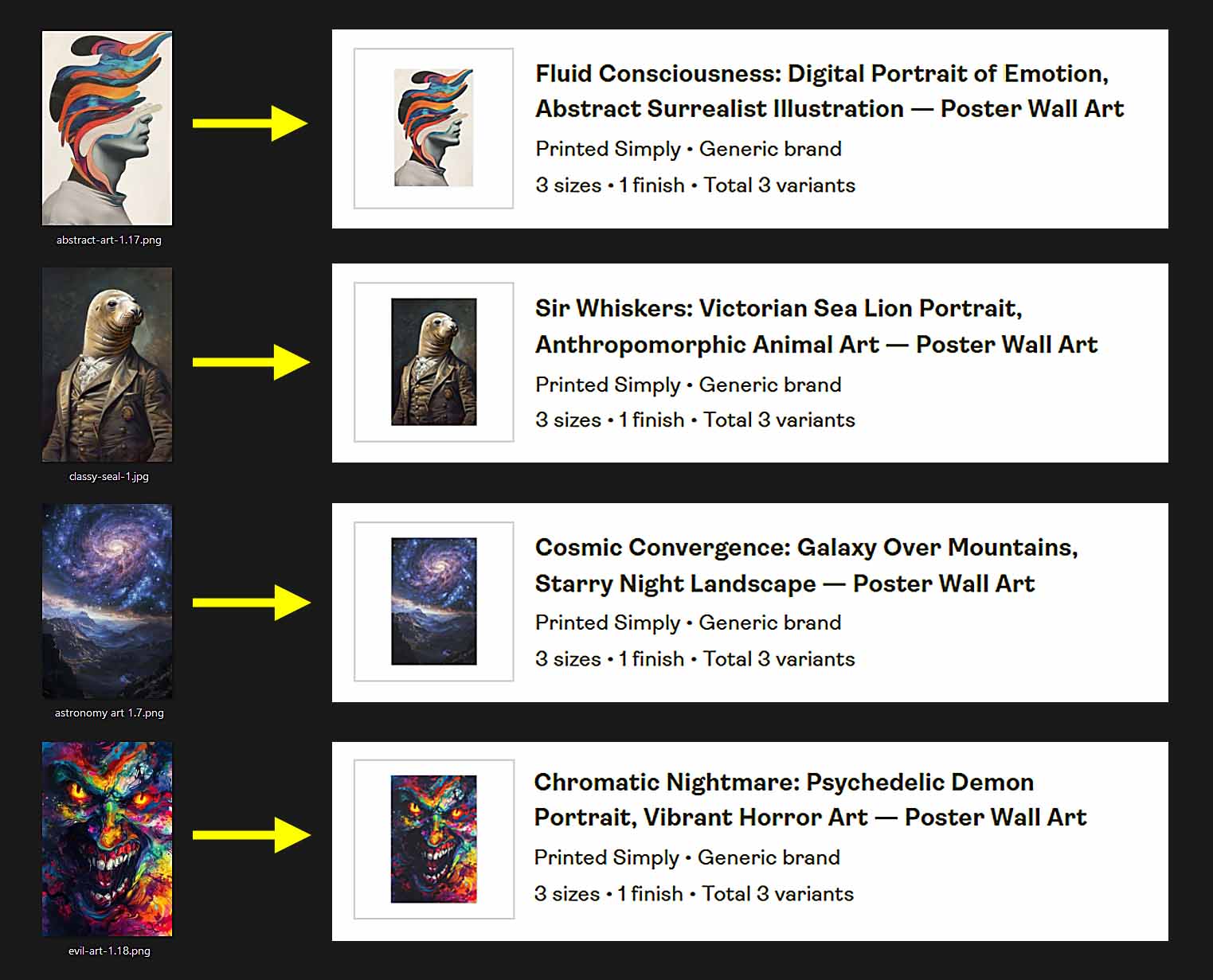
Each artwork image is then analyzed using advanced AI image recognition. The system identifies what’s visually present in the artwork—objects, subjects, colors, artistic style, mood, and even embedded text (such as quotes or typography-based designs). Based on this understanding, the AI automatically writes:

Titles
Concise, keyword-rich identifiers describing the artwork’s subject and composition.
Descriptions
Extended contextual text that elaborates on the image’s theme, tone, and visual qualities.
Tags
Supporting keyword terms that strengthen product categorization and internal search coverage. These outputs are all optimized for search discoverability, diversity, and accuracy—each unique, semantically rich, and perfectly aligned with what the artwork depicts.
Step 4: Customization and Final Touches
You can append your own Custom Text to the titles and descriptions (for example, adding product-level context such as “—Premium Wall Art” or “—Cotton T-Shirt”). You can also insert a Custom HTML block that contains standardized product information (materials, care instructions, etc.) to every description automatically. This pairing gives you the best of both worlds: AI-generated artwork descriptions for SEO depth plus consistent, brand-specific product info for buyer clarity.
Step 5: Publish and Scale Effortlessly
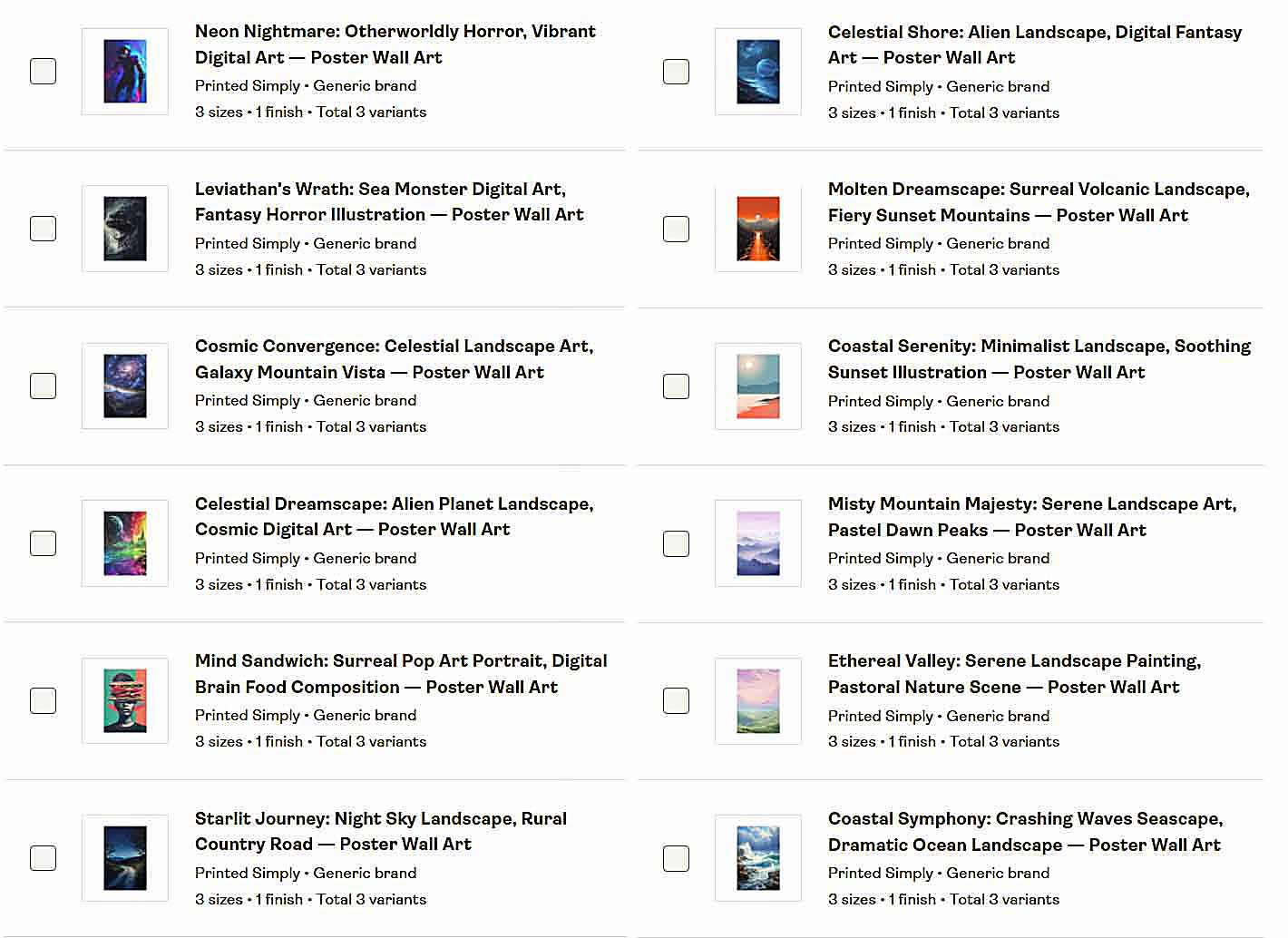
Once configured, you run the operation—and the Bulk POD Product Creator creates all your print-on-demand products in bulk. Every listing comes out SEO-optimized, properly structured, and ready for publishing to your Shopify storefront. It’s not about typing faster. It’s about never needing to type again. With automation handling the repetitive SEO work, your time can finally go toward the creative and strategic parts of your business that actually move the needle.

Sounds Nice, But Are the AI-Generated Outputs Any Good for POD Sellers?
Yes—they’re far beyond good. They’re exceptional.
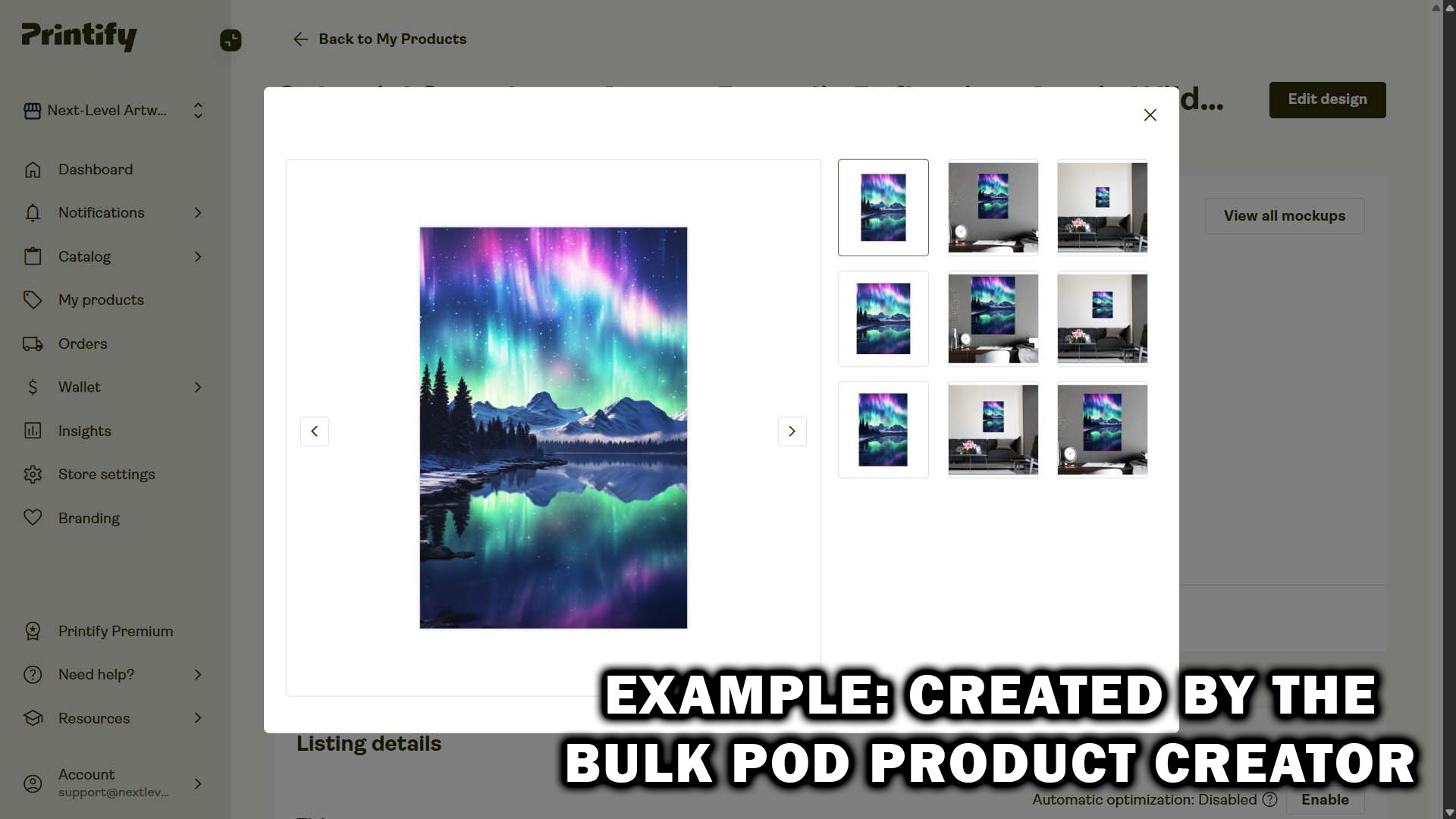
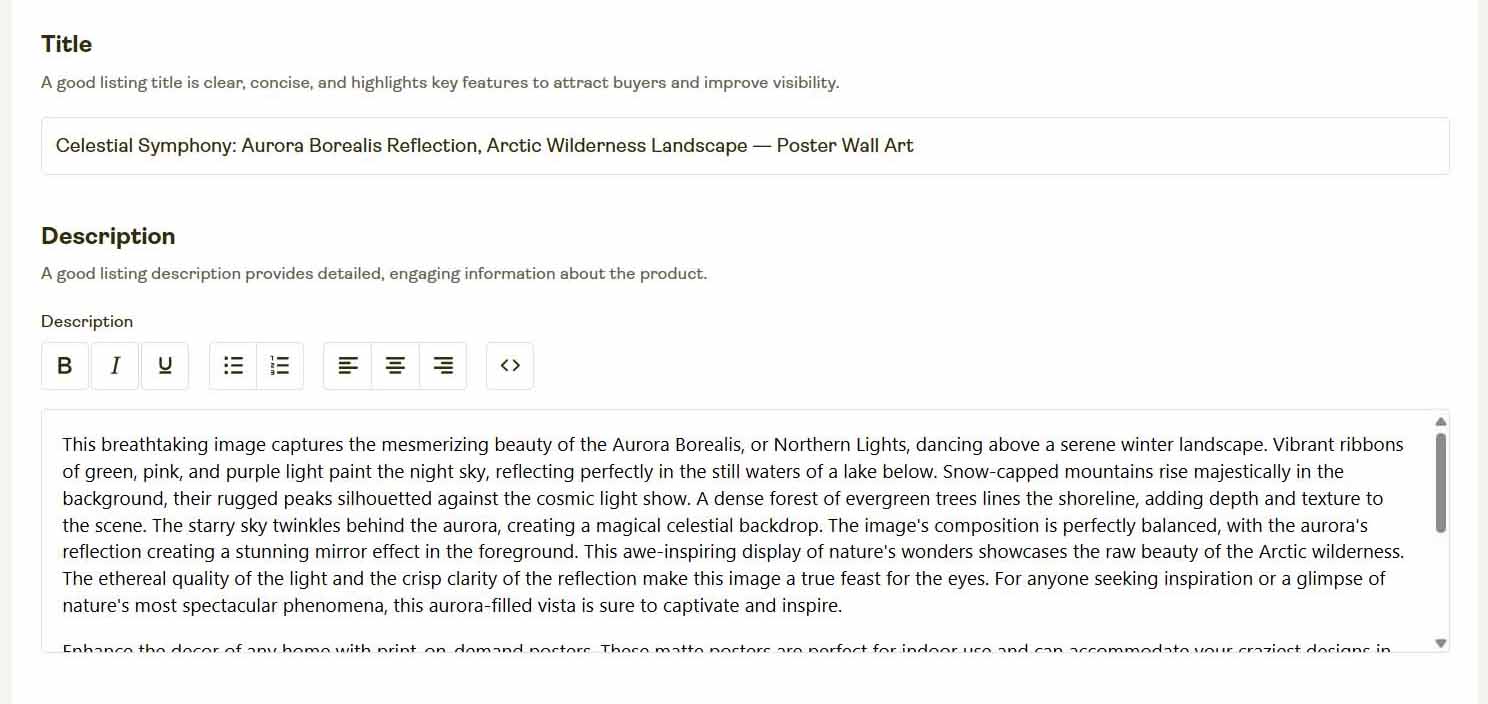
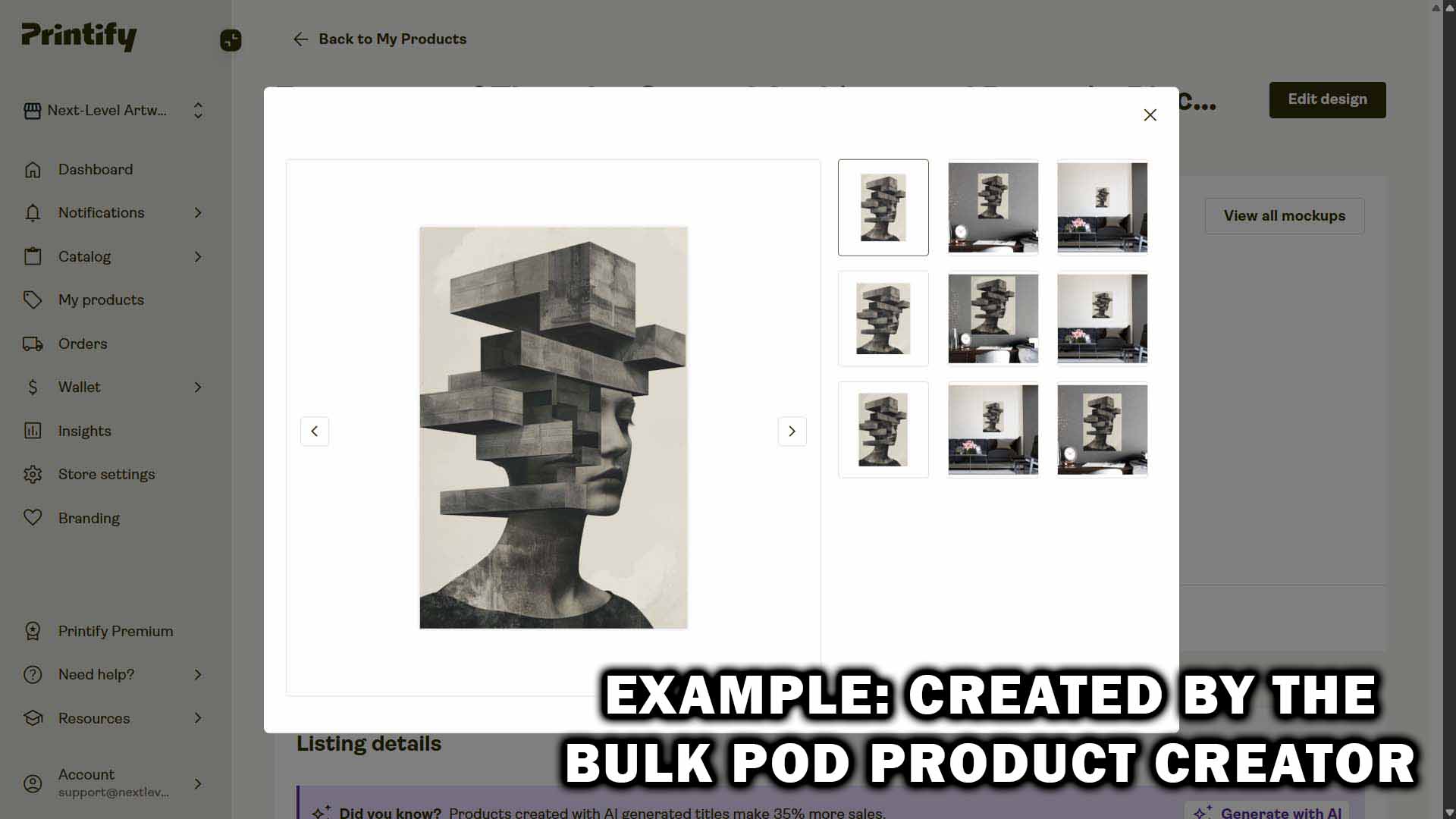
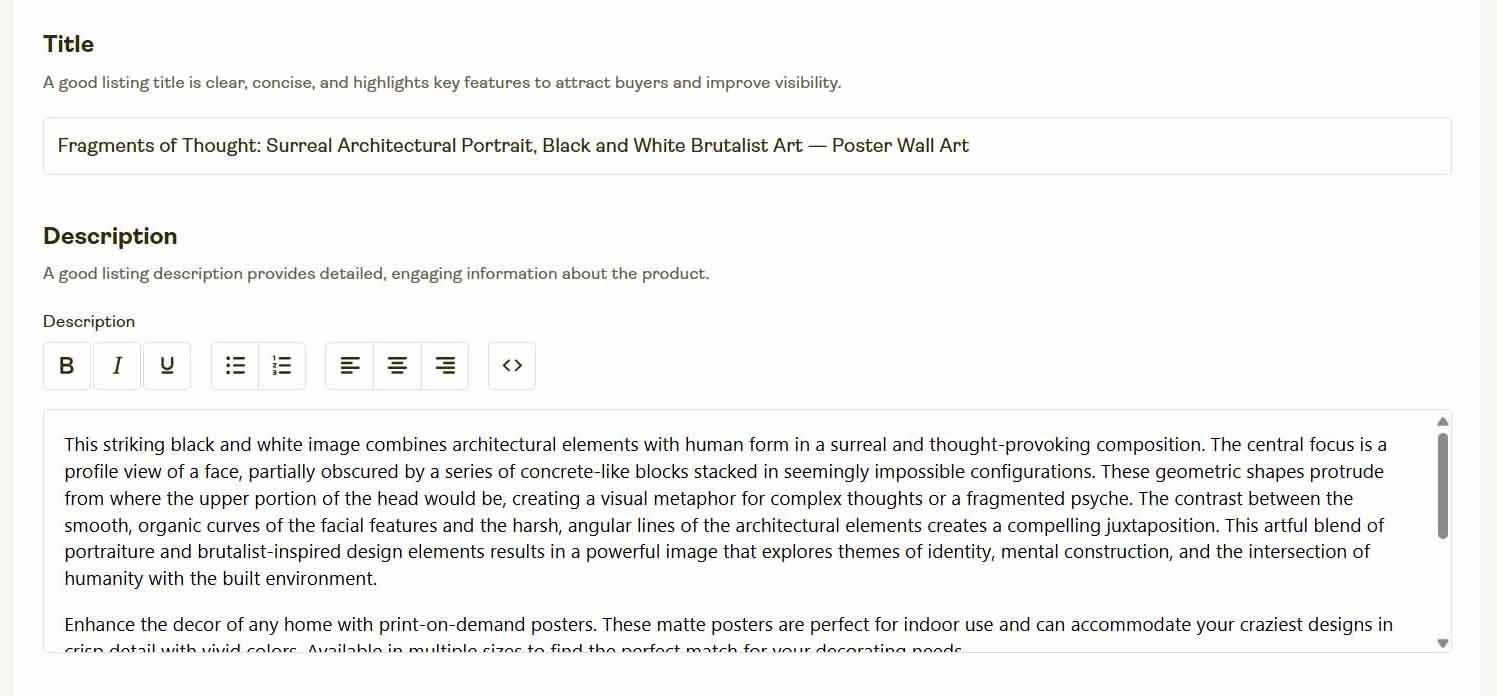
The AI systems powering the Bulk POD Product Creator combine image recognition with large-language-model (LLM) reasoning to produce text that’s contextually accurate, linguistically rich, and semantically optimized for search. The result is product information that not only reads well to humans but also signals relevance perfectly to search engines.
Why the AI Excels at This Task
From a technical standpoint, AI systems excel here because they process data fundamentally differently from humans.
- Massive Visual Vocabulary: The image recognition component has been trained on millions of visual examples across nearly every artistic medium imaginable—digital art, photography, watercolor, surrealism, typography, and more. That means it understands the language of art far better than the average person does.
- Semantic Precision: Once the image’s visual elements are interpreted, the LLM takes over—using its enormous linguistic model to describe what’s seen in natural, keyword-rich language. It doesn’t guess or generalize; it draws from a global pool of vocabulary and artistic terminology that a single human, or even a team, could never consistently replicate.
- No Fatigue, No Inconsistency: Human writers inevitably lose focus. By the hundredth listing, fatigue sets in—phrasing repeats, attention to detail fades, and SEO quality plummets. The AI, by contrast, delivers the same level of precision and creativity for listing #1 as for listing #1,000. It doesn’t tire, get distracted, or settle for “good enough.”
- Collective Knowledge Advantage: The AI effectively embodies the combined linguistic and artistic understanding of thousands of experts. It has “read” more descriptions, analyzed more art styles, and seen more compositions than any single human team ever could. That cumulative intelligence shows up in the text it generates: accurate, descriptive, and beautifully on-point.
Why That Matters for SEO and Sales
Each product listing becomes a self-contained, search-optimized entry point into your store. With AI generating rich, detailed titles and descriptions, your catalog gains hundreds of unique keyword footprints across Google and Shopify search.
It’s not just about sounding better—it’s about being found more often.
Because the AI can vary phrasing intelligently and emphasize different semantic dimensions of your artwork, your overall keyword coverage expands dramatically. More variety → more impressions → more qualified traffic.
The result: better visibility, longer session times, and higher total revenue potential—all without you writing a single sentence manually.
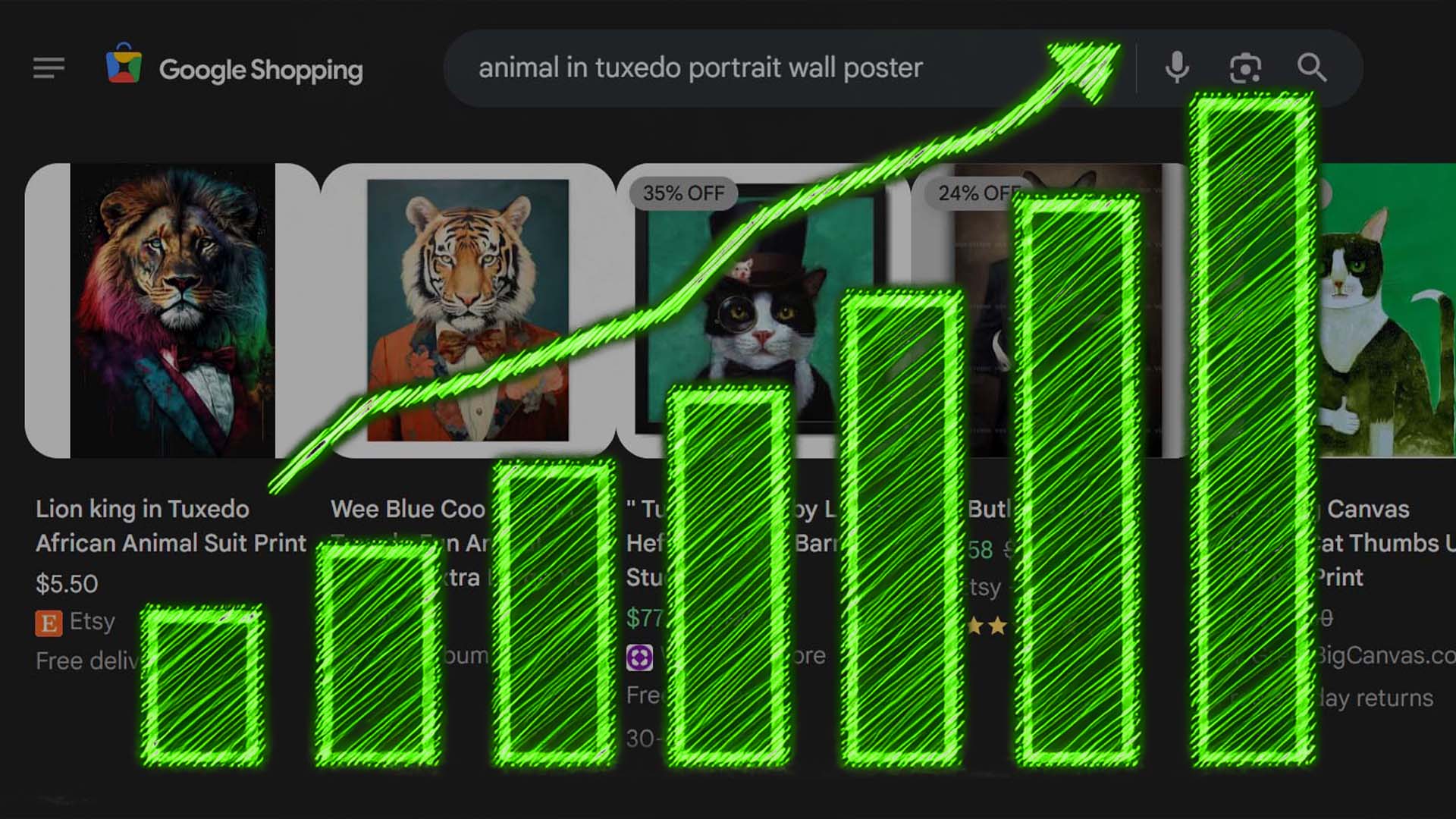
Additional Bonus Features That Are Useful for Shopify POD Sellers
Beyond its automation core, the Bulk POD Product Creator includes several thoughtful features that streamline your Shopify workflow even further. Each one removes another layer of repetitive clicking and setup work, keeping you firmly in “creative mode” instead of “admin mode.”
1. Custom Tags for Automatic Tag-Based Collections
Shopify supports a feature where collections can be built automatically based on tags.
Instead of manually selecting every new product to add into a category—“abstract art,” “space-themed designs,” “typography pieces,” etc.—you can let automation handle it.
By defining custom tags in your operation setup, any new product that includes those tags is automatically grouped into the correct collection when published to your Shopify store.
Example:
- Create a collection in Shopify called “Astronaut Artwork.”
- Set its rule to include any product tagged with “astronaut.”
- Add the “astronaut” tag to your Bulk POD Product Creator operation—and every product generated from your astronaut artwork batch will appear in that collection automatically.
Result: perfectly organized storefronts without manual sorting or error-prone product selection.
2. Save Operation Setups and Load Them Later with One Click
Once you find the perfect configuration for a particular product type—your example product, pricing, title format, AI settings, custom HTML, and tags—you don’t have to rebuild it from scratch next time.
The tool lets you save operation setups, storing all those parameters under a name you can easily recall. Next time, just click “Load,” and you’re instantly ready to run the same setup again.
This feature is invaluable for sellers who manage multiple product lines. Whether you’re doing wall art drops one day and apparel the next, your ideal configurations are preserved for effortless reuse.

3. Flexible Support for Shopify Product Variants
Different product variants often mean different image placements or aspect ratios—and the tool handles that gracefully through its image placement and resize settings:
- Stretch Images To Fit Print Area(s): Fills the entire print area for maximum coverage, even across variants with slightly differing aspect ratios.
- Preserve Image Aspect Ratio & Center: Keeps the original proportions intact while centering the design perfectly.
- Exactly Match Example Image(s): Replicates the pixel-precise positioning and scaling of your Example Product for complete consistency.

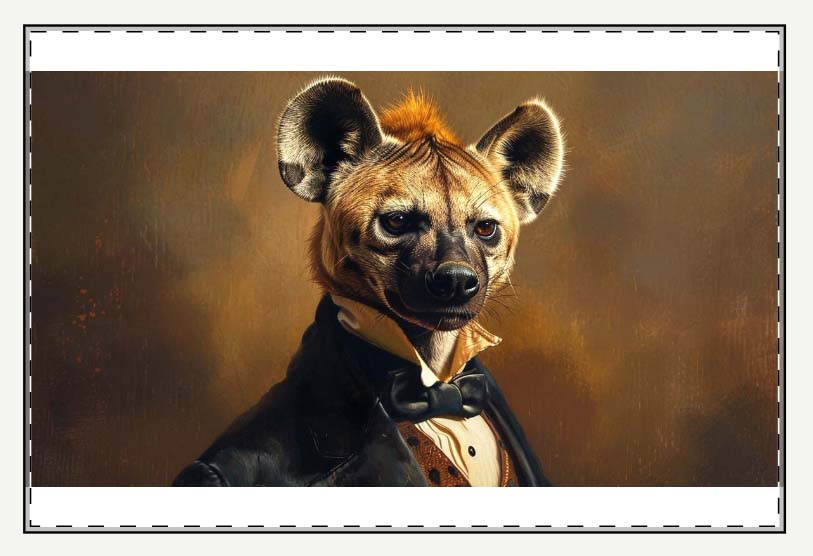
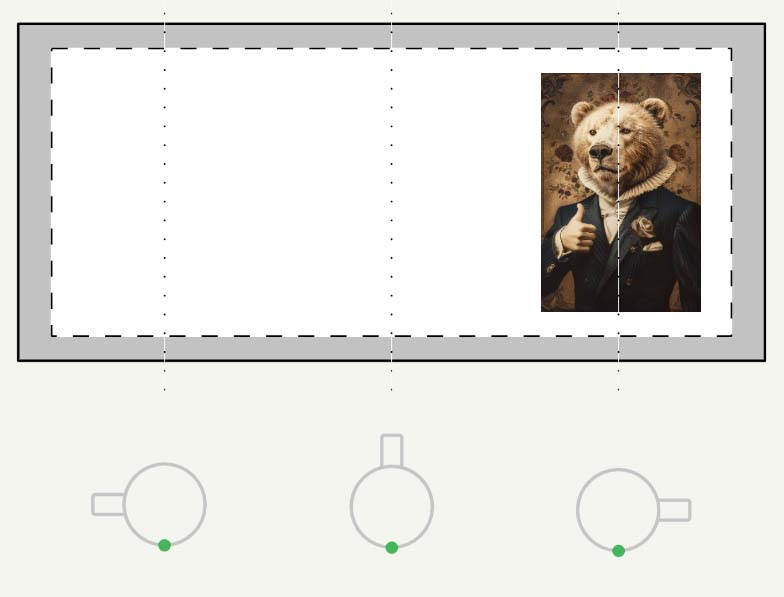
This flexibility allows your storefront to offer a wider variety of product sizes and shapes—without you manually resizing and adjusting every single image. Just define your placement logic once, and the automation takes care of the rest.
Conclusion: Automation Is the New Competitive Edge
Manually optimizing every product’s SEO might’ve been viable when you had ten listings. But for serious print-on-demand sellers with hundreds or thousands of artworks, it’s no longer humanly scalable.
The Bulk POD Product Creator gives you that scalability—not by cutting corners, but by raising the standard of quality while eliminating the drudgery.
You get perfectly structured, SEO-optimized print-on-demand product listings in bulk, complete with consistent metadata, clean descriptions, and intelligent tagging—all powered by AI.
The result is simple: more search visibility, more visitors, and more sales, achieved with a fraction of the effort.
Automation doesn’t replace your creativity—it amplifies it.
It takes over the repetitive, mechanical parts of the job so you can focus on what actually matters: designing great art, refining your brand, and growing a store that scales effortlessly.