5 Best SEO Tools For Shopify Print-on-Demand Stores
Overview: This guide profiles five high-impact SEO tools that help Shopify POD sellers attract more organic traffic and convert more shoppers. We explain why SEO matters for POD, then outline how each tool improves discoverability—including 1) automated blog-post creation, 2) AI-powered SEO product-info generation, in bulk, 3) image alt-text automation, for all your products, 4) image performance optimization, across your entire store, and 5) structured-data markup, to boost your pages. You’ll see how to combine these tools to compound rankings, speed, and rich-result visibility across your catalog.
Why SEO Matters So Much for Shopify Print-on-Demand Sellers
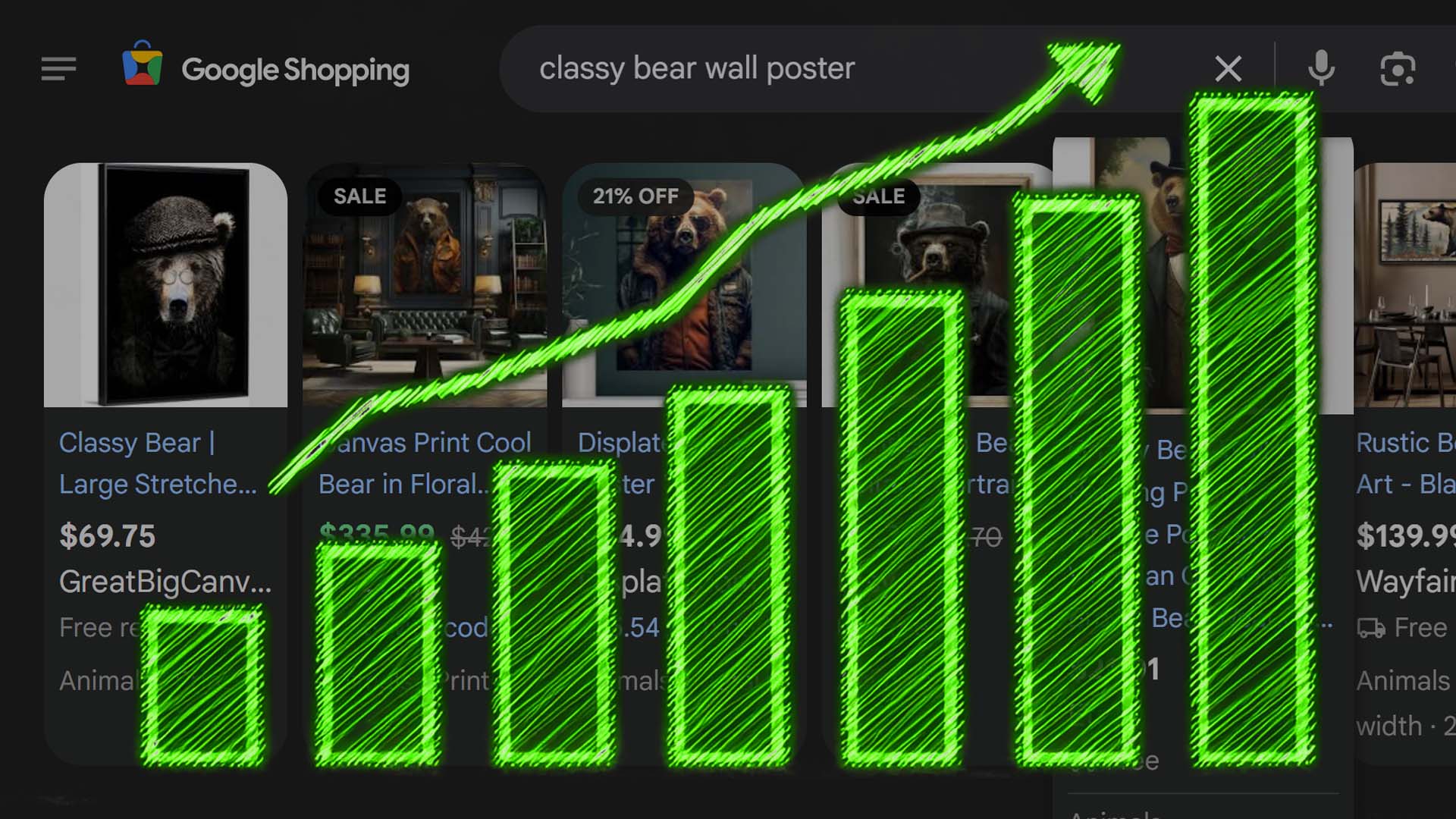
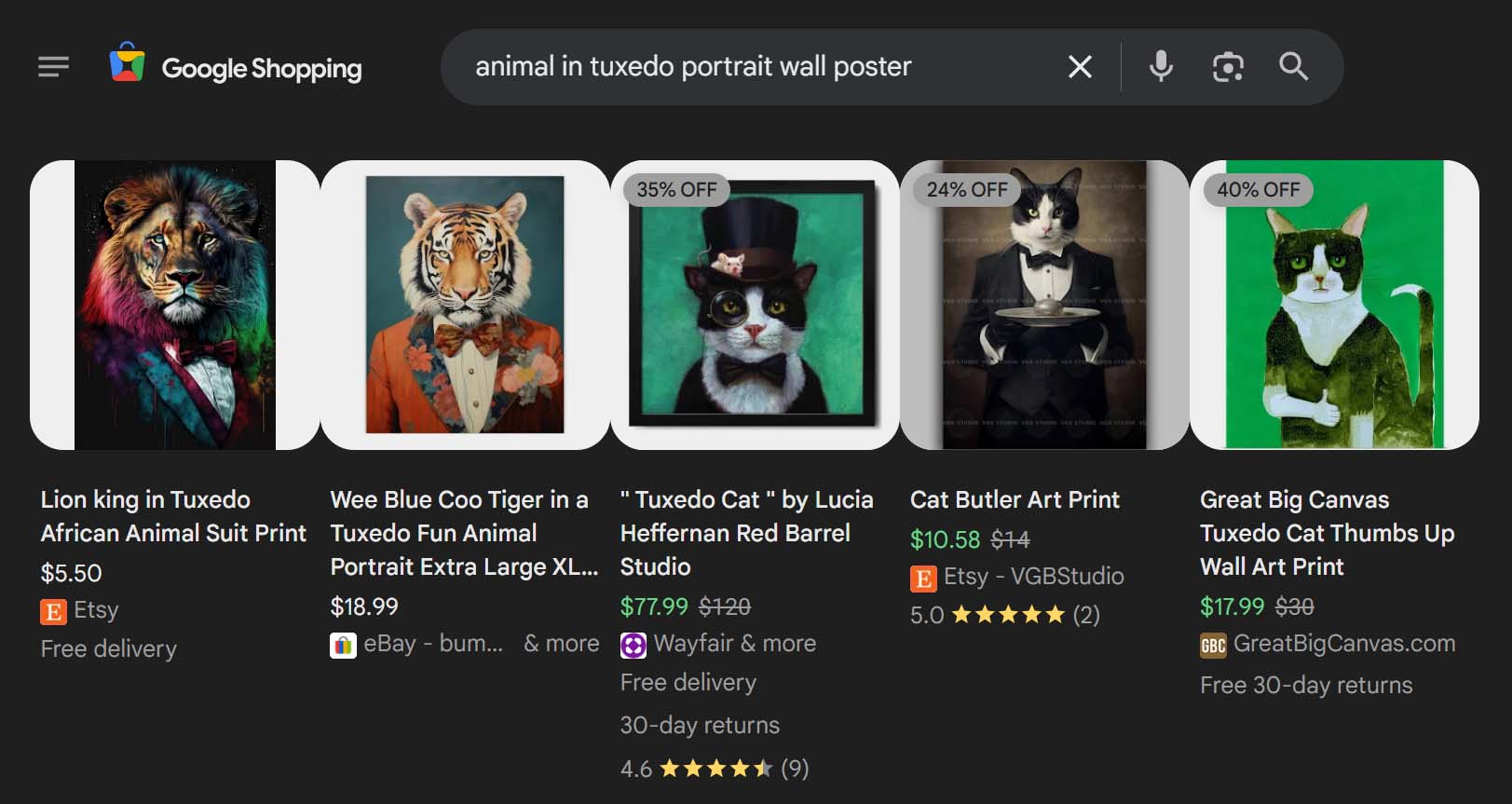
Search engine optimization (SEO) isn’t a luxury for print-on-demand entrepreneurs—it’s the mechanism that determines whether potential buyers ever even see your products. The difference between ranking on page 1 and page 3 is the difference between steady sales and silence. When a shopper searches “galaxy-themed poster” or “minimalist cat t-shirt,” Google’s algorithm decides whose store appears first, and it rewards those that have strong, relevant, and well-structured metadata across their products, collections, and blog content.
Unlike paid ads, which stop working the moment you pause your campaigns, organic SEO growth compounds over time. Every optimized title, image alt-tag, description, and schema markup adds new long-tail keywords that make your store more discoverable in search results. Over months, these small technical and content improvements snowball into sustained traffic that keeps working even while you sleep.
That’s why modern print-on-demand sellers are increasingly stacking automation-powered SEO tools inside their Shopify stores. Rather than manually writing dozens of blog posts, hand-typing product titles, or guessing which keywords to include, these tools apply artificial intelligence and data-driven automation to handle repetitive SEO work at scale.
Below are five of the most effective and complementary SEO tools for Shopify print-on-demand stores—each tackling a critical piece of the optimization puzzle.
SEO Tool #1: "Essential AI SEO: AI Blog Post" - Shopify App
What This SEO Tool Does & How It Works
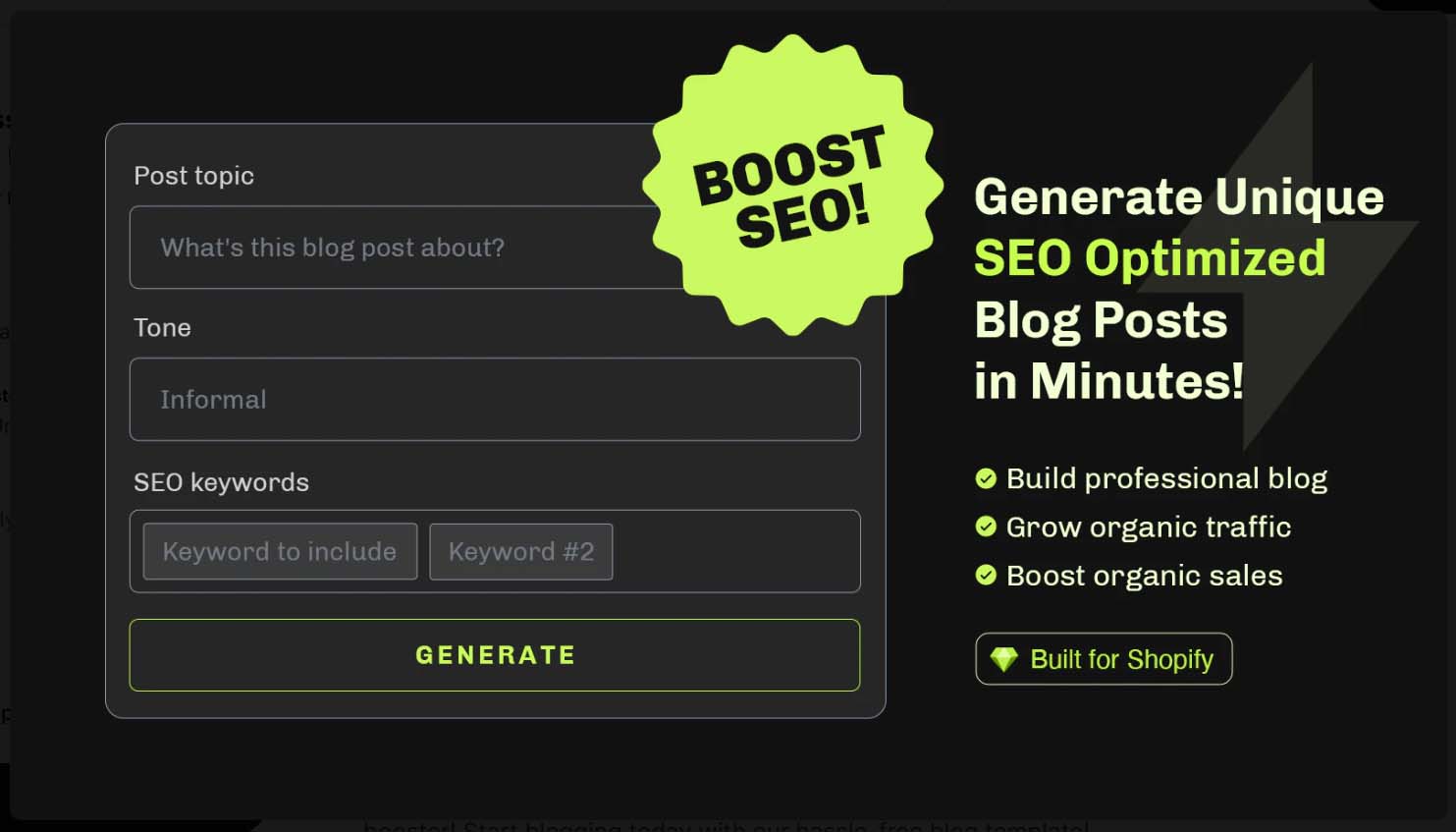
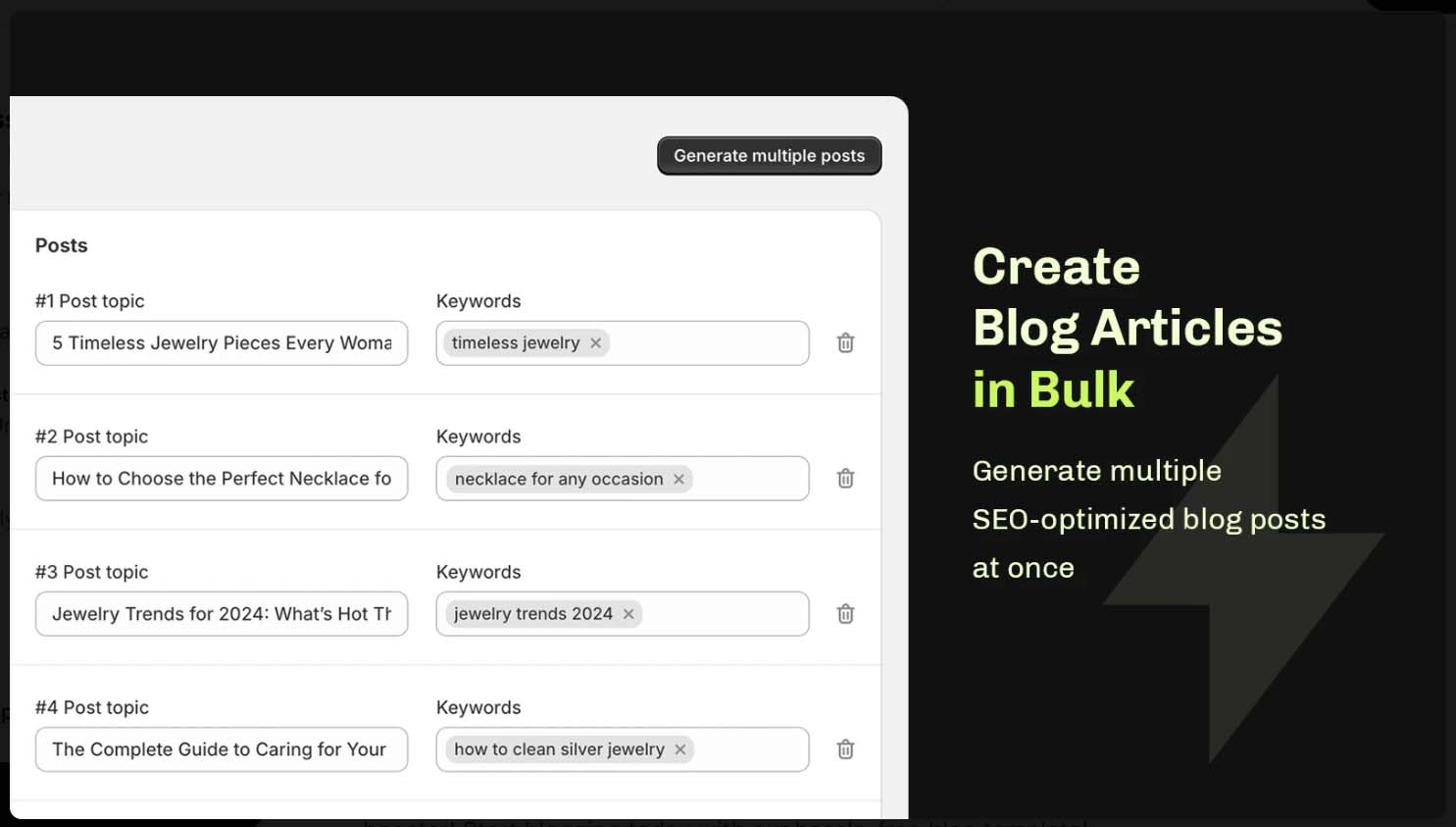
Essential AI SEO is an AI-powered blog-writing assistant built for Shopify. It generates fully SEO-optimized articles designed to attract organic traffic to your store’s blog section. The tool leverages advanced natural-language models similar to ChatGPT to analyze your chosen topics, keywords, and product niches, then writes structured, human-sounding posts that follow SEO best practices—headings, keyword density, meta tags, and internal linking opportunities all included.
Sellers can produce content in multiple languages, which is particularly useful for international POD audiences. The app’s “bulk blog generator” feature also lets you queue multiple posts at once—each tuned for the right keywords, formatting, and tone—without spending hours writing them manually. Once generated, posts can be edited directly within Shopify’s editor or automatically published on a schedule.
In essence, it turns your Shopify blog into a passive, keyword-targeted traffic engine.
The Benefits of Using This Tool For Your Shopify POD Store
Consistent SEO activity without burnout. Google rewards sites that publish fresh, high-quality content regularly. With Essential AI SEO, your store can maintain a consistent content schedule—even if you don’t have a copywriter.
Keyword-rich topical coverage. The AI blog writer identifies related keywords and synonyms naturally, expanding your topical footprint and helping you rank for a broader set of search terms.
Professional structure and readability. Posts follow clear formatting—titles, subheadings, and structured paragraphs—which improves dwell time and signals to search engines that your content is authoritative.
Multilingual expansion. Generating blogs in up to 13 languages can expose your products to new regional audiences without hiring translators.
In short, it lets you capture SEO visibility on autopilot, turning your blog into a 24/7 inbound lead generator.
What This Workflow Is Like Without Using This SEO Tool
Without a tool like Essential AI SEO, most store owners simply don’t blog—or if they do, they publish sporadically, with posts that are short, repetitive, and lacking keyword depth. Writing manually means hours spent brainstorming, researching, drafting, and formatting each article. You might produce one decent post, get burned out, and stop for months.
Even worse, those manual articles often fail to include key search terms or schema cues, meaning Google has little idea what the post is about. The result: wasted effort and little organic traction.
Essential AI SEO eliminates that bottleneck. It gives you scale, structure, and quality simultaneously—something almost impossible to achieve manually.
SEO Tool #2: "Bulk POD Product Creator" - AI-Powered SEO Product-Info Writing
What This SEO Tool Does & How It Works
The Bulk POD Product Creator is an advanced automation platform that connects directly with your POD platform to let you create hundreds of Shopify print-on-demand products in bulk—complete with AI-generated, SEO-optimized titles, descriptions, and tags for each created POD listing.

Here’s how it works: you start with an Example Product that defines your print areas, variants, pricing, and placement rules. You then upload your new artwork files, and the system automatically applies your chosen placement mode (such as “Stretch Images To Fit Print Area(s)” or “Preserve Image Aspect Ratio & Center”) to generate the product images and mockups for each variant.
The software then uses AI image recognition to analyze each artwork image—identifying subjects, colors, themes, and styles—and feeds that data into large language models that generate highly descriptive, keyword-rich product titles, descriptions, and tags. The process runs at scale, meaning you can publish an entire product collection that’s not only visually polished but also deeply optimized for search.

Users can also append custom text to titles to further target specific high-volume keywords—such as “poster,” “canvas,” “wall art,” “shirt,” or “gift.” Combined with the automatically detected artwork descriptors, these compound titles often hit laser-specific long-tail search phrases like “vintage astronaut poster wall art” or “minimalist mountain canvas print.”
In other words, it turns your product catalog into a dense web of relevant, semantically rich search entries that Google can easily crawl and rank.
The Benefits of Using This Tool For Your Shopify POD Store
Massive keyword coverage across your entire catalog. Every AI-generated product listing contains dozens of relevant search terms—covering styles, subjects, and materials—creating more ranking opportunities than a human could manually write.
Consistent SEO formatting and metadata. Titles, descriptions, and tags follow uniform structures that align with buyer intent and marketplace standards, improving both professionalism and SEO performance.
Efficiency and scale. What once took days of manual entry can now be done in minutes. Instead of typing out metadata for each product, you define the logic once and let the system replicate it across hundreds of items.
Continuous quality output. AI doesn’t tire or cut corners. It delivers 100 percent effort on every listing, ensuring that even your 500th product looks as polished and optimized as your first.
Flexible customization. You can still override or add custom keywords, prefixes, or suffixes to target strategic search phrases and seasonal trends.
Ultimately, this tool doesn’t just save time—it dramatically amplifies your organic visibility, making your entire catalog more searchable and keyword-dense than any manually built store could ever be.

What This Workflow Is Like Without Using This SEO Tool
Without the Bulk POD Product Creator, a Shopify POD seller faces an exhausting uphill climb. Every single product must be manually uploaded, manually titled, manually described, and manually tagged. After a handful of listings, most sellers start reusing the same generic phrases—“cool t-shirt,” “beautiful poster,” “funny mug”—and Google quickly stops ranking them because the content looks repetitive and low-effort.
Human fatigue becomes the bottleneck. Even talented creators lose steam after writing dozens of near-identical product descriptions. The result is a limited catalog with weak metadata coverage, missed long-tail opportunities, and minimal organic reach.
By automating both the creative and technical sides of SEO metadata, the Bulk POD Product Creator breaks that cycle. It lets you operate like a full-scale publishing company, producing hundreds or even thousands of SEO-optimized listings—each tailored to its specific artwork—without ever compromising on quality.
SEO Tool #3: "ALT SEO AI Alt Text Generator" - Shopify App
What This SEO Tool Does & How It Works
The ALT SEO AI Alt Text Generator Shopify app solves one of the most overlooked yet important parts of search optimization: image alt text. Every image on your Shopify store — from product photos to mockups and banners — contributes to how search engines understand your content. Without accurate, descriptive alt text, Google can’t “see” what’s in the image, meaning valuable SEO signals are lost.
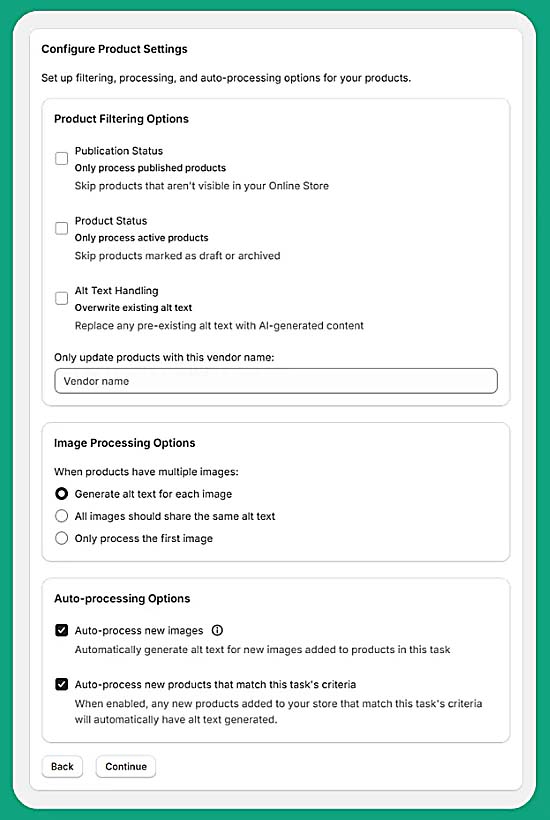
This app uses AI to automatically generate keyword-rich, descriptive alt text for every image in your store. It scans your catalog, interprets what each image contains, and writes concise, brand-aligned alt text that both improves accessibility and boosts discoverability.
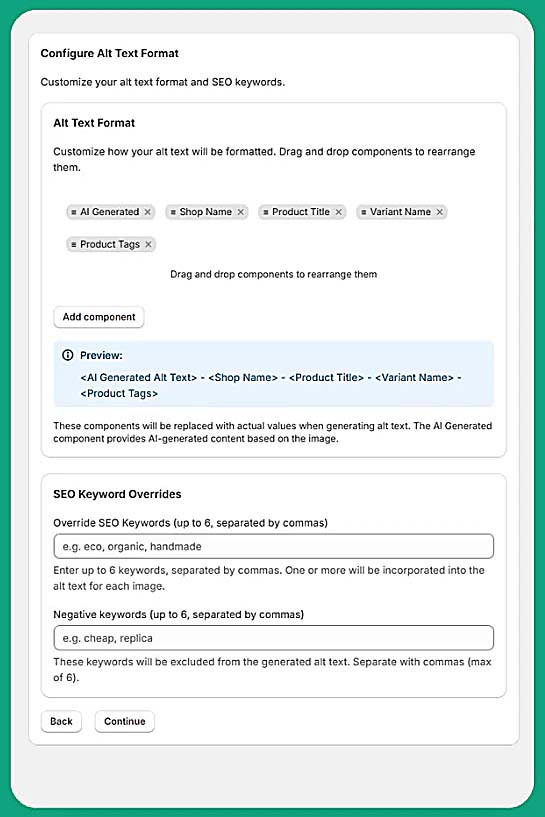
You can process your entire image library in bulk or schedule recurring updates so that new images are optimized automatically. The AI output can also be customized to match your brand’s tone, industry vocabulary, or product-specific terminology. For example, you can tell it to include “poster,” “canvas,” or “print” in each image description if those keywords are important to your niche.
It’s a true set-it-and-forget-it SEO automation layer that keeps your image data clean, consistent, and search-friendly.
The Benefits of Using This Tool For Your Shopify POD Store
- Improved search rankings for image results. Google Images can drive significant organic traffic, especially for visual products like wall art and apparel. Optimized alt text increases the odds your images appear there.
- Automatic compliance with accessibility standards. The app helps ensure your store aligns with ADA, EAA, and WCAG accessibility guidelines, which improves user experience and brand credibility.
- Time savings at scale. Instead of typing descriptions for thousands of images manually, you can generate all of them in bulk within minutes.
- Smarter keyword integration. The AI inserts relevant, non-spammy keywords naturally within the alt text—helping search engines understand image context without keyword stuffing.
- Consistent, brand-aligned metadata. Tailor the descriptions to your preferred tone and product language so they remain cohesive across your entire catalog.
In short, it upgrades the entire “under-the-hood” layer of your store’s SEO—quietly improving visibility with almost zero ongoing effort.
What This Workflow Is Like Without Using This SEO Tool
Without an automated alt text generator, most store owners either skip alt text entirely or write vague, unhelpful descriptions. Shopify’s default image uploads don’t require alt text, so it’s easy to forget—and even easier to underestimate how much it matters.
Manually adding alt text for hundreds or thousands of images is tedious beyond reason. Each image needs to be described in a way that’s both accurate and keyword-optimized, and repeating that process every time you add new products becomes unsustainable.
As a result, many Shopify POD stores end up invisible in Google Images, and their accessibility compliance remains incomplete. The ALT SEO AI Alt Text Generator eliminates this entire problem—turning what was once a repetitive afterthought into a fully automated SEO asset that quietly strengthens your store’s performance every day.
SEO Tool #4: "Crush: Speed & Image Optimizer" - Shopify App
What This SEO Tool Does & How It Works
The Crush: Speed & Image Optimizer Shopify app focuses on one of the most technical yet impactful factors in SEO—page speed. Fast-loading pages rank higher, convert better, and retain visitors longer. Conversely, slow, image-heavy print-on-demand stores (with hundreds of high-resolution product photos) often suffer from long load times that drive shoppers away before pages even finish rendering.
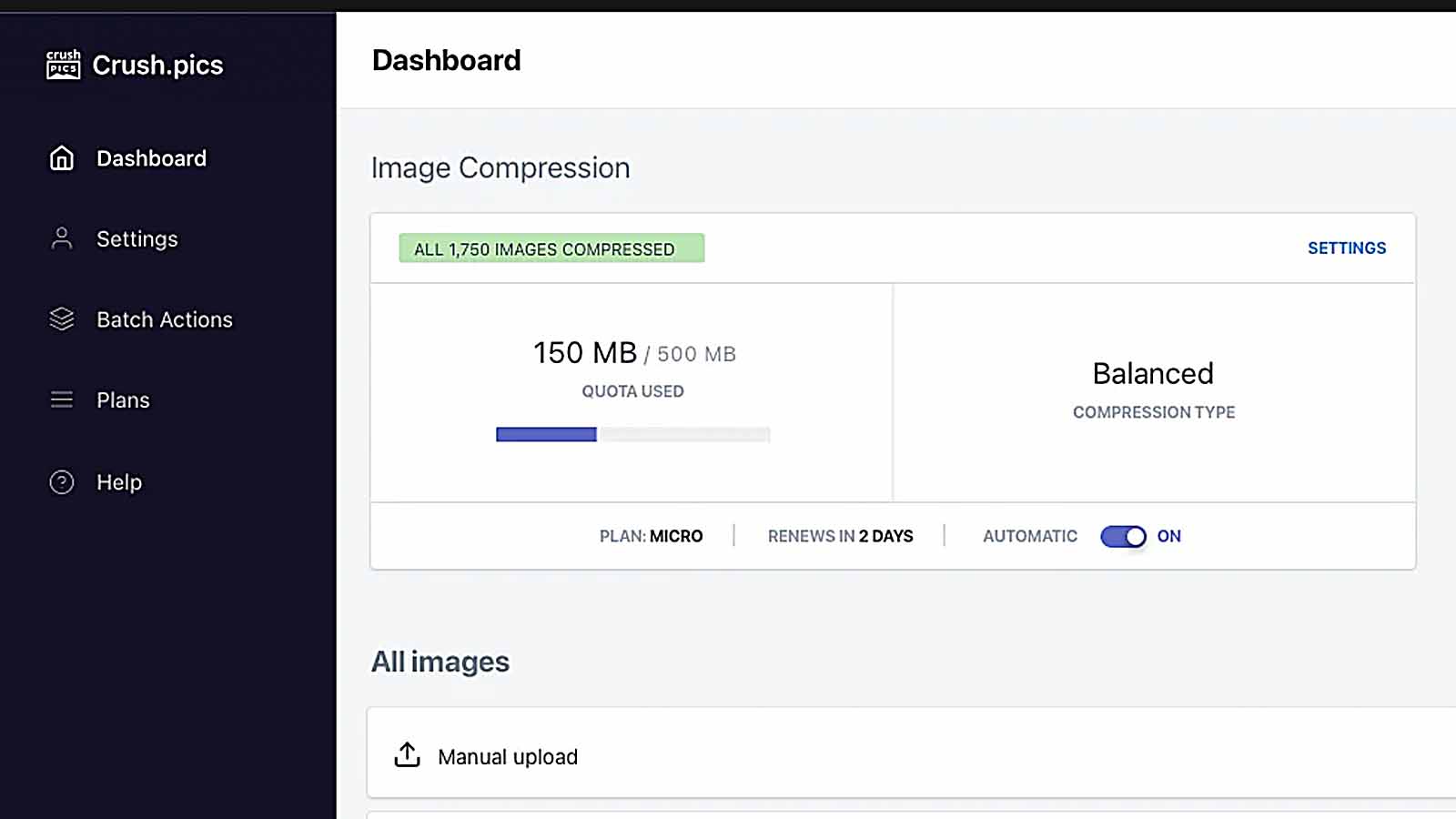
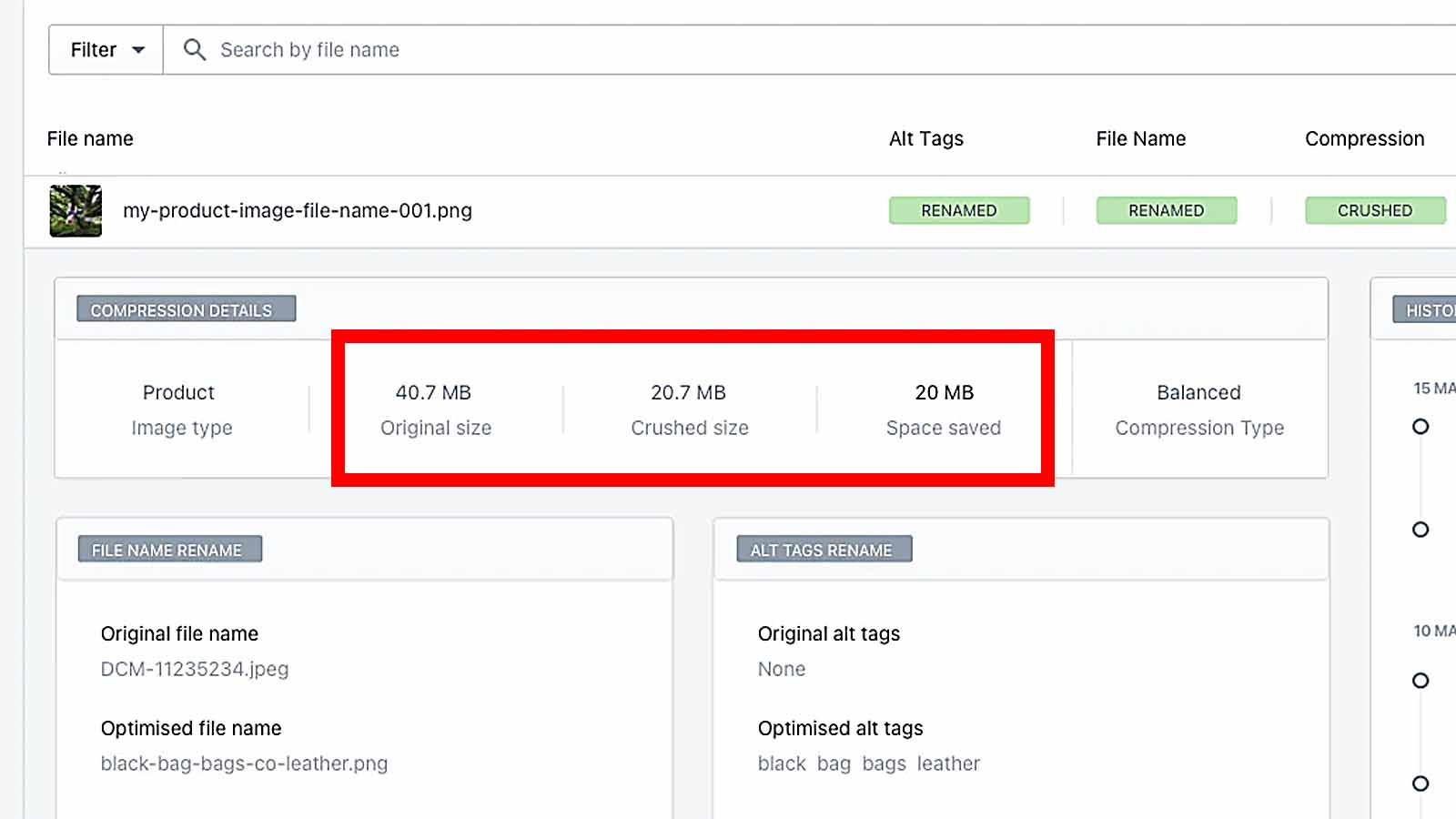
Crush automates the process of compressing and optimizing all your store’s images without sacrificing visual quality. It reduces file sizes through smart compression algorithms, ensuring that images still look sharp and professional while loading in a fraction of the time.
But Crush goes beyond just compression—it also includes SEO optimization for images. The app can automatically rename image files and update ALT tags to describe the product they represent. For example, instead of having a file named “IMG_3282.jpg,” Crush can rename it to “vintage-astronaut-poster-wall-art.jpg.” That new filename acts as another ranking signal for Google, helping the image surface more easily in relevant searches.
Once configured, Crush runs quietly in the background, optimizing new images automatically as they’re added to your store. You can choose between different compression algorithms to balance speed and quality, ensuring your visuals stay crisp while the site loads lightning-fast.
The Benefits of Using This Tool For Your Shopify POD Store
- Faster load times = better rankings and conversions. Page speed directly affects SEO and user behavior. Faster stores rank higher, and customers are far less likely to abandon pages before they load.
- Automatic image renaming for improved discoverability. Search engines rely on filenames and alt text to understand images. Renaming images with descriptive, keyword-relevant terms provides another layer of optimization.
- Reduced storage and bandwidth usage. Smaller file sizes mean less strain on your hosting resources and faster delivery across devices.
- Improved mobile performance. Many POD buyers shop on mobile devices, where speed is even more critical. Crush ensures your images are lightweight and responsive on all screens.
- Hands-free maintenance. Once set, Crush continues working automatically—optimizing all future uploads without requiring you to manually touch anything.
Crush effectively acts as a silent performance engineer for your store, continuously tuning the balance between image quality and loading speed so your customers experience the fastest possible browsing experience—and Google rewards you for it.
What This Workflow Is Like Without Using This SEO Tool
Without Crush, your Shopify store can easily bloat under the weight of large, unoptimized images. Each product photo may look great on your computer but could take several seconds to load for users, especially on mobile or slower connections. That delay directly hurts your SEO ranking and frustrates shoppers.
Manually compressing and renaming hundreds of images is not realistic for most sellers. You’d have to download them, optimize in Photoshop or another app, rename the files, and re-upload them—a process that would take weeks for even a moderately sized catalog.
Stores that skip this step typically suffer from sluggish performance metrics, lower search rankings, and higher bounce rates. With Crush, all of that is handled automatically in the background—giving you both a technical SEO advantage and a better user experience without any manual labor.
SEO Tool #5: "Webrex: SEO Schema & JSON-LD" - Shopify App
What This SEO Tool Does & How It Works
Webrex: SEO Schema & JSON-LD handles one of the most technical—but incredibly powerful—dimensions of Shopify SEO: structured data markup.
When search engines crawl your site, they don’t inherently “understand” what each page represents. Schema markup (written in JSON-LD format) acts like a translator—it tells Google exactly what your content is. For instance, it clarifies which pages are products, which contain reviews, which feature FAQs, and even which include videos.
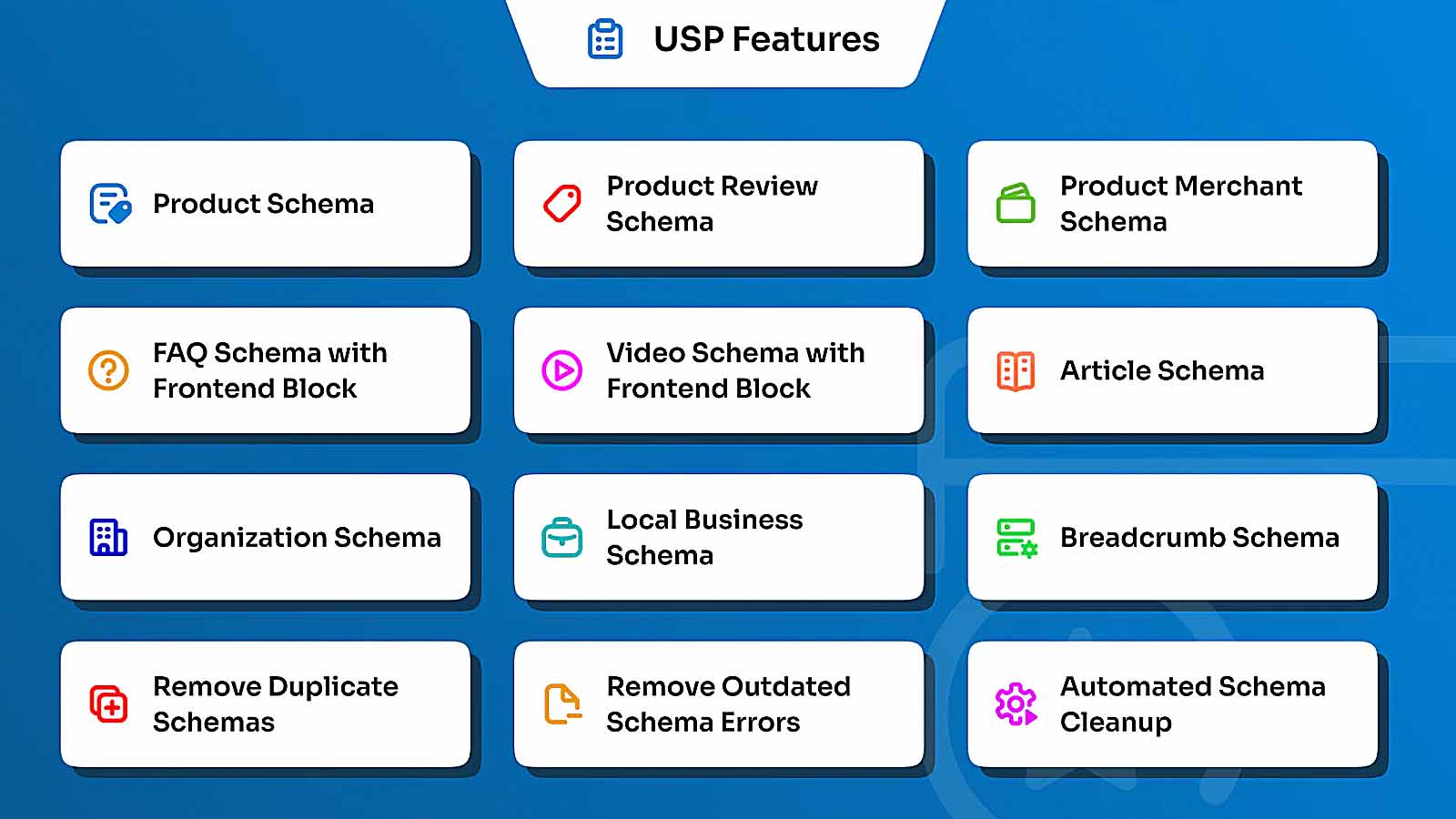
Webrex automates the entire process of generating and maintaining this structured data for your Shopify store. It creates JSON-LD entries for all key content types—Product, Review, Merchant, FAQ, Video, and Recipe—then injects them into your store’s code without requiring you to touch any HTML or scripting.
Beyond adding structured data, Webrex also performs deduplication, identifying and removing outdated or duplicate markup that could otherwise confuse Google or lead to penalties. It follows current Google guidelines to ensure every schema field is formatted correctly, so your store earns maximum credit for its structured data.
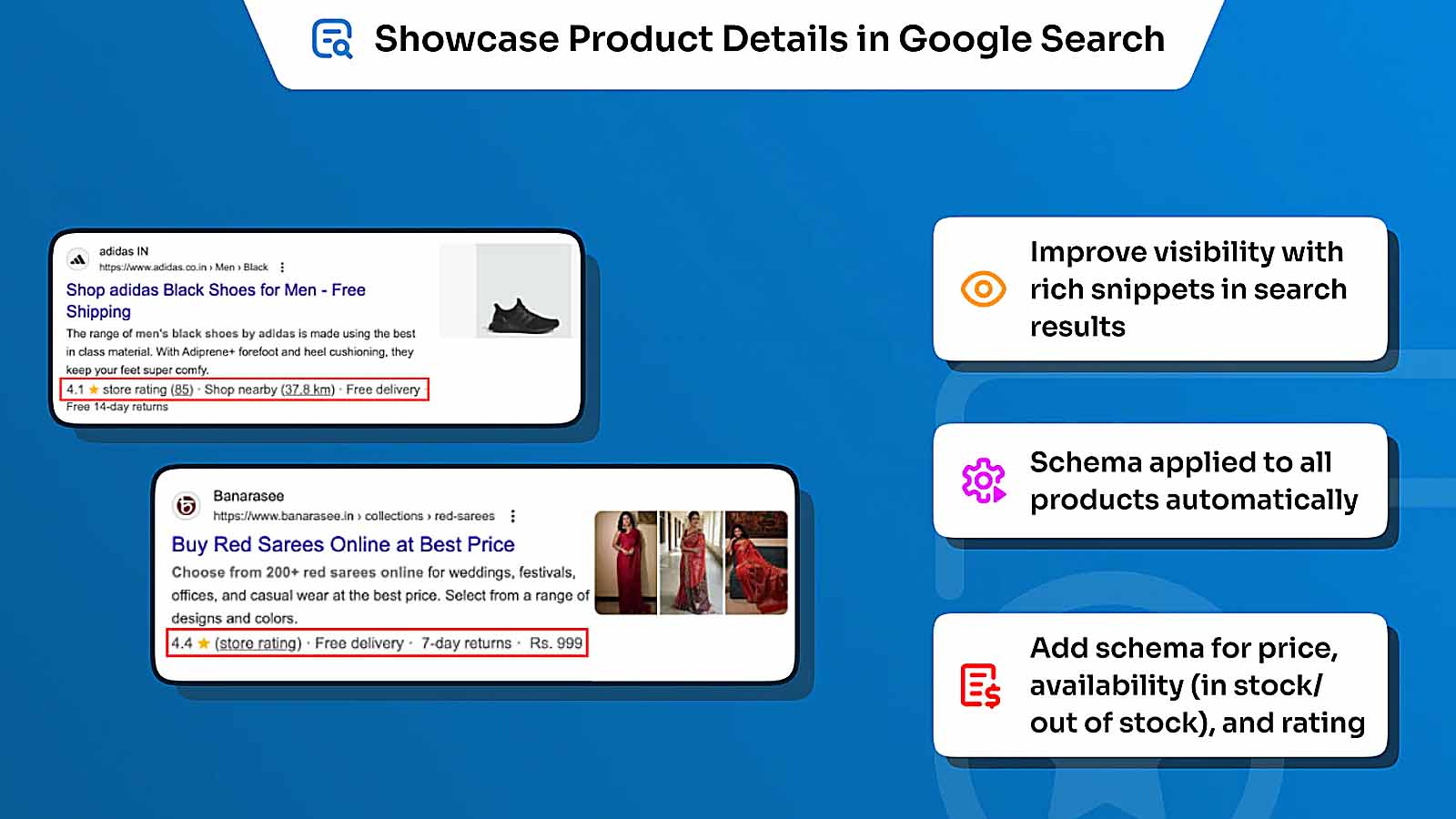
The result: enhanced visibility and richer search results. When someone searches for one of your products, Google can display price, availability, star ratings, and even FAQ snippets directly within the search listing—making your results stand out dramatically from competitors.
The Benefits of Using This Tool For Your Shopify POD Store
- Improved click-through rates through rich snippets. JSON-LD markup enables enhanced search listings that include star ratings, FAQs, and price details—drawing the eye and encouraging clicks.
- Automatic, error-free schema management. You don’t have to manually write or update JSON-LD code. Webrex keeps everything compliant and up-to-date.
- Protection from duplicate or conflicting markup. By automatically detecting and removing redundant data, it prevents indexing errors that can tank SEO rankings.
- Expanded search surface area. By adding multiple schema types (product, video, FAQ), you create more opportunities for your content to appear across different parts of Google’s search ecosystem.
- No coding knowledge required. What previously demanded developer intervention is now a one-click setup. Even non-technical sellers can enjoy advanced SEO structure benefits.
In short, Webrex gives your Shopify store the structural clarity that search engines crave—helping you surface more often, look more professional in results, and ultimately convert more of that traffic into sales.
What This Workflow Is Like Without Using This SEO Tool
Without Webrex or another schema management solution, most Shopify store owners either (a) skip structured data entirely, or (b) attempt to implement it manually and introduce inconsistencies or errors that harm SEO rather than help it.
Incorrectly formatted schema or duplicate markup can lead to search penalties, missing snippets, or suppressed listings. And because schema rules evolve over time, even technically inclined sellers often find themselves maintaining outdated JSON-LD templates that no longer meet Google’s latest standards.
Without schema, your listings also appear plain and generic in search results—just a title, URL, and a two-line description—while competitors with rich snippets display ratings, pricing, and FAQs that immediately capture user attention.
Webrex removes all that complexity. It keeps your markup clean, current, and comprehensive—ensuring Google knows exactly what your products and pages represent, and rewarding your store accordingly with higher visibility and richer presentation.
The Compounding Benefits of Stacking These SEO Tools Together
Each of these tools provides powerful value on its own—but the real transformation happens when you stack them together.
Think of your Shopify store as a living system. Every layer of optimization amplifies the others:
- Essential AI SEO builds a foundation of keyword-rich content through blog posts that attract new visitors.
- Bulk POD Product Creator converts those visitors into buyers by ensuring your print-on-demand product listings are filled with precise, AI-generated titles, descriptions, and tags that dominate search results.
- ALT SEO AI Alt Text Generator ensures your product images—often the first thing people notice—are fully visible to search engines and accessible to all audiences.
- Crush: Speed & Image Optimizer keeps your site lightning-fast and technically healthy, improving rankings and user experience simultaneously.
- Webrex: SEO Schema & JSON-LD ties it all together at the structural level, giving search engines crystal-clear context about every page and product.
The combined effect is multiplicative, not additive.
When all these systems are running in harmony, your store becomes:
- Faster and more crawlable. Search bots can parse your metadata instantly.
- Richer in keywords and structured information. Every element—from titles to image names—reinforces your SEO footprint.
- More trustworthy in the eyes of algorithms. Consistency and completeness are ranking signals; automation ensures you never miss a detail.
- Exponentially more visible across all surfaces of search. Organic listings, image results, and rich snippets all point back to your store.
That’s how modern print-on-demand sellers gain a durable advantage—by letting automation handle the technical grind while they focus on creativity, branding, and growth.
If you’re serious about long-term traffic, discoverability, and passive sales growth, stacking these SEO tools is no longer optional—it’s the new baseline for success.